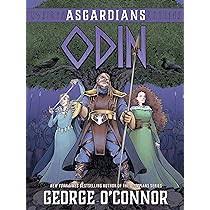
Since I loved, loved, loved O’Connor’s Olympians series, I obviously had to check out his newest offering. The Asgardians! A quartet on the slightly less popular but just as well known Norse pantheon.
As one can guess, the first book focuses on the All-Father, Odin, leader of the Aesir Gods and covers the creation myth of the Norse world, and several different stories regarding Odin’s never-ending quest for knowledge to avoid his own mortality.
Suitably for the Viking audience, this is a darker tale with death, warring and suicide as Odin sacrifices himself for his own obsession with knowledge. And I thought scientists were intense about their quest for knowledge. None of them have ripped out their own eyeballs.
I don’t think I can discuss much about the stories themselves because readers should learn them on their own, but I will say O’Connor continues his supurb storytelling with dramatic narration and action-filled panals remiscent of pre-MCU movies.
There’s his signature humor as well which adds some levity to the darker parts of the story and relatable to the modern reader when they think and realize these myths were taken as fact in the early days.
Yes, we were born out of the sweat of giant primordial thing in space.
It’s an interesting read because my Norse mythology is very bare bones, and two things I’ve learned is that Norse myths are bonkers and they name EVERYTHING (except wives or mothers apparently).
And to think, we don’t even know all of them since the main source of all Norse myths, the Poetic Edda and the Prose Edda have large chunks of it missing.
So I’m very impressed with how O’Connor cobbles together the story even as he admits in his Norse Code (the author notes on certain panals and pages) that he doesn’t have all the information because no one does. Like Odin has two brothers that help him create the world and mortals and then. . . they just disappear. Never to be heard of again. Were there brothers or were they just separate aspects of Odin, who knows? But O’Connor plays with both of those theories.
Due to this lack of sure knowledge (hehe Odin would be going nuts), O’Connor does his best to reasonably tie up loose ends like if the Aesir Gods are the gods created from Ymir’s sweat and begat the god/jotun/human race, where did the Venir gods come from? And why are they so similar to the Aesir that they could be Roman/Greek counterparts? Only they can’t be because they interact as two separate dieties?
What are the Nine Realms (that only six are officially named in the Poetic Edda) and how does one reasonably illustrate that on a giant ash tree?
And so on. He’s able to make reasonable assumptions without getting the reader too confused. Although you might want to make a list of names because all the Norweigian got me mixed up.
There were some stylistic similarities to The Olympians such as the introduction where “the reader” is brought from the dead to Valhalla that was vey similar to when Hermes takes “the reader” to the Underworld in Hades, but as the lines were from the official Poetic Edda, I guess it proves some mythologies are universal.
Another similarity that struck me as Olympians-like was how Loki was depicted similarly to Pan. I guess O’Connor simply has a set style when it comes to mischevious faces.
Fun fact, unlike what the MCU has you to believe, Loki and Odin are the ones who are “blood brothers” and that’s how Loki’s adopted into the Aesir. Not Odin adopting Loki to be a brother to Thor. Loki is actual Thor’s uncle so . . . I guess the MCU thought the evil uncle angle was overplayed? Point is, now you can spout off trivia at MCU conventions. See how fanboys react.
So overall, good story, dynamic illustrations and I’m eager to see how O’Connor portrays the boistorous god of thunder in Asgardians Vol 2. I really hope they have the Thor pretending to be Freyja in a Jotun wedding myth.
5 eyeballs.
 Rachel Reads & Reviews
Leave a comment