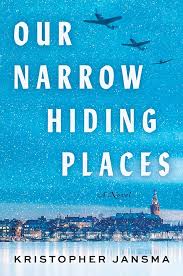
While in my happy place of Barnes & Noble, my mother and I stumbled upon an author’s promotion. Kristopher Jansma, like the rest of us, got to spend quality family time during the pandemic and it is in this isolation he got to learn more about his grandmother’s history in the Netherlands where she endured years of starvation under Nazi Occupation. Something that is rarely discussed in history books even in the country.
So combining family histroy, fiction and creative license, Jansma’s story highlights the cruel barbarity of war through a child’s eyes, and the legacy handed through generations of silence.
Mieke is only eight so she doesn’t quite understand the permenant air of fear hovering over the adults in her life but when Nazis invade, her childish imagination does little to dissociate her from the antisemitism aimed at her friend, Rob, the clustraphobic fear of hiding her neighbors and father in the attic and of course, the hunger that comes to define her every moment.
Will, on the other hand, is worried that his marriage be on the verge of divorce when his mental illness starts to manifest more often and more visibly. He knows the answers lie with his mother and the father that left him decades ago, but it is a hard truth to parse through the history and the scars that still haven’t healed.
Jansma has lyrical sense of prose during the flashback chapters where Mieke’s child’s understanding blunts the horrors that you understand are happening while also cutting it close to the heart of the matter. That humans can be unthinking and savage to one another just because one is different. One haunting passage is that when her friend, Rob, shares that his father is hiding in a Japanese painting. A delusional fantasy that is the only thing keeping him from breaking down and Mieke is too sad to tear it apart.
This contrasts with the harsher present where Will’s life feels just as messy, jagged edges tearing at him as his mind seems to turn on himself. Compounded by the fact that his mother won’t answer anything. His journey reflects the reader’s journey as he delves into the Nazi-Occupation years and how the mass starvation manifests in not only physical defects in children and their parents, but mental as well.
There is also another narrator in our story. In the vein of folklorists if folklorists were eels. Yes, I said eel but they are a meaningful source of food in the novel as well as emblematic of the theme of survival, slipping away and adapting on land as well as the creeks feeding into the little villages. I’ll admit their sections were a bit confusing to me as they try to blend eel logic with the large history of the Netherlands and how it relates to their persistant survival under the Nazis.
Still it’s a tightly-plotted, well-paced novel, showcasing the best and worst of humanity. You can see how personal this story was to him and so it was hard to resist seeing as not just a historical narrative, teaching a forgotton piece of history but someone trying to piece his family together in the larger tapestry of the world.
 Rachel Reads & Reviews
Leave a comment