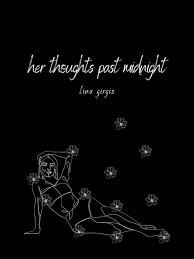
Lina Girgis is a poet and author of her thoughts past midnight. After meeting her at an author signing, she kidnly took the time to answer my questions on her journey and her poetry. Enjoy!
1. When did you begin writing?
I used to write all my life. I recently took a trip back home-my home is Egypt and moved to the US when I was 13 in 2013-this was my first trip since I left 11 years ago.
I actually found all the poetry I used to write when I was little, around 6 or 7, in Arabic. It was inspiring to see that folder and look back in the head of six year old Lina and how I expressed myself even though I didn’t know it was poetry.
So I could say I’ve been writing all my life. I stopped writing when I moved to the US because it was a drastic culture shock especially at thirteen which is already a tumultuous time period, dealing with the language difference, a new school, everything
I started writing again when I was senior year of college, around October 2021 as I was reconsidering my career in engineering along with other overwhelming things. Poety helped, I found my passion again.
2. What draws you to poetry?
Poetry for me when I was young was a form of expression. I didn’t know I was writing poetry, it was just me expressing my thoughts, and emotions. Looking back at it, I realize it was deep stuff.
When I had my rediscovery of poetry in senior year, I wrote with more knowledge of what poetry is.
Also I was born and raised in Egypt and the language itself is poetic and very expressivewhich influenced me. There are many great poets that are Syrian and Palestinian, they’re out of this world. I read many works by them, and that also inspires my poetry.
I’m drawn into poetry because I think it’s a raw form of expression. When someone is writing poetry, they’re writing 100% truth and they’re not altering any thought or emotion in any way.
3. What are your poetic influences?
A lot of the poetry is in Arabic like Mahmoud Darwish, Palestinian poet; Gibran Khalil Gibran, Lebanese-American writer and poet; Nizar Qabbani, Syrian writer and poet; Ahmed Shawqi, Egyptian poet laureate and linguist; Rumi, poet and Islamic scholar; Saadi Youssef, Iraqi poet and other like Franz Kafka, Fyodor Dostoevsky, Emily Dickinson, and C.S. Lewis.
4. How did you organize your collection? (Story arc? Which poems to include? etc)
With my first book, I wrote it as a way of expressing or separating certain overwhelming emotions, I didn’t set out to write a book.
But one day, I woke up and rereading some stuff and was “Wow, this is actually really powerful.” I wanted to publish this book to share with others who may understand this feeling.
The story I wanted to share with people was a story of deep love, from idealizing love to betrayal to the rollercoaster of pain to finding yourself back, that cycle.
I wanted to put it out there so people can understand the stages of emotions they’re going through are real and know that you’re not alone.
The ones I chose were the ones that made sense with the story I wanted to tell, and they’re the ones I felt deeply.
5. Most of it seems to be in first person, but sometimes slip into third-What is the significance of the shift?
The poems in third person were because they’re the ones I was incapable of saying “I.” It felt too hurtful and I wasn’t able to be honest with myself because I was too shy or too afraid to admit certain things.
6. Similarly, is the narrator mourning the loss of one relationship or multiple?
At the time, it was one relationship but my intention with this book was not a relationship- it’s mourning the loss of something.
I’ve had people come to me saying they’ve lost a close friend or a husband and they related. So it’s not necesasarily a heartbreak situation, it can be anybody like someone who left the word or friend, parent, anything.
7. I really admire the lyricism of your work. So they come to you like a song? How does it spark?
I don’t know, it just comes out that way. Usually I think of something and I’m inspired to write a scene in life or a previous experience I’ve had that unfolds into more things overtime.
They don’t come out like a song, they came out in thoughts that I put together poetically.
8. Is there a particular poem in the collection that speaks to you the most?
If I had to choose, I would say the one p. 165 and p.188.
165 says “I never allowed myself
to completely feel
to grieve
I was on a sole mission of carelessness
even though I knew I cared
so whenever
I hurt
I break
I don’t know what else to do
but to run after the things that killed me
begging them to give me back
the life they stripped out of me.”
It is one of the poem that describes who I am as a person. I feel like a lot of us tend to feel very deeply but tend to ignore or push away those feelings.
“I never allowed myself/to completely feel” -It’s something about human nature that we ignore something that upsets us and don’t address it in real time, and everything adds up so we explode in the wrong moment to the wrong person. We are afraid of ourselves, to feel certain emotions. We say “It’s not a big deal” or “Why we’re upset?” But we have to ask ourselves why we’re upset, face it and decipher our feelings.
“to grieve-I think most of these emotions that we avoid have to do with grief, the loss of someone.
“I was on a sole mission of carelessness”– We want to push away or minimize our feelings.
“even though I knew I cared”-I’m on a mission to prove myself to everyone else and myself even though I know deep down that’s not true.
“I don’t know what else to do/but to run after the things that killed me/begging them to give me back/the life they stripped out of me.” -I feel as humans that when we allow others in our lives and share ourselves, that part we don’t normally showcase to the world and they hurt us, we feel we can’t let them go because they think we’re weak and can’t let leave thinking that. We try to make them say even though it hurts us like drinking poison.
9. What do you want readers to take away or enjoy from your work?
I want them to relate and feel like they’re not alone. If someone read this poem, and are like “Wow I felt this,” I feel like I accomplished what I wanted to accomplish.
10. Any upcoming events or works to look forward to from you?
My second book is dropping this Sunday, I’m so excited! I can’t wait for it to be out there. The title is “Mom I Am Lost, Can You Tell Dad?“
The book is split into three major chapters, the first is about being lost from the POV of an adult aka all of us right now. We’re all adults who are lost in life because we don’t really know what we’re doing and don’t face the questions, how, why when?
The adult goes on a journey into the past so there’s lots of time travel in the poetry as he tries to find himself as a child.
Second chapter is about grief and childhood, and meeting the child.
The last chapter is about self-rediscovery.
You can find more about Lina and buy her books on her amazon page: www.amazon.com/author/linagirgis and all relevant social media: poetrybylina.
Get her new book out this Sunday, Sept 16- https://www.amazon.com/Mom-Lost-Can-You-Tell/dp/B0DGZ26CBH?ref_=ast_author_dp
 Rachel Reads & Reviews
Leave a comment