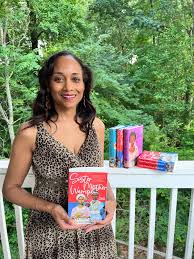
Vanessa is the prolific, best-selling author of the Lady Worthing Mysteries series, Queen of Exiles, Rogues and Remarkable Women, and much more. From mystery to historical to regency, Vanessa puts strong, dynamic Black women and women of color in her novels in all their joy and complexity. She graciously took the time to answer my questions on her work. Please enjoy.
1. You have a PhD in mechanical engineering. How did you pivot to writing?
Even while pursuing my engineering career, I’ve always had a passion for storytelling. The analytical skills from my engineering background help me plot intricate stories, be adept at researching historical details, and bring additional insight into understanding how money flows in the past. My background lends to my fascination with materials and how things are made—more ways to draw a reader into appreciating the past.
Writing became a natural extension of my love for history, allowing me to explore new worlds and characters and engage readers in meaningful ways.
2. What are some of your biggest influences in writing?
My influences range from classic literature to contemporary authors. Jane Austen, Shakespeare, and Longfellow profoundly shaped my understanding of character and society. Additionally, Toni Morrison’s rich narratives and James Baldwin’s cultural insights have inspired me to delve deeper into the experiences of people, particularly marginalized people, throughout history.
3. What is it about the Regency period that has an enduring appeal for you and your audience?
The Regency period is a fascinating era of transition, filled with social and political changes. The elegance, wit, and drama of the time provide a rich backdrop for storytelling. It’s also about uncovering the untold stories of people of color who lived and thrived during this period, bringing a fresh and inclusive perspective to the genre.
4. What are your favorite tropes to write or ones you want to explore someday?
I love writing about strong, resilient heroines and heroes who defy societal norms. Tropes like friends-to-lovers, second chances, and hidden identities are favorites.
5. Do you have different processes for crafting your mysteries in comparison to your historicals and your romances?
Whether it is a mystery or a romance, it always begins with what the story is and from whose perspective I’m trying to tell it.
Poor Lady Worthing, the mysteries course is lady-worthy. What is going on in her world? Who is hurt or affected by her actions or by deciding to do nothing? Of course, we must think about how many bodies will appear in a murder mystery.
For a romance, it is again about what story I am trying to tell and what obstacles the hero and heroine must overcome to find a love worth fighting for. I also think about what it means for these two people to be together; they should be whole individuals who realize that together, they are stronger than before, and somehow, they make the world better for their friends, their families, or even the greater society of the whole by being treated themselves to the love they found.
Moreover, crafting mysteries involves meticulous plotting and ensuring that clues are woven seamlessly into the narrative. Historical romance plotting about the period’s social norms and knowing etiquette and how to challenge it in believable ways to create authentic characters. While each genre has nuances, the core process of developing compelling, engaging plots remains consistent across my works.
6. Your stories highlight strong, free, multiracial heroines and heroes. Why do you think it’s important to highlight their experiences outside of the enslavement narrative?
It’s vital to showcase the full spectrum of experiences and achievements of people of color. Today, some people, when thinking of history and people of color, particularly Black people, only think of pain.
The reason that I’m here is that I can write that there was some joy. Someone found a way to love and to continue and move forward. We need stories about pleasure and power in black hands as much as we need to know about the history of enslavement.
It has not been balanced in publishing. Sometimes, it feels that the story must be tragic, almost to the point of inhumanity, for it to be accepted. Things have changed, but the attitude persists. I want to change that. I want people to think of black women as beautiful as queens, as powerbrokers as entrepreneurs, and not necessarily victims in a historical context.
7. Queen of Exiles/Island Queen/Sister Mother Warrior focuses on lesser-known historical figures. What was the research process like, and how were you able to find reliable resources amid racist/biased reports of colonists?
Researching these figures involved digging into archives, personal letters, and contemporary accounts. It’s essential to read between the lines and cross-reference sources to piece together an accurate and nuanced picture.
Often, I will translate the original languages merely to hear the perspective of Jean-Jacques Dessalines or Queen Marie Louise Covadavid Christophe. Frequently, I may have to code-switch when reading certain historians. For example, suppose I’m reading a document that states that the enslaving master had a relationship with one of his chattel. In that case, one can automatically assume that it was not a consensual relationship between owner and slave and that the modern-day historian is trying to dress up a pig in mud.
Often, I collaborate with historians and librarians to help identify reliable resources, ensuring the integrity of the stories I tell.
8. You’ve mentioned in other interviews that there is a lot you’ve had to cut out. Are there any plot threads or cool facts you wish you’d been able to keep in?
Absolutely. There are always fascinating anecdotes and intricate subplots that don’t make it to the final draft due to pacing or narrative focus.
For instance, I had to trim fascinating details about the birds painted on the buttons of Toussaint L’Overture’s waistcoat. It was three weeks’ worth of research, which included everything from the textiles used to how it was cleaned, just to get one sentence into the book. You can see a lot of things were left out.
9. This dovetails back to your historical mysteries, focusing on your free lady of color, Lady Worthington. What inspired this dynamic, layered heroine and her wider world?
Lady Worthington was inspired by women fighting for abolition. Abigail is a woman who wants to use her influence for good. She’s also quite good at solving crimes. The true fight for abolition is in the backdrop, something she’s fighting for that can be impacted by the crimes she is trying to solve.
Her world blends history and imaginative storytelling to provide a rich tapestry for her adventures.
10. With the push for diversity from the public, what are your thoughts on the industry’s level of representation?
The industry has made strides in embracing diversity, but there’s still a long way to go.
True representation involves publishing diverse voices and supporting and promoting them equitably. The industry must continue fostering an inclusive environment where all stories can be told and celebrated.
We also need readers to take a chance on the book that might be something different, than their usual reads. Some can be very familiar but told through a different lens, a diverse lens. I had a friend attend a conference and ask how many favored diverse books. Everyone raised their hands. But the room became deathly silent when she asked them to pull out their Kindle to show what diverse books they were reading.
I read widely and diversely written stories about people who don’t look like me, and characters who don’t look like me. I enjoy stories with great storytelling. I think everybody should take that chance to read something new.
11. Anything you’d like to share about upcoming projects?
I’m excited about my forthcoming projects, which include a new historical novel featuring another remarkable Free Black woman in the 1600s, a Jamaican-Trinidadian who made significan contributions to history; Regency Romance, A Wager at Midnight, and the next Lady Worthing Mystery, Murder at Berkeley Square. Stay tuned for more!
You can read more about Vanessa’s books, interviews, events, research and upcoming projects on her website: https://www.vanessariley.com/ and all relevant social media.
 Rachel Reads & Reviews
Leave a comment