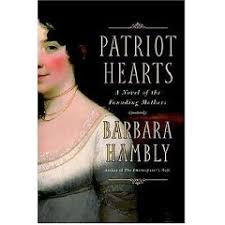
After going on that Hamilton binge, I needed to read more about our Revolutionary Founders. Or as Abigail Adams said, “Remember the Ladies.”
Hambly’s novel focuses on the first four ladies of the Founding Fathers. They kept the home fires burning, protected their love’s back from sneers of rumor and political deception and played hostess in order to make sure the compeating factions got along. For as much as men believe they could rule the world on their own, it’s the women behind the man that ensures that everyone obeys the pretense of getting along and not devolve into petty squabbles.
Set in frame story alternating between the four POVs, Martha, Abigail, Sally and Dolley, the four women reflect on how their love for their husband or in Sally’s case, her master comes at the cost of their own or their children’s happiness and they must ask if it is all worth it.
Dolley is arguaby the main character as she is the frame that the story is set aroud. Mere moments before the British storm the Capitol to burn it down, Dolley must decide which momentoes are worth saving for the future of her nation. Of course, with such reflection comes reflection of how the near failings of the fledging democracy has ruined the happiness of those before.
For Martha, her happiest years with George were before the war. They were heavenly, only she’d realize that in hindsight. But when the call comes for the General to go to battle, Martha decides to join him, leaving her children to be raised by boarding schools and tutors and leave somewhat dismal lives thereafter. Martha wonders if she could have prevented that if she had actually raised the children (including her orphaned nephews and nieces) herself instead of following her heart.
Abigail has a similar storyline as she chooses to follow Adams to Europe and organizes her childrens’ lives to suit their family life of political service. Forcing her sons into political diplomacy even though Charley doesn’t have the nerve for it, encouraging her daughter’s quick courtship to a man who turns out to be a useless drunk, and just leaving them with a sense that they’re not enough for her, unable to reach her or John’s intellectual heights.
Sally’s storyline was the most intriguing although she fades in the background compared to the interconnected lives of abigail, Martha and Dolley, befitting her status as slave and secret mistress.
Sally has to contend with her complicated feelings for Thomas Jefferson. She grew up with him and his kinder nature (compared to other potential masters) allows her to overstep her bounds in some ways as he encourages her reading and writing, engages her scientific mind and playing chess. But he is ultimately her master. And although he talks big game about men’s freedom, he is ultimately a white Virginian slaveholder and he is not willing to let go those he considers his.
But it’s not possessiveness that makes Sally unable to leave Thomas’ orbit or sheer pragmatism that he will uphold his promise to free their children, but she understands him that he desperately needs someone not to leave him after so many of his family and his beloved wife died.
Ultimately, Thomas (in Sally’s eyes) is as complicated and hypocritical as her feelings. He is even unknowable to himself, thinking one thing but acting contrarily, and he does not put up with discussion about things he doesn’t wish to see, making it impossible to have an honest conversation.
Yes, Sally’s story was the most interesting as she toes the colored line with her nearly white features (she was the half sister to Thomas’ wife after all), occupying a pleasurable spot as favored slaves but that is no balm to having no freedom and to he constant threats of rape and being sold with the cold aminosity of Thomas’ eldest daughter, Patsy who sees Sally as the seducer of Thomas from his ideals. It also the most bittersweet even though she doesn’t see it that way because of her fixed position in time. You know she isn’t going to be able to have a better life than she has but she does her best navigating it.
Dolley is the second most interesting and is no wonder since she is the narrator of the frame story and the most vivacious of the First Ladies. She was born part of the Quaker religion and though she submits to a loving marriage with John Todd, there’s a part of her that wants more than the plain Quaker lifestyle that forbids association with non-Quakers.
Perhaps it is that God-reflecting and plain lifestyle that allows Dolley to be the most astute of the First Ladies, not caught up in the political manuvering of the day but content to support her husband. She’s not involved as Abigail Adams who takes each affront on her husband personally and inserts her opinion nor is she belenguered as Martha who wishes to go back in time before the Revolution.
She is simply happy to be with a man who supports her, unfortunately she cannot support her son in the same way as he gets drawn into the luxurious, debauched lifestyle of a plantation owner’s stepson. Yet another example of a woman choosing love of her husband over the Quaker lifestyle that could have disciplined Todd.
While Hambly does a good job bringing things full circle and tying together the themes of marriage vs family which these women can’t seem to balance, it did not sparkle with historical fiction immersiveness. Rather the tone felt plain which made the novel feel overdrawn. Not to mention the names are confusing! I complain about how royal families repeat names, but here is the same with so many Patsie/Patsy, Louisas, etc.
And the Washington family! All fo them were marrying each other. Technically Martha’s children were George’s stepchildren so it would be biologically okay for them to marry his nephews and nieces but damn it was a confusing family tree. Same with Jefferson who married a Patsy and then had Sally as a mistress who happened to be his wife’s half-sister. And his brother was also sleeping with Sally’s sister who is also a half-sister? It’s hard to untangle.
There’s also a reoccuring plot thread of an original character named Sophia who is a loyalist that left during the Revolution to become a seamstress in Paris and then returns during the War of 1812. She is Dolley’s best friend and met all the other Founding Ladies but Dolley currently suspects her to be a spy. . . It added nothing to the book. I suppose there was some sort of lesson about revenge and how America in its infancy was stillf acing doubts by former Tories and the rest of the world itself but it felt shoe-horned and unnecessary.
Overall, it was an interesting book that makes readers think about the legacy of the first ladies and the unsaid sacrifices they made to support their prominant husbands and what successors owe to their predecessors, but a bit on the staid side.
3 stars.
 Rachel Reads & Reviews
Leave a comment