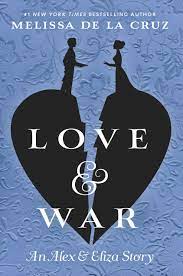
I know it looks a bit ironic to start the month of Valentines, love and romance with a broken heart title but it is just the theme of the story, Alex and Eliza do triumph through their obstacles like any good HEA.
The second book in the Alex & Eliza trilogy is split into two parts, the end of the Revolutionary War and the 1781 Battle of Yorktown while part two deals with the Hamiltons’ married life and start in New York. I suspect that De La Cruz took in the criticism of the previous book with artistic lisence and historical inaccuracy as her Author’s Note reminds readers that this a work of fiction based on real events and take pains to explain what parts she changed, and what is historical accurate.
This extends to the characters. Her Hamilton is still the idealistic, ambitious, workaholic, romantic, feelings on his sleeve icon that we know. I had mentioned in my review for the previous book that Eliza felt more like a spuny, modern romance heroine with her forward-thinking views on vaccination, bantering with Hamilton etc. Here, Eliza still has her fiesty moments and De La Cruz aptly displays her ability to hold a grudge and put people in their place, she is more reserved her, concerned with the separation between her and Hamilton and the mundane realities of being the mistress of her own home.
De La Cruz does an excellent job of playing on the literally titular themes. In wartime, Eliza’s fears for Hamilton’s survival is compounded by her anger at his ambition where he accepts a post without telling her. She had to hear it from someone else, a communciation affront that makes her question how much he respects her as a partner. Understandable, Hamilton didn’t want to break the news to her but it illustrates one of his biggest flaws that he flings himself head-long into his own wants, and lets his loved ones (primarily Eliza) deal with the fall out. Hamilton’s adreneline-lust is also in full-front because even though he wants to return to Eliza, there is still that slightly suicidal part of him that wants to die a hero for his country.
This would be a reoccuring theme as Hamilton fails to communicate what he’s doing in his work or his wants, but informs Eliza later, making her feel like an after-thought. The physical distance during war doesn’t help as Eliza’s time at home helping her pregnant mother seeds her own desire for family.
Part 2 is the more interesting bit as the musical glosses over their first years as newly-weds in New York. Living on Wall Street, the two are making their home but Hamilton is caught up with the desire to keep Eliza in the manner she’s accustomed to. A bit hard as the war has made a mess of the financial system and everyone is operating on credit. Hamilton hopes his work as a lawyer will boost their finances, but his desire to provide leaves Eliza lonely.
Eliza for her part must contend with making do with her home and their makeshift collection of china and porcelein, and the feeling that she is a decorated ornemenation next to the whirlwind that is Hamilton. She can’t even contribute to her favorite chairities (the orphanage) because of the aforementioned money problems, so she is very lonely and irritated with Hamilton’s continued absences. Predictably, it leads to hurt feelings when Hamilton fails to inform her of guests coming, of his absences, the sspicious amount of time he is spending with his client, Mrs. Childress. Though Eliza knows some of the jealousy is unwarrrented, the feeling of being left behind is real. Only they don’t have the time to actual talk, he’s usually exhausted and she’s already asleep when he leaves.
Hamilton’s work as a lawyer is an interesting piece as he defends the loyalist, Mrs. Childress, whose property has been seized since ‘losing’ the war. Sentiment toward loyalists are hostile but Hamilton believes that everyone needs to calm down and become united. Everyone in the colonies has a part to play, even the losers, and punishing the loyalists who still live in the colonies will only divide the country further. Same with the different colonial governments, Hamilton believes there has to be a stronger federal government and bank that will unite the colonies and keep things from descending into chaos. Yep, I smell the ink on the Federalist Papers.
Hamilton’s work with the fictional Mrs. Childress does excellent forshadowing as Mrs. Childress is young, widowed and desperately lonely. While Hamilton doesn’t fall for his temptations, it sets the pattern that Hamilton can’t resist a woman in trouble. His trial also brings him to his first real battle with Aaron Burr, sir whose also his neighbor! (Yep, that is a true historical fun fact. Must have been awkward) Here, their rivalry is purely professional and friendly, with Hamilton taking more affront to Burr using his family connections to get ahead rather than talent like he does. I’m eager to see how it will evolve in the final novel.
In another excellent dash of forshadowing, during the war the Schuyler household was almost ransacked by redcoats. In real life, Peggy managed to trick them into retreating but De La Cruz puts Eliza in the role here (I get it, she’s the main character but justice for Peggy!) and Mr. Burr, sir, is positioned as one of the soldiers who comes to the household the next day. He also comes bringing Hamilton’s letter that he survived Yorktown and the war is over. Eliza’s reaction? Hug Burr and tell him he’s a lifesaver.
I know the tragic irony is delicious.
De La Cruz’s choice to be more historical accurate is nice, but she does put more exposition that takes me out of the story. I mean, it’s necessary as you need the historical context since 17800s America is nothing like today, but the text reminds me of an academic narrator for a Ken Burns film, intoning the thematic questions about America, and the Hamilton’s future.
Also the war years and Hamilton’s command feels glossed over. It’s a story choice since this is more of a romantic story but I wish we had more scenes about Hamilton bonding with his officers and gaining their respect, maybe empathesizing with them about having to work up from nothing, so the pressures of being a good commander really hits Hamilton later. I do admit that De La Cruz does a great job in depicting the chaos and confusion of the battlefield, adding to the danger of being potentially picked off by a sniper.
Unfortunately, the ending feels a bit abrupt as neither Hamilton truly communicates their issues, only privately resolving to be home more (Hamilton) and learning to accept that she’s married a whirlwind genius of a man and must find her own company as she supports his ambitions (Eliza).
Overall, I found this book to be an improvement as De La Cruz realistically expands what we know of these historical figures with the difficulties of beingnewly married, living on their own, juggling work and home with the demands of creating a new, more hopeful idea of what would become America.
4 stars.
 Rachel Reads & Reviews
Leave a comment