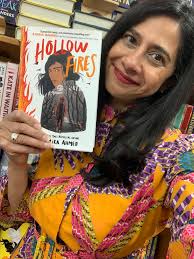
If you want to read something that makes you take a hard look at our society, the ugly and the hopeful, read Samira Ahmed.
If you want something that is relatable, opinionated and has distinct protagonists, read Samira Ahmed.
If you want to read romance, read topical issues, read personal growth, read family communication, read Samira Ahmed.
If you just want a great read to pass the time, read Samira Ahmed.
After reading her first four YA books in succession, I cannot emphasize enough about how Ahmed knocks it out of the park each time in creating engaging and sometimes chilling scenarios rooted in real life.
I’ll be talking about Love, Hate and Other Filters, Internment, and Hallow Fires here, but I posted about Mad, Bad, & Dangerous to Know elsewhere in my Samira Ahmed tag if you want to look.
First off, Ahmed’s debut is a typical coming of age where Maya Aziz is your typical desi senior. She tries to keep up with her parent’s expectations but she is secretly building up the courage to tell them that she applied and got accepted to NYU to do film, her real dream, not medicine. She also has a huge crush on Phil. Phil, the school football star in their small Michigan town and definately not brown or Muslim. But as the deadline approaches for Maya to send her acceptance to NYU just as Phil starts to take a real interest in her with some quality swim lessons, tragedy strikes.
Terrorist action has amplified Maya’s “otherness” in school. It doesn’t help the suspected terrorist shares her last name, but now she is visible in all the wrong ways. Phil doesn’t understand and she fears he’ll become distant. Worse, her parents have become overprotective that Maya will be harmed, blamed for the actions of terrorist who doesn’t represent all Muslims or true Muslims as her father says as it is against the Quran to harm innocents.
It’s a well-crafted story albeit slow in the beginning to highlight the suddenness of the tragedy, the shock that it could happen in their town and flip it on its head. The chapters are broken up by first person POV of the domestic terrorist that plays on people’s assumptions, and the dangers of stereotypes. The romance was sweet, bittersweet in a way as Maya and Phil acknowledge that with graduation approaching, their feelings may not stand long-distance but that’s life. Maya’s relationship with her parents are palpable too as you can feel the love radiating from them, they want to keep her safe, but the communicaton gap and generational divide brings some harsh consequences that are softened by the epilogue.
Ahmed’s second novel, Internement, is chilling. Much like Margaret Atwood’s Handmaid’s Tale, Ahmed utilizes the events in our history to depict a dystopian future where Muslims are rounded up into the Japanese internment camps for America’s protection. Books are burned, and banned. Neighbors spy on neighbors. You can see how this could have easily happened if choices were taken a step too far because as we’ve seen in the media and real life, there are those who will take it to extremes and there are those who will allow it.
That’s what happens to Layla Amin and her family, rounded up in the middle of the night to Manzanar. While her parents are understandably scared to bring harm upon themselves, Layla refuses to lay down and accept the internment as it is. The Japanese were interned until the end of the war, how long would they wait? Would they be forgotten?
She and several other young people refuse to do so, trying to circumvent and protest against their unfair conditions and reach the outside world to show that it is inhumane to treat them this way. They will not be forgotten.
While this is inspiring in itself, Ahmed doesn’t shy away from depicting the gaslighting, the trauma and physical/psychological threats waged against them by the internment heads who try to divide the Muslim internees by geographic location and bribes to be informers. It’s clear Layla will have nightmares for years as she struggles to unpack the adults sometimes blaming her for the consequences when she knows the truth. It is not her fault she is young, female or Muslim. These are not crimes. It’s those driven by hate, power and control who are the real threats to democracy, to humanity even.
She may never regain the normalcy she had before the unmentionable president was elected, the normalcy of being just a regular teen girl who was able to go through life without being looked as a criminal. But she can work to prevent it from happening again.
It can be a hard read, it can be depressing because you can see the historical examples and you know that humans can be the worst to each other. It’s frightening because it can be true. But there is hope to it too even as the characters bear the scars of their internment. It comes from the one guard, Jake, realizing how lost he was in just following military orders that he forgot to follow his moral compass. It’s in Layla and her friends finding the courage to stick by each other through grief and discouragement because they know they will not lower themselves or their values. It’s in Ahmed displaying the solidarity among the Muslims internees as they realize that no matter how religious or non-religious they are, they are stronger together.
The fourth book, Hallow Fires, is also chilling. You can see the pattern that Ahmed is willing to go deeper and more hardcore on the topics that need to be heard about. In this case, Safiya is not the principle’s favorite in her fancy high school. Her journalistic integrity and willingness to point out the flaws and his not-so-secret racism makes her badass in my book.
Still, she’s on scholarship and when her beloved newspaper gets hacked and a racist screed is printed instead, The Spectator gets temporarily shut down and leashed. She, and her journalistic cohort are determined to get to the bottom of it.
As she investigates this Ghostskin (neo Nazi term of hiding their true beliefs in order to infiltrate all the systems of government like sleeper agents), she begins to connect The Spectator hack into other racist incidents around town, and the murder of a local teen, Jawad Ali aka “Bomb boy” because he was unfairly arrested when his teacher assumed his costume was a bomb.
Just as with her debut, the book is interspersed with Jawad’s POV from beyond the grave as he tries to get someone to find his body, tell his story. Plus excerpts from news outlets in 2023 detailing the aftermath of the Jawad Ali murder trial. Together, it makes fast-pace true-crime read highlighting the insidious privilege and racism that allows such crimes to go undetected. Or when uncovered, forgiven because rich, hot boys always get a pass, and the POC victim gets forgotten.
While Safiya’s original target of Ghostskin is corrected, I was able to easily guess who the second perpetrator was. Honestly, it was because I read the Author’s Note first that said it was based on the Loeb and Leopold case and the other suspect fit the Loeb person perfectly. But the correct guess did not detract from my enjoyment. In fact it made creepier as I knew the guy was up to no good so his charm and affable facade was even more sinister. It was like Hitchock level of suspense.
Safiya and Jawad’s story also highlights how the victim is forgotten. How easy it is to let the popularity and notoriaty go to the criminal. He should be held accountable but not lionized. Jawad shouldn’t be forgotten, he impacted people, and his story should be of who he was, not who people mistakenly believed him to be. It might not be justice, what can be justice for someone who should have had their life? But it would be the right thing to do.
And again, the gaslighting, neo Nazi praising insanity of these people who hold so much hate in their heart and belief in their superiority is seriously scary cuz it’s real. Forget what I said earlier about this being a great read to pass the time, you might need to prepare yourself for this one.
Now, I can’t wait to get my hands on her latest book, This Book will Not Burn all about book bans!
 Rachel Reads & Reviews
Leave a comment