The Fault in Our Stars by John Green
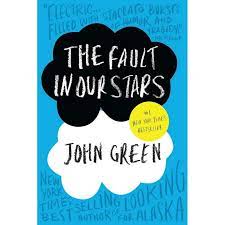
I know, I know this was a sensation years ago which like the contrary person I am avoided it but eh, why not. I already seen the movie back in college and again, it was such a hit I already knew the major points and Augustus dying. Perhaps all the foreknowledge made this a meh experience for me.
Not that Green isn’t an engaging writer, he is. He is able to get into teen’s head that it seems realistic enough. The feelings of knowing everything yet knowing nothing existing simultaneously with cyncism especially in their circumstances. Honestly, they can get obnoxious but also sympathetically vulnerable, they’re human even though their conditions make people walk on eggshells sometimes, they want to be heard and treated as normal as possible.
So yeah, I found some of their dialogue to be pretentious like they read one AP lit book and now they think know everything especially Augustus but it makes sense as they’re dying kids wanting to make their marks and wanting to be love and loved in return. The difference between Hazel being content with what she has, enjoying the time she has and trying to minimize the pain for her loved ones (though we all know its not possible) and Augustus’ dreams of a legacy are both so real.
So yeah, it was a good one-time read, I can see why others like it.
Bridge to Terabithia by Katherine Paterson
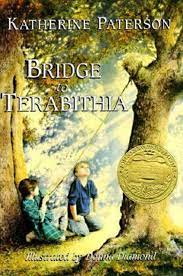
I know, I know, it’s such a famous book but I only read it this month. It’s pretty well-known so I knew the tragic end to Leslie and Jesse with the broken swing. I found it cute and realistic, transporting readers to the 70s down south or the present day when it had been published. There’s something so wholesome about Jesse learning to embrace his imagination and the two creating the kingdom of Terabithia, a place where they rule instead of being the outsiders at school.
But I’m not sure what was so groundbreaking for its time. Is it that Paterson showed the kids being kids which I know was revelatory in some child lit circles where the books primarily focused on moral messages and treated the kids as vessels for those messages, not relating to them but talking down to them.
That’s one theory but maybe I would have understood if I read when I was a kid instead of now. Oh well, it was cute.
The Golden Screen: The Movies that Made Asian America by Jeff Yang
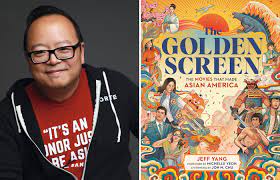
This comprehensive book details the record-breaking, the conversation-starting, good and ugly of Asian Americans on film from the nasty portrayals of xenaphobia and stereotypes in Flower Drum Song and The Son of the Dragon to ones that celebrated Asian American history and love like Crazy Rich Asians, Chutney and The Joy Luck Club. Separated into seven chapters (generational divide, monstorous other, across borders, romance, gender etc), Yang details the history of Asian American depictions in a historical and film-making contexts and its influence on its audiences.
And like any good movie book, it includes blurbs from prominan movie critics and actors of what these movies mean to them which are sometimes contradictory but show how films hit people in different ways. Plus it gives you a lot to add to your TBW pile.
Yang also has interviews at the end of each chapter with actors and filmmakers like Michelle Yeoh, Kal Pen and Daniel Kwan reflecting on the topic of each chapter which adds even more to the experience and appreciate how far we’ve come in diversity and what more that can be achieved.
Rosewood by Sayatani DasGupta
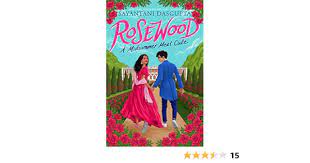
While DasGupta’s first Austen-inspired book was inspired by P&P, Rosewood is inspired by Sense and Sensability and a whole lotta Shakespeare. Plus Bridgerton for good measure where the sisters sign up for a regency acting camp inspired by Bridgerton to include POC teens to enjoy regency romps and a chance to get on the show, so-called, Rosewood.
Much like in Sense and Sensibility, Eila is the elest daughter whose sense of responsibility has made her repress her actress dreams to go for a more suitable career in the sciences and has taken upon herself to watch over her little sister, Mallika since their dad’s death so not to overburden their mother in her grief. Eila is very stern about this and so she finds this whole regency acting camp even more ridiculous because it feels like they’re dismissing the regency era’s colonial past and revising it to something madeup and even more vapid.
But Mallika’s plan works as Eila gets into the acting that she so enjoys and is swept away in the fantasy of it all. She starts to understand why people enjoy play-acting the era despite the societal resitrictions and protocle because breaking them is so much fun. Especially since she’s breaking them with the sweet yet reserved Rahul.
It has all the storybeats of S&S like being rescued by a charming Whilloughby type, the snooty Ferrera’s girl trying to drive a wedge between and by pointing out their financial/class differences and painting Eila as a social climbing gold-digger which leads to more miscommunication and lying that drags on because of Eila’s pride. A bit predictable in the last quarter where the third act break up dragged on to the point of irritation because Mallika is right, Eila seems like she doesn’t want to let herself have fun or pleasure.
Honestly, the romance was meh (minus the incredibly romantic lantern boat scene, just swoon!) but Eila devcelopment and the sisterly bond was great as she realizes is more capable than she thought and she should stop neglecting herself and pursue her dreams despite the doubts and fears of failure. Also I just like how the Willoughby-stand in didn’t turn out to be a jerk like in the original. He remains his charming albeit suspicious self throughout.
Love, Theoretically by Ali Hazelwood
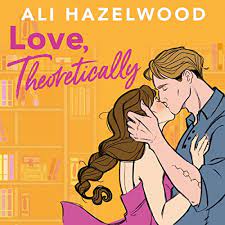
The last Hazelwood book I read left me burnt-out as she tends to use the same formula. I respect that, if it ain’t broke and all but this one regained my interest.
Okay, first off the same tropes are here with the protagonist, Elise being another quirky science girl who is a perpetual people pleaser and uses her skills to work as a platonic escot for boys who want a cover girlfriend for whatever family situation. Meanwhile, Jack fufills the trope of a high position person on the job board who falls for her and wants to take care of her. At least he’s a lot more charming and humorous compared to the last few love interests.
Oh and they’re rival physicists in the science world. Honestly, the science politics were a lot more interesting than the romance for me as I could probably predict the story beats. The academic side was a bit more sciency than I could understand but I felt smart for comprehending the basics. Plus it’s so interesting yet relatable as Hazelwood uses Elsie and Jack’s positions to highlight the manipulations of advisor-advisee relationships in the workplace that controls their career timeline.
And yes, I did get into their relationship near the end as Jack Smith’s concern for her consent and enjoyment is hot.
But I found Elsie’s friendship with Greg (Jack’s brother whom she initially fake-dates cue lots of comical misunderstandings) to be so sweet and endearing. Honestly, I may have shipped them a bit more but their friendship is adorable.
Queen of Exiles by Vanessa Riley
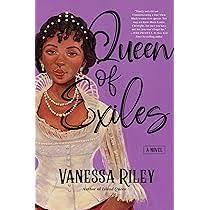
Riley unveils the underrated and forgotten story of Haiti’s first queen. Queen Marie-Louise Christophe who tries to balance being one of the first black queens in the Western hemispheres after Haiti’s revolution and overthrowing the shackles of their colonizers, the French. Yet her husband is deposed only a few years later and she is forced into exile in Europe and must find a way to keep her family safe and her daughters’ futures secure by gaining the aid of European nobles. It could be degrading but Riley never overwhelms with pain and humiliation but on the fact that Queen Marie-Louise managed to carve out an independent and fufilled life for herself despite the tumultous life she had.
For Queen Marie-Louise’s role was complex. She was trying to balance being a symbol of the future for her people and be a supportive partner for a husband who is bending over his past demons (as a slave turned king is quite a culture shock) and the pressure of his own ambition.
Which makes sense as King George’s desire to prove himself as worthy of respect and equal to European counterparts. He is now a symbol for almost all black people and he wants to prove that they are not the uncivilized savages others paint them as to justify their racism and oppression.
But it is that same desire that makes him tear down Haiti’s culture and black roots in order to mimic European protocol, architecture, music etc. which leads to the coup and downfall as Haitians reject the king that acts like a lap dog to their slavers in their view.
The themes of trauma, grief and being strong for her family could weigh Queen Marie-Louise down which is why she is reluctant to fall in love again when the chance is presented to her. After all, there’s so much else going on like raising her daughters who are facing a world that constantly tries to limit and dismiss their beauty because they don’t fit Eurocentric standards. She’s a true role model as a mom who strives to look on all sides, balancing realism with compassion and support for others, finding time for herself and her own grief even though she can’t share it with others.
Going back and forth between the present and the past with snippets of real life newspapers detailing events and rumors during her lifetime, Riley brings an inspiring figure to the centerstage,
Salt the Water by Candice Iloh
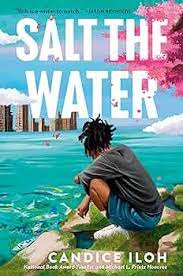
Cereulen Gren is just tired. Tired of the apathetic teachers who don’t really care if they learn anything but blind obedience. Tired of being misgendered. Tired of the systems of oppression in society. They can’t wait till the day that they and their friends can fufill their pact of saving up funds to go to sunny California and live.
But when a family injury strikes, they have contend what life can be for a high school dropout who doesn’t want to settle for limit themselves.
As usual, Iloh’s book was a breeze to get through as it is written all in verse. Unfortunately, that same easy rythmns that makes it a quick read makes it also feel like not much happened in the novel. It’s under 300 pages, sure, but most of it is just plodding sentences of Cerulen’s day. Then it switches to the POV of their friends and brother after his disappearence and then it just ends. I understand Iloh wanted to experiment but I didn’t understand how this provided a more positive or uplifting portrayal of queer, black kid escaping a limited society. It just ends, and I felt unfufilled and confused.
Dear Martin by Nic Stone
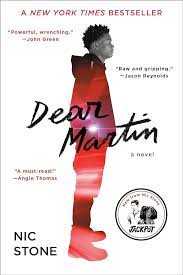
It’s never easy to be a black male in America. Even for straight A, debate champ, Harvard bound Justyce McAllister. After a traumatic incident of racial profiling where he gets arrested and thrown down by a cop when he was doing the right thing, Justyce can’t shake the incident from his head. In order to make sense of all the microaggressions and overt racism that he can no longer ignore, he starts writing to MLK and struggles to figure out who he wants to fight back and who he wants to be.
Stone doesn’t sugarcoat things as she details not just racial profiling, but the difficulties of interracial relationships and their perceptions in the black and white communities, police brutality, the belief that one must assimilate or ride on the coattails of a white guy to make it successful, being treated as a race-traitor, gang life, overlooked for promotions, everything.
It’s a lot but Stone’s voice which alternates between prose, dialogue (think reading a play script) and Justyce’s letters to Martin, he untangles that fighting the system through gang life is not the path he wants to go despite the temptation and the feeling of brotherly understanding he gets from the black jihads. He is not about that life but he can’t quite grasp the peaceful, nonviolent way either, it doesn’t really get him any acceptance or stop others from underestimating or judging him.
But that’s the point as Stone shows there’s no easy way in this complicated world to be a black male but it depends on the individual’s decision of who he wants to be. Another thing that stands out is how she depicts a variety of black males and shows they’re not a monolithe and their decisions aren’t either.
It was a really good read although I wish it went on a little longer, I’m eager to get my hands on the second book.
Love in English by Maria E. Andreu
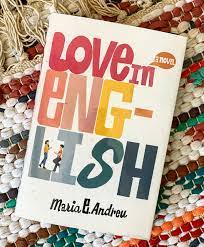
Ana is a sixteen year girl, reuniting with her father for the first time in three years in America. Even though her father promises that life will be better here than in Argentina, she is doubtful. She hates how distant and changed her relationship with her father is as he’s almost fully assimilated and doesn’t seem to understand the difficulties she has with the language, and the subsequent isolation and homesickness she and her mother feel. Is moving to America really better?
Ana’s ESL classes are a major point to the book as Andreu uses her parts of her real life journey in moving from Argentina to America to inform readers of the Ana’s struggles. Honestly, people don’t realize how difficult the language is. Yes, the verbiage is easier but the idioms and fast-paced talking leaves Ana demoralized. Language is the foundation for so much and not being able to speak English or understand what people are saying makes her feel like a failure. She misses social cues, looks like an idiot, feels like one, makes it harder to connect and belong.
At least others in ESL get the struggle even though they don’t necessarily speak a common language like Nero, a boy from Cyprus whose adorable attempts at communication endears him to Ana and the reader. Yet she has her sights on an American teen, Harrison, which the language barrier is a major issue as one can imagine but in trying to do so, they broaden each other’s horizons and laugh at the strange sayings.
While the love triangle is predictable, I appreciate how Andreu doesn’t make either boy the bad guy and focuses primarily on what each one represents to Ana. The real story is about language, what it means to forming bonds and how it helps one define themselves and find their voice. Making Ana’s triumph not in her kisses with Harrison and Nero but in sharing her poetry for the first time.
Plus there are such fun bits like the ESL’s teacher love for eighties Joh Hughes films and Ana’s complete confusion in it and the weird ways it portrays 80s America.
Everything, Everything and The Sun is Also a Star by Nicola Yoon
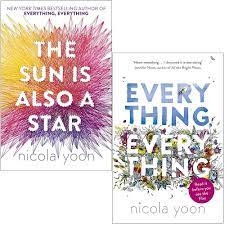
I’ll keep these short as I was already spoiled by the movie’s popularity so even though I never seen the movie or read the book, I already knew what happened. Same with The Sun is Also a Star yet I was able to pick out pattern in how Yoon manages to weave a convincing story of insta-love in both of the couples.
To be fair, Madeline and Olly have more time together even though they’re separated by distance but the tension of her sickness makes everything more heightened, emotionally and physically and I love the journey Madeline goes through in realizing being contained a bubble is surviving but not truly living. Yet her decision to go to Hawaii is not only driven by Olly but how he is a catalyst to remembering her past happiness and reaching for it with both hands. It was a good story. I enjoyed her equally powerful bonds with her mother and with Carla, and how her mother’s mental illness was not munchausen by proxy but something driven by her own grief, it made her more sympathetic.
Another thing her books share is that the narrative is interrupted by other related tangents. In Everything Everything, it comes from Maddy’s homework, doodles and text messages which I found cute and relatable.
In The Sun is Also a Star, there are brief histories of the people Natasha and Daniel meet or bump into which plays into the story’s big picture about multiverses and fate, and how multiple instances and random decisions led to their meeting, to their falling in love, to Natasha’s deportation, etc.
I enjoyed The Sun is Also a Star a bit more as there’s a great push-pull between the more scientifically-minded Natasha and romantic Daniel, whose own personalities also serves as flaws (Natasha choosing not to feel passion to avoid disappointment, Daniel leaving things to fate to avoid making a decision), showing how they complement each other.
They contend with the question of whether fate or destiny plays a role in love or if love really exists. Is it just another pattern in the chaos of life that humans give meaning to their existance. I sided with Natasha during the beginning that the extremity of their love was probably heightened by Natasha’s deportation and teenage hormones but damn Yoon makes it so sweet and engaging, I was rooting for them to be together. Still, Yoon chooses a realistic route, leaving enough room for a happy ending that makes the story even better in my opinion as it leaves he sweet spot of HEA that isn’t too a deus ex machina.
Love From A to Z and Love From Mecca to Medina by S.K. Ali
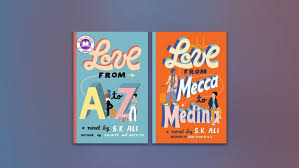
Since I really enjoyed Ali’s Misfits duology, I had to get into her Love From duology and it is just the antidote one needs with its sweet romance, spiritual fervor and coming of age exploration of two well-meaning yet flawed people finding their perfect complement.
The first book has Zayneb and Adam’s first meeting on an airplane where by a complete coincidence, the cute girl/guy from the plane turns out to be the family friend of her aunt/his family friend’s niece. During these two weeks in Quatar, Zayneb and Adam are in dire need of space from their regular lives. Zayneb is under suspicion after calling out her islamaphobic teacher and Adam is struggling with his MS diagnosis and having to tell his family who are still reeling from his mother’s death from MS a decade later. Both want to take this time to be different, to be normal and calm, but how can they add the addition of a potential romance when it can’t be.
Because of the short time span and the big problems, Zayneb and Adam are dealing in their lives, the miscommunication issues are understandable and non-annoying. It isn’t a question of religion as they’re both Muslim, but of personality compability as Adam is mellow and zen but becoming fearful that his MS will make him a burden while Zayneb is so passionate and fiery that she tends to be impulsive and self-sabotaging. Add in that this is their vacation selves, they feel like getting into a relationship now would be like making the other commit to someone they don’t really know.
Yet it works because they do communicate and they do balance out and honestly, I’m describing it well but Ali does a wonderful job in progressing their relationship in concurrent time to their personal journeys where they solve their own problems thanks to the lessons they learned from being with one another.
Love From Medina to Mecca takes place four years ago and is much more adult. Since nikh (where a couple is wed under muslim law. Not at all related to American commonlaw marriages. Basically, they’re allowed to see each other unchaperoned) and college has taken up their time, they haven’t been with each other for months. Adam and Zayneb are living for their Thanksgiving break in a honeymoon-esque cottege in Sussex. But then Adam’s dad offers them a chance to do a pilgrimage from Mecca to Medina. With Adam’s MS stabalized, he is determined to go while he can. He is hoping the prayer and spiritual community will give him some peace after months of no work and continuing anxiety of proving himself to Zayneb’s family. Meanwhile, the passionate Zayneb is crumbling under anxiety, a smear campaign and no place to live. She just wants to vacation not pray under the hot Mecca sun but she wants to be there for Adam.
This one was my favorite as it really digs into the issue of couple communication. Both are insecure here as Zayneb struggles with jealousy and the loss of her sense of self, so focused on stuff she cannot control and her own negative feelings that she draws herself away from Adam. Meanwhile, Adam is consumed with finding a job, not wanting to accept another loan because he fears it will be a strike against him from Zayneb’s workaholic family and from Zayneb who is so driven. What if this is what will make her leave him, him being a burden on her and her dreams?
It’s seriously heartbreaking. I mean, you know they’ll get together in the end, but damn the personal hellhole of isolation they’re experiencing made this feel like the brink of a divorce. Yet in this pilgrimage, they do find a spiritual balance. Not just in the history and scripture but reflecting what Islam means to them and how it fits into their lives.
It should be noted that Ali is very casual about her references to the scripture and its arabic words. While you can glean meaning from the context, you might want to look up any words that are unfamiliar.
Fruits Basket Another vol. 4 by Natsuki Takaya

The fourth volume of Fruits Basket Another is more of a bonus feature, not really completing the story but a side story detailing Shike’s relationship with his mother and his pain at seeing her pain, isolating herself from the Sohmas after everything she did to them. Understandable as Shike knows her when she’s more adjusted and she’s a good mother to him. It’s hard to reconcile the actions of her past with how kind and reserved she is now.
This is a moving, complex side-story that delves into the themes of family, trauma, healing, guilt, abuse etc. that Fruits Basket explored in the original series. However, I just felt this was disconnected and unresolved when you connect it to the main Fruit Basket Another storyline.
Sawa is mainly absent as Shike takes center stage which I can understand but considering how her storyline ended in vol 3, I just still feel like it was unresolved. Now, she has friends and she has hope that someday she’ll be able to move out of her abusive mother’s house but it feels hollow. She’s still so insecure and so unsure of telling others about her situation. The Sohmas always say that they’re there if she wants to talk but it is clear that she’s not going to do that unless she has no choice.
Anyway, Fruit Basket fans will enjoy all the bonus content where writes a bonus story of “The Three Muskateers” which was a meta-take on Ayame corralling the others on a pilgramige of big Sohma family locations in the countdown to the anime.
Then there’s the tie-in anime content which I was just confused because I hadn’t seen the anime and it’s been a year since I read the Fruits Basket series. So overall thoughts, hard-core fans will enjoy this but those just picking up will leave confused and unsatisfied.
Kilala Princess vol 4-5 by Rika Tanaka
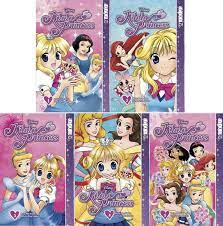
These final volumes of Kilala Princess not only show my two favorite princesses, Jasmine and Belle, but introduce a potential rival (that will obviously lose because she’s snarky and spoiled and sexually suggestive) and Kilala embracing her role as the seventh princess and saving the kingdom.
And yeah, there’s honestly not much else to say. It’s for kids so it’s predictable although I have a few question that will probably go unanswered like Rei and Kilala are married now even though they’re like 14, and I guess she’s just not going to go to school again. Or heal her sick mother.
Eh, it’s not supposed to be that deep so I enjoy the cute, optimistic protagonist and the amazing art. Kids willd efinately get a thrill out of the escapist elements.
Our Brave Foremothers: Celebrating 100 Black, Brown Asian & Indigenous Women Who Changed the Course of History by Rozella Kennedy
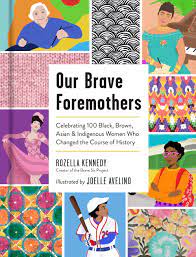
It’s exactly what it says on the tin as Kennedy showcases some well-known women (Wilma Mankiller, Harriet Tubman, Anna May Wong) along many new faces who stories who should be more well-known like anarcho-communist poltiical agitator Lucy Gonzales Parsons who faced against the titans of the Gilded Age
Lydia Mendoza who was a precursor to Selena Quintilla in popularizing Tejano music on both sides of the border
Martha Louise Morrow Foxx, who was the principle of The Piney Woods School for the Blind where her students were able to enter classes with sighted students and keep pace. Even Helen Keller praised her success
Red Wing was one of the first and only indigenous actors in the silent film era and would later found the Indian Community House
Florence Ebersole Finch was a Filipina but used her white-passing looks to aid the Allies and the Philippine Resistance during WW2 and Japan’s occupation. Sylvia Mendez of the less recognized Mendez v. Westminster case paved the way for desegregation in California on ehalf of Mexican-Americans (and set precedence for anti-Native and Asian discrimination), eight years before Brown v. Board of Education.
This is not an in-depth look. Kennedy says she’s a storyteller rather than an academic so this should be a primer, encouraging readers to learn more about these women as well as connect with them and how they can inspire their own lives with Kennedy’s little prompts at the end of each bio.
Books I read
The Illustrated Guide to Shadowhunters, Denizens and Downworders by Cassandra Clare and Jean, Our Wayward Fate, Rent a Boyfriend and When You Wish Upon a Lantern by Gloria Chao, The Fault in Our Stars by John Green, The Golden Screen by Jeff Yang, The Sleep and the Spindle, Snow, Glass, Apples, and Hansel and Gretel by Neil Gainman, Rapunzel’s Revenge and Calamity Jack by Shannon and Dean Hale, Spy x Family vol 4-10 by Tatsuya Endo, Kilala Princess vol 1-5 by , Dark Jem by Kelly Thompson, Fruits Basket Another vol 1-4, Lost in a Book by Jennifer Donnally, Black Girls Rock by Beverly Bond, Girls Who Run the World by Diane Knapp, Secret Sisterhood by Emily and Emma, Commercial Breaks trilogy by PJ Kain, Die Kitty Die, Hollywood or Bust, Heaven and Hell by Dan Parent and Fernando Ruiz, The Aubrey Hepburn Estate, The Liz Taylor Ring and The Grace Kelly Dress by Brenda Janowitz, milk and honey, and the sun and her flowers by Rupi Kaur, Betty and Veronica: Prom Princesses and Shopping Spree, World of Betty and Veronica Jumbo Comics #29, The Missing Sword by Melissa de la Cruz, A Grimm Warning and Worlds Collide by Chris Colfer, Every Body Looking and Salt the Water by Candice Iloh, Hotel for Dogs trilogy by Lois Duncan, Dear Martin by Nic Stone, Everything Everything and The Sun is Also a Star by Nicola Yoon, Wicked by Gregory Maguire, Love from A to Z and Love From Mecca to Medina by S.K. Ali, Fullmetel ALchemist vol 10 by Hiro Awakara, Our Brave Foremothers by Rozella Kennedy, DC Comic Bombshells vol 1-9 by Margurite Bennett, Art of DC Comic Bombshells by Ant Lucia, Goddess Girls #1-29 and Super Special by Joan Holub and Suzanne Williams, Art of Avatar the Last Airbender by Mike DiMartino and Bryan Kozentino
 Rachel Reads & Reviews
Leave a comment