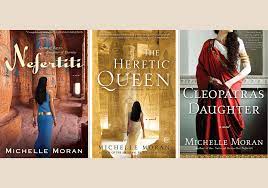
I have already extolled Moran’s virtues in historical writing in previous posts but after several more books in her catalogue, I have to expound on how deftly she immerses the reader into the ancient world.
It probably helps that she had previously majored in archeology and has travelled extensively on dig sites so she has a ‘real world” connection to the Egyptian saga (Nefertiti, The Heretic Queen, Cleopatra’s Daughter). I mean, obviously modern Egypt is different from ancient Egypt but I imagine exploring the temple ruins and such does give you an idea of what it was like back in the heyday, coupled with the research and histography archeologist go through in contextualizing the artifacts in connection with the cultural, political and personal beliefs of the people in that era.
That’s why when one reads her work, you can easily picture the setting and atmosphere of the palaces as Moran walked in their steps herself.
In regards to her characters, she does an excellent job in blending the personal struggles alongside the political. In Nefertiti and The Rebel Queen, she chooses to have the narrator not be the famous queens (Nefertiti and Rani of Jhansi) but people close to them in court. Initially, I was disappointed to see these women not through their own lens but percieved through others but narratively it makes a better choice as it illustrates that we can’t quite ever know how these women thought as their stories can only be pieced together by the remnents and stories of others.
An overarching theme throughout all her novels is the protagonist being in love with someone else but having to choose duty or forced by their relatives to take a political match over happiness. We see it in The Second Empress where Marie Louise marries Napoleon to gain his favor and unite the French to the Hapsburg Empire. When Nefertiti’s sister has to marry a court minister so Nefertiti can continue her religious overhaul in Egypt, and so on.
However, staying to close always proves to be the more dangerous option. Not only from opposing revolutionaries but jealous rivals like Marie-Louise having to contend with Josephine’s supporters as well as Napoleon’s sister who wants to marry her brother in a throw-back to Egyptian royalty. It’s all connected and very incestuous, seriously insane. But that’s what makes it entertaining as Moran puts a human spin on these famous figures, highlighting their foils, flaws and success.
The most powerful would be in The Rebel Queen which takes on the underrated (in the U.S.) story of the Rani of Jhansi who used legal and militarial means to take back her kingdom from British colonial rule. Truly, a ruler of the people, the Rani amassed a following by personally leading battle, training soldiers (including an all-female contigent) and selling her valuables to clothe the poor.
These are great books, even if some tropes get repetitive, as it serves a nuanced view of historical figures contextualized in their respective eras. Nefertiti is a visionary but pragmatic, ruthless and unmoving when it comes to changing her plan when it provokes backlash from her own people. Marie-Louise is an ideal empress, being docile and bound to duty but learns to harnass her voice and stop bowing down to political pressure and seize her happiness (while siccing the Haspburg Empire on her ex-husband). Rani is generous, intelligent and a warrior, but unknowable and secretive except to her inner circle for good reason. All worth knowing more of and should get big-screen debuts.
 Rachel Reads & Reviews
Leave a comment