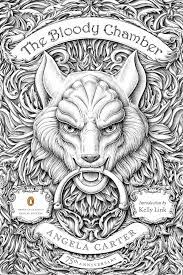
You know how darker, sexier retellings of fairytales are all the rage?
Well you have Angela Carter to thank for that subgenre in fairytale retellings with her collection of short stories that subvert and invert these popular tales to pay homage to their darker origins while making it slyly progressive. Putting the females in peril and also able to get themselves out of distress. Going as to far to embrace the primal and dark.
The most famous would be the titular The Bloody Chamber, serving as the first and longest story in the collection where the young teenage girl is wed to a Marquis de Sade as she distressingly finds out after her wedding night.
The story is a great primer in laying out Carter’s pen for suptumous, decadant detail that you cand rown in the European opulance alongside a chilling uneasy that mounts as the nameless narrator finds out her husband’s secrets and the fates of her previous wives. Most thrillingly is when the girl’s fate is spared. Rescued not by the blind piano-tuner she befriends but her protective mother whose instincts had been right all along, blazing down the cobblestone path in fury with a shotgun. It’s just glorious.
The Courtship of Mr. Lyon and The Tiger’s Bride are two different takes on Beauty and the Beast. One in the distant cold of Russia that plays straight with the original tale of a more vain, selfish Beauty initially forsaking the Beast before remembering her love for him. While the other one Beauty is the unwitting of her gambler father’s debts as she’s taken to the Tiger marquis and unwounds the layers of power and vulnerability in nudity, revealing that the instinctive animalia is the beauty underneath human skin. Or something like that. I think there was a deeper message to The Tiger’s Bride but it still hasn’t quite clicked for me.
Puss in Boots is the second longest story and a very fun romp where the titular cat narrates his mischevious antics in helping his master gain the heart (and bed) of the most beautiful married woman in Venice. Anything to get his love-sick master to remember to feed him treats again. Paying reference and allusions to the Italian operatic romp of mistakes and cons, everything ends happily and mated between humans and cats. It was my favorite out of all of them.
The Erl King and The Snow Child are just one page long each. The Erl King providing a personified look at the Erl-King of trees and nature whose beauty captures the narrator to the abyss of love that she loses herself. Something that is not his fault because it is just his way but which the narrator must make desperate measures to escape. The Snow Child is based on Snow White where the king is a creepy, necrophilic pedophile to pound home the message of men are dogs who prefer youth and beauty even when their wives are right there. So I guess the Evil Queen had a point? Nonetheless, they’re short yet atmospheric.
The Lady of the House of Love is more of a gothic tale than a fairytale adaptation as the titular lady is a vampire, the first daughter of Nosferatu who occupies the uneasy limbo of having a compassionate heart but her instatiable hunger prompts her to drain her lovers dry. A reverse of the tales where a man’s innocent purity is imperiled but it is that same innocence that protects him from the dangerously seductive vampire. I’ll admit it’s not my favorite as Carter’s tendency to write the most descriptive of descriptions, wrought with metaphors, makes the story drag. I do enjoy the themes though.
The Werewolf and In the Company of Wolves are both based on Red Riding Hood tales. One where Grandma is the wolf, and the other where Red riding Hood flips the predator-prey dynamic on its head as she uses her seductive wiles to seduce the wolf, embrace her wild side and survive.
Wolf-Alice is Alice Through the Looking Glass. If Alice had been a feral child raised by wolves and forced to realize her humanity and womanhood in isolation with only a mirror and an aging lycanthrope for company. It’s an eerie tale the nuance and slow epiphanies of self-examination and I enjoyed it more than the original Alice tale.
Carter’s stories are full of beautiful prose that luxuriates in the beauty and the darkness. Making something timeless into a more current, empowering and provocative, paving the way of the dark fairytale aesthetic so many enjoy.
 Rachel Reads & Reviews
Leave a comment