Hotel of Secrets by Diane Biller
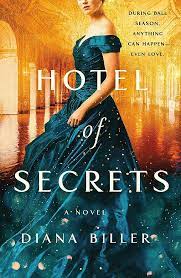
It is New Years Eve in Vienna and Maria Wallner is determined to rebbuild the Wallner Hotel, her family legacy even though her mother neglected it throughout the economic downturn. The hotel is her life and provides a distraction from romance which all of Vienna is waiting for her to partake him. After all Wallner women only love one man passionately, and scandelously. Maria has seen how that one-minded devotion from her mother leading her to become selfish and neglectful of the rest of her life. Maria has so much more to work for than just one man.
Eli Whittaker also has his mind devoted to work as he travels to Vienna to look into the financial gaps in the embassy. He is all about rooting out corruption in the American gov. so men of privilege won’t get away with everything just because of their wealth. However, the missing finances seem to be entangled with the Wallner’s residences and he soon finds himself more invested in protecting Maria.
This book was chock-full of competence. I mean, Eli Whittaker was just amazing as a person and as a romantic interest. I wish he was real. He’s has Darcy’s awkwardness without his prejudice and disdain. How could Maria not fall for him. And Maria is great too, so confident and witty yet unable to accept help after seeing her mom’s blantant affair ruin their family. Something Eli and Maria bond over as he has his own neglectful parental figure that convinces him that he is better off alone than in love because being love is a vulnerability that feels more dangerous than a gunshot.
Speaking of gun-shots, Biller deliciously blends espionage intrigue with the lush historical romance of Vienna in winter. It’s just dazzling. Regency romance is nice but it’s also great to get a change of pace like with Vienna’s love of waltzes, nonchalance of spies and joie de vivre towards life, and love. Plus the familial aspects of the story also drew me in as Maria and her half-brother strive to make a positive relationship despite their family’s petty dramas. I just feel that some characters got the short shrift like Maria’s mother who went through an abrupt though hysterical in-character change to maternality. There was a French spy who served as comic relief for the most of the novel, and I was just waiting for him to reveal his secret skills but it never happened. He was a minor character and it wasn’t the point but I was still disappointed by that.
I was not disappointed by Eli and Maria’s sizzling, intense chemistry and how Maria took the reins with the more celibate Eli, highlighting the different attitudes toward sex between cultures and how they were able to communicate so they both had an amazing time that was so different from what they ever had before. I
Seriously, just go, go read this book!
Iris Kelly doesn’t Date by Ashley Herring Blake
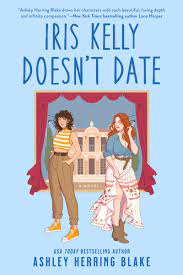
Much like the title says, Iris doesn’t date. She’s totally fine with being single while all her friends are paired up and getting engaged. She’s tired of the pity and blind dates from her family and friends, she’s happy with her life as it is. She’s just having trouble with her latest romance novel . . .
Meanwhile Stevie is desperate to prove to her friends that she’s okay with her ex and their mutual friend’s brand new relationship. She’s totally over it, and to prove it she goes out to have a one night stand. Which ends with her throwing up on Iris’ shoes before it goes anywhere. But her friends don’t know that, they think she and Iris are now dating. It’s cool, it’s not like they’re ever going to meet each other.
Until Iris decides to get out of her funk by auditioning for Much Ado About Nothing. Directed by Stevie’s ex and starring Stevie as Benedick. Embarrassed and desperate, Stevie begs Iris to be her fake girlfriend and Iris agrees seeing potential material for her book.
Of course, they fall in love but like in all of Shakespeare’s best work, the course doesn’t run smooth.
After Blake’s previous novel in the trilogy, I was a bit hesitant to see how this one would go. But Blake blew me out of the water! It helps she utilized all my favorite romance tropes. Iris has always been the funny, sexually adventurous friend in the series, but this revealed so much more to her. The repressed layers of abandonment and insecurity that she hardly shows anyone, even her friends. Since she was an out and proud bi teenager, she’s been preopositioned as if she’s only good for sex and nothing else.
And her subsequent failed relationships, a failed engagement with a man she did love but wanted different things and rebound that made her into “the other women,” Iris has started to believe it. She’s not someone people love, and she tries her best to keep things light so she won’t feel that painful sting of abandonment when yet another person leaves.
But Stevie manages to get past those walls. Iris actually feels heard by Stevie, she feels safe yet out of control, and it scares her.
Stevie is also terrified. With her anxiety, lots of interactions others take as normal, she gets paralyzed and yes, throws up. She fears this makes her “too hard” to love, she’s scared she’s too clingy, she tends to let the other person arrange everything and she twists herself to be what the other wants. Even as she recognizes her ex-relationship was a bit toxic and codependent, she’s also scared of falling into those same bad habits. Yet with Iris, she also feels safe and heard. Iris gives her time to cool down, to listen, to let Stevie take control and make decisions and it’s intoxicating.
By the half-way point I was totally rooting for them to realize their feelings and get together. Thankgully, Herring delivers rather than dangle a will-they-won’t-they till the end, allowing readers to enjoy Stevie and Iris as a couple while working at their issues at the same time. Still, their issues prompts big obstacles and a third act break-up that hurts but feels real even as they find their way back together, showing how Herring prioritizes her characters working on themselves before finding the strength to give that full love and healing to someone else.
Also the scenes between them range from utterly adorable to steamy like Iris teaching Stevie how to seduce, and then the grand romanticism of Stevie going full into the relationship from fake to real, showing serious she is about Iris to hold off sex so she can shower Iris with all the romantic dates, flowers, cliches that no one ever considering treating her with. Just. My. Heart!
Highly recommend this one. It’s a story about choosing love as well as prioritizing themselves and finding a way to balance them both. I just wish Blake incorporated more of the play that is the central plot that brought Iris and Stevie together, totally missing the great parallels, symbolism and chaotic theater people there. Also wanted more of Iris’ friendship with the others that served as an important part of the other books and the epilogue here.
Stranger than Fanfiction by Chris Colfer
We all have that avorite tv show. For Topher and his friends, Sam, Mo and Joey, it was Whiz Kids. It’s what brought them together and what they plan to watch every Wednesday over Facetime once they go their separate ways in college. But before that happens, they’re going on an epic road-trip.
And with one off-hand email, their favorite star from Whiz Kids, Cash Carter decides to join them.
Well you know what they say about meeting your heroes. Or in this case, going on a road-trip with them. They learn Cash Carter is not like the lovable, adorkable professor he plays on tv. He’s honest, abashedly honest and it wrecks their fantasies. But the no bullshit approach leads them to seeing past the obstacles and challenges they currently have and see that the expectations and fantasies other people have put upon themselves shouldn’t define or limit their happiness.
I enjoy how Colfer embraces the meta fanficness of this novel. Carter could obviously be taken as a stand-in for Colfer’s feelings about fame, enjoying the respect and inspiration part but annoyed by the high, unrealistic expectations of fans thinking of you as the character, not a person, and the invasiveness of paparazzi, and an industry only looking out for number one.
That would be called a self-insert in fanfic circles, and he delightfully uses such tropes as run-down in the middle of the road, friendship fights, road trip hijinks, deathbed confessions and spontaneous inheritance so each protagonist can get their wish fufillment. It’s totally unrealistic but seriously fun especially when Carter acts as a deranged, irresponsible Mary Poppins corrupting them with fake IDs, wild dancing, and marijuana. That marijuana scene had me cackling, it was hilarious.
Yet with the entertainment, Colfer does dispense some wisdom of how these newly minted adults still see themselves as kids and allow their parents and circumstances dictate their lives. Carter urges them to take control and reach for that happiness. Something that’s nice to vicariously read but I don’t know if that will work in real life as much as I want it to. He also continues his themes of inclusion and fight against the prejudices and bigotry of a world that won’t get with the times. Though I appreciate his approach in being compassionate and inclusive, it did veer at times as educating the reader. I was surprised he didn’t add statistics. Nonetheless, it was a fun story and a nice YA debut even if it had a rushed ending. I’d like to think he was trying to emulate those wish fufillment fanfics. It’s all about entertainment.
The Extraordinary Secrets of April, May and June by Robin Benway
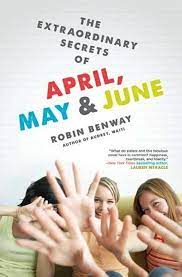
It was an ordinary day when a near car crash sends three high-school sisters spinning in more ways than when. The impossible happened, and even though they tried to convince themselves they had a shared hullicination but it’s soon clear. They have powers. April has visions of the future, May can turn invisible, and June can read minds.
Though they don’t know where their powers come from, they waste no time in using them. Okay, June is the only one who gets a kick out of using hers to finagle her way to the side of the most popular girl in school. Well, the freshmen class. April chastises her for the unethical use of it but June couldn’t care less. April and May are having a more difficult time between the unexplained visions that April can’t interpret and become increasingly scary. May can’t control when or how she becomes invisible which is embarassing during her study date, but becomes all the more apt to how she feels as the middle sister still dealing with their parents’ divorce and the ensuing move.
I really enjoyed how Benway dove into the complications of sisterhood especially in their birth order with April taking on too much and trying to watch over the others that comes across as controlling, patronizing and untrusting. May feels invisible and represses her emotions in unhealthy ways that causes her to lash out and bring trouble to the whole family, which compounds her guilt and regret. And June feels ignore so she overcompensates by chasing after popularity and parties, dismissing the rules. All these problems are exacerbated with their powers when June finds out the secrets the others have been keeping, and how May had been enabling both of them, stuck in the middle.
On the side to all this sister drama is the dynamics of a divorced family and requisite romances for May and April, but Benway managed to balance all of these elements and put her focus on the sisters finding their way together again.
Midwives by Chris Bohjalian
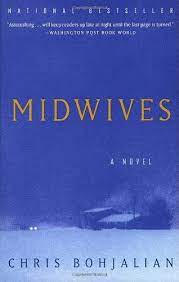
In an out of the way Vermont town, Sibyl’s routine home birth turns into tragedy when her patient, Charlotte has a stroke and dies. Sibyl’s quick thinking and experience allows her to save the child with an emergency C-section.
But there is doubt, and a few weeks later, the police come to arrest Sibyl under suspicion of accidental manslaughter. Did Charlotte die from the stroke or did Sibyl mistake the seizures and killed her with the C-section?
Soon the whole practice of midwifery is under attack as the trial focuses the place of midwifery and home births in the modern world of science and hospitals, as well as the overwhelming question that did Sibyl doubt her actions for just one moment last night?
I’ll admit I didn’t really like the choice made with having the story narrated by Sibyl’s daughter as it made the book feel less urgent since it was stalled by ‘s own romantic notions with the formerly bad boy, Tom, her concerns that her mother was having a flirtation with the lawyer, Stephen and worries about her own doubts. I understand that this was to provide some ambiguity over Sibyl’s actions and if she had doubts about Charlotte being alive before going through with the ceseran but still I felt it slowed down the book.
Yet the highlight was the trial itself and the building anticipation as shows how Stephen builds the case, demonstrating the various arguements for and against midwifery going from the medieval ages, reflecting how women’s work has been dismissed and ignored in the medical community even now. Despite the choice of narrator it was an engrossing book of medical malpractice and ethics that will hook you in from the first page of that snowy night.
Just a Hat by S. Kubiar
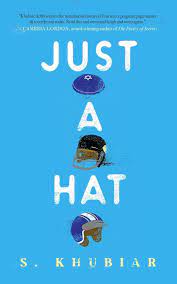
Youssef or Joseph is an All-American teenager. Somewhat. He is a Jewish-Iranian-American which has its special set of complexities at home and at his school. Not that many people know it. Due to his parents’ escape from Iran to America from the Secret Police, it has been pounded into him to avoid trouble. Sometimes he finds it cowardly how willing his Baba is to lower his head at the taunts and racist comments directed to him by the small-town Texans. How he accepts the snide comments by their Rabbi in the synagogue.
Joseph is willing to stand up for himself, but for now, he’s fine with fitting in with his Mexican friends like the Yberrera brothers. That is until he joins the football team. His parents don’t like him joining such a trivial thing as football when he has the Torah to study for his bat mitzvah. Nor do they approve when he sets his sights on the Christian reverand’s daughter (neither does her father). But all this comes to head when the Iranian Revolution brings ugly islamaphobia, antisemitism, and racism to their doorstep.
Although this is high school book, I feel like it fits more into middle grade as the protagonist, Youssef is thirteen. There’s some mild foreign cursing but I don’t see why it was bumped up to a higher demographic when high schoolers would be out off by the more simplistic, straightforward narration.
However, it has great content and messages as Joseph wreastles with hs identity, feeling complicated about his pride and shame, wanting to fit in, wanting not to get harmed for who he and his family is, but also wanting to stand up because he shouldn’t be ashamed. Basically words have powers , the ones we use in racist taunts, the ones we use to justify our bigotry, and the ones we use to articulate the compassion we should have for all because we’re all American and deserve respect.
The latter is especially as awesome as Kubiar provides plenty of triumphant moments for Joseph and his father/friends to stand up for themselves like his Baba showing his boxing skills after a decade of holding back. The speech, Joseph’s friend makes when becomes class president is equally meaningful as his connects his ancestor’s flight from Spain to the New world to the Joseph’s current situation, highlighting how their place of origin doesn’t make them un-American but their strength of character, and America is a place that is supposed to welcome everyone. Same with Joseph showing his Biblical knowledge by pointing out all the commandments the reverand has broken in his hatred for Joseph’s Iranianess and Jewishness.
The latter is especially important lesson as Joseph learns to grapple when there’s a time for anger and when there’s a time for controlled anger. Baba feared Joseph was to willing to use his anger to harm, and Joseph is slow to realize why the balance is important. The same goes for learning not to judge others so harshly for their actions and seeing things from their perspective. He starts to see other people have struggles just as he does like his crush, his bullies and even his parents as their secret past is revealed to him in drips, showing the trauma and complexities of the Jews position in Iran.
This was a worthwhile read about intersected identity, community and courage, must try it at least once.
Pride and Protest by Nikki Payne
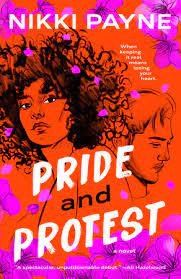
Pride and Prejudice is iconic, and it’s a truth that’s universal acknowledge that its appeal is universal.
Much like other adaptions, Payne’s retelling is accurate to the original text from Darcy (this case Dorsey) insulting Lizzy (Liza) by not wanting to dance including Mrs. Bennett’s “He’s a snob’ reaction, trudging over to Netherfield because Jane gets stuck with the Bingleys (or Janae getting snowbound with David) and all the important moments of the WIC/Dorsey/Liza love triangle.
Payne does not even skim side plots like Charlotte’s (Chico) engagement to Collins, Gerogia’s (Gigi) trouble with men and all that. I’m impressed by how she masterfully blends some of the original Austen lines and modernizes everyone. It’s a common trope but Payne’s updates perfectly translate the original intentions of Austen’s social commentary.
But how does she differentiate it besides the setting and language? Liza and Dorsey primarily clash as Dorsey is the CEO of the developers (PEMBY) gentrifying Liza’s neighborhood.
Despite their difference in class, Liza and Dorsey have a lot to bond over like their feelings of not fitting in with greater society while also having to work on their own biases about others. They also differ about how to change things for the better where Liza thinks Dorsey using his funds is engaging with the system and complicit with the oppression. While Dorsey thinks Liza’s viral rants and memes are performative. This relates to the book’s larger themes like how social media makes a false reality, amplifying previous biases and first impressions of each other.
I enjoy how Payne incorporates modern romance tropes like sleeping in the same nap pod, Janae getting depth that the original Jane Bennett doesn’t with her drinking as an unhealthy coping mechanism of grief. Which segues into Liza’s tamped down jealousy over Janae easily attracting men with her sweetness while men can’t seem to handle Liza’s bluntness and she worries that she’ll end up the side chick like her mother.
It’s such a good Austen retelling and I can’t wait for her next one next year-Sex, Lies and Sensibility.
The Last Black Unicorn by Tiffany Haddish

Celebrity memoirs are all the rage but Haddish has one of the toughest and wildest rides during a relatively short period of time and she does it with her signature frankness and humor that helped her survive such circumstances.
Between crappy foster situations, an absent father and regular bullying, Haddish would have every right to be “woe as me” but like I said, Haddish is honest. She never saw the situation as bad or wrong because it was her normal. She found ways to hustle through it, figuring out humor got her out of beatings and if people liked her humor, she could get her own stuff like cheating on homework. A skill that helped as she didn’t learn to read until 9th grade.
It also shows her vulnerability for beneath all that abuse, Haddish rarely felt deep anger against her parents and other adult figures. Rather she felt the same sadness any child would have for a parent, wishing that her mom would get better and love her again as she did before her brain injury.
Haddish’s memoir really feels like she wrote it. Yes, I know she had a ghost co-writer whom she explicitly thanks but her memoir keeps thing simple. No descriptions of settings, extra context or long philosphical musings of self-reflection. Haddish’s memoir is interspersed with dialogue texts like a script, some repetitiveness, copious amounts of swearing and very in the moment thinking/writing.
It felt like a conversation with a very inappropriate friend. Some bits are offensive and will rub people the wrong way, it shows how Haddish can be shallow and wholly ignorant, but I like that she kept it in and presented her flaws. I just wish there had been a bit more self-reflection as it reads in a very fast-paced style that is remiscent of her stand-ups. Maybe it would have been better in audio.
Kilala Princess vol. 2-3 by Rika Tanaka

I have to admit that while the first volume set up a fun premise where Kilala gets to live the Disney dream by meeting her favorite princesses and is swept up into helping a prince rescue his kingdom. The next two volumes continue in this vein where Kilala meets Ariel, Tinkerbell and Cinderella and Prince Rei finds out his trusted advisor is his Brutus.
But this series is clearly out of my age range as I was just annoyed by the insta-love between Rei and Kilala and their obtuseness in not realizing Kilala is the seventh princess.
Still, it’s a sweet series that pays tribute to the childlike optimism and spirit Disney is known for, magical world where dreams are encouraged, good people persevere with hard work and compassion and the villains get what they deserve. It’s an ideal world, one that we wish exist so I like the escapism. So I’m holding out as there’s only two more volumes and Belle and Jasmine get to appear.
Coraline by Neil Gaiman
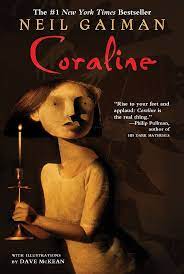
I vaugely remember the Coraline movie, and thus remember how absolutely creepy it was. The acctual novel felt like a let-down in comparison.
Now I haven’t watched the movie in a decade so maybe my memories exaggerate how scary it was but I was expecting more.
Now the premise is the same, Coraline explores her new house and a door in the drawing room leads to the Other world where her Other parents are ideal adults that pay attention and give her whatever she wants. There’s a theater and chocolate and talking cats but said talking cat warns her that the Other Mother will keep Coraline there forever. Coraline’s only chance of escape is if she outwits Other Mother at her own game, saving the souls of other children and rescue her real parents too.
Like I said maybe I was expecting too much but the prose felt too simple. Almost remiscent in Coraline being Gainman’s Alice, not understanding what the adults around her are talking about, exemplifying how otherworldy and confusing the adult world is. The description of the Other World was interesting in how it is a crude childish imitation of an ideal world by a creature that doesn’t really understand it. It’s a spider’s web.
All very creepy but fangless at the end. At least to me.
Did You Hear About Kitty Carr by Crystal Smith Paul
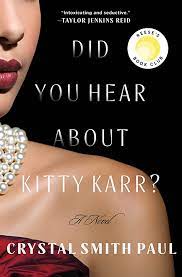
Taylor Jenkins Reid recommended this book and it’s no surprise as this has a few similarities to her own The Seven Husbands of Evelyn Hugo-featuring a frame story where a semi-famous protagonist in the modern era is suddenly connected to a famous old Hollywood socialite who was a minority passing herself as white to gain fame and fortune before dying a recluse. Then all her hidden secrets are revealed.
Kitty Karr was originally Mary. . . Mary Lakers to be precise after her wealthy white father raped her mother, and never acknowledged her as the child. But Mary was white-passing, occupying the confusing space where whites accepted her but she had to live with the knowledge that they’d sooner spit and kill her if they knew the truth. And the African-Americans who saw her as uppity, were jealous and cruel to her because she wasn’t black enough, not knowing the kind of prejudice they experience in Jim Crow South.
Still her mother wants a better life for Mary and sends her to California with another white-passing friend, cutting her off so she can rebuild her life as the white woman, Kitty Karr who soon becomes a secret script-writer and actress. Her secrets aren’t revealed till now.
Paul depicts a spectrum of the black female experience as Kitty’s journey through Hollywood leads her to a covert group of white-passing and non-passing women who use their influences, knowledge and connections to aid African-American causes. It’s a group that Kitty feels understood in yet has its own challenges as the white-passing women are willing to engage in cruel acts to keep up the charade, and they will abandon each other and cut off all connection if someone is caught. Kitty doesn’t want to shed her roots or feel ashamed of herself. She doesn’t want to bite her tongue and agree with bigoted racists. But that’s what they have to do for the means ot justify the ends.
I admire Paul’s exploration of these complex and differing attitudes within the community like Kitty who toes the line between the worlds and her “sister” Emma who abandons her old identity, actively wishes she was white but is ultimately isolated and depressed, unable to let go of the past she claims to hate.
The modern-day protagonist, Emma, is directly tied to Kitty though she doesn’t know it and faces similar dilemmas as others say she isn’t black enough to understand the black experience and her white friends are uncomfortable when she does support controversial topics like BLM and Colin Kapernick taking knee. But this is overshadowed by family and romantic drama which makes her less compelling compared to Kitty, and Kitty’s mother, Hazel whose POV briefly takes the first few chapters.
While there are similarities and interesting look into Old Hollywood, I can’t help but compare this to Jenkins Reid’s novel and see how it comes short. The Old Hollywood aspect is just a setting and Harris Paul doesn’t dive deeply into the studio politics nor does she explore Kitty’s metoric rise on television. Rather she stops just before Kitty stars on television with her sitcom co-stars whom she’d eventually bequeath her inheritance.
It feels we were robbed of seeing the rest of Kitty’s story in favor of Emma. The ending in general feels abrupt with a maybe happy ending vibe that feels unrealistic as Emma decides to use the inheritance to give reparations to other white-passing African-Americans who were shunned from inheritances from their white parents. It’s a noble goal and I get that some novels are part of wish fufillment. But this felt too vague and tacked on when the book had been so grounded in the start.
So it’s good but the comparisons will make it unnecessarily heighten your expectations.
The Original Sisters by Anita Kunz
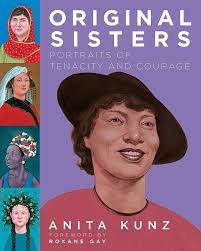
A long-awaited personal project by Kunz, the isolation of the pandemic allowed her to finally do a deep-dive into the forgotten women of history that have shaped our world. For a women’s contributions do shape the world in pivotal ways but are often unrecognized as Roxanne Gay points out in her forward. The reasons for why need to be examined and the responsibility of uncovering and execavating these stories are necessary to understand our world and women’s place in it despite the obstacles and incorrect assumptions of their time periods.
Many of the women featured in the book are well-known, or at least I’ve read them in other nonfiction collections so I wouldn’t say they’re forgotten. But it’s a good primer for anyone’s first nonfiction collection. I just felt disappointed by its one paragraph biography. Like I said, I’ve read about these women in other places and limiting their bios to one paragraph leaves out lots of interesting and fascinating parts of their stories. I guess it’s supposed to whet your appetite for more, and it did.
Maybe the real reason for the short bios is so readers are drawn to the art, and how. Kunz’s artwork is the real stand-out in this novel with each women having a unique palette, style and even autograph but for how Kunz makes them pop up from the page. The art is just gorgeous.
Now, here are some women I didn’t know before I read this book:
St. Abbe the Younger: You know the phrase, “To cut off your nose to spite yourself”? She may be the originator of it. During WW2, St. Abbe encouraged the nuns in her abbey to cut off their noses to repel the Vikings who’d want to defile them. It worked because they weren’t raped, the Vikings just burned them all alive instead. So thus possibly originates the phrase.
Storme DeLarverie: An American drag performer and civil rights activist, she performed all over and protected lesbians in Greenwich Village as their self-appointed guardian. Her performanes raised money for battered women and children, and was considered the Rosa Parks of the gay community.
Ni Gusti Ayu Raka Rasmi: Ni introduced Balinese dance to the western world and considered the finest dancer and instructor of all time.
Angela Ruiz Robles: This spanish teacher invented the precursor to the ebook so her students could have an easier time learning without the heavy weight of books. Although she patented her work, she never got the money to manufacture it.
Amalie Aguste Melitta Bentz: She invented the coffee filter, making millions of lives much more bearable in the morning.
Rose Marie McCoy: Though she didn’t sing much, she made her mark on mysic as a (co)songwriter for Nat King Cole, Elvis, Bette Midler, Eartha Kitt and the Turners.
Marty Goddard; A victim’s rights advocate, she invented the rape kit but when she took her idea to Louis R. Vitullo, he dismissed the idea. Only to turn around and make his own and get all the credit.
Beulah Louise Henry: In her time, she was dubbed the Lady Edison with her 49 patents including vacuum ice cream freezer, new type of hari curler and bobbin-free sewing machine.
Amrita Sher-Gil: She may have died only at 28 but she pioneered India’s modernist movement as the Indian Frida Khalo. Her work is so beloved, it isn’t even allowed to leave the country.
Adelaide Herrmann: The Queen of Magic astonished audiences with her bullet catches and phantom bride trick, paving the way as one of the best magicians ever irrespective of sex.
Daphne Sheldrick: Wildlife conservationists that saved over 200 elephants in Africa and Asia, spreading love and knowledge of the smartness/humanity of the gentle giants. Consider donating to her David Sheldrick Wildlife Trust foundation (named for her husband) that rehabilitates wildlife and fights poaching in the ivory and other trades.
Mabel Ping-Hu Lee: A Chinese suffregette, she was part of the New York suffrage parade heading up the Chinese-American contigent. A grad from Barnard, she’d be the first Chinese women to earn a PhD in economics from Columbia. Unfortunately, despite all her work for the cause, she was unable to vote because of the Chinese Exclusion Act.
Ruth Coker Burks: A caregiver and confidante during the AIDs crisis, she ministered patients and held them as they died. She became known as the Cemetary Angel for being the few who ministered without stigma.
Dorothy Cotton: An aid to MLK, she served as education director to the SCLC and worked with the Citizenship Education Program that helped African-Americans register to vote.
Autumn Peltier: An indigenous clean-water activist, she is the chief water commissioner of the Anishinabek Nation and attends international conferences to bring global attention to the issue of clean water for indigenous community. “We cannot drink oil.”
Lorena Borjas: A Mexican-American transgender women and community activist, Lorena fiercy fought against human-trafficking, offered legal and immigration help, and set up syringe exchanges for trans people undergoing hormone therapy.
Books I read this month
(The Last Unicorn by Peter Beagle, The Princess Bride by William Goldman, Jessica Darling series by Megan McCafferty, Azula in the Spirit Temple by Faith Erin Hicks, The Art of Archie: The Covers, & The Art of Betty and Veronica by Craig Yoe, and Victor Gorlick, The Original Sisters by Anita Kunz, Spy x Family vol 1-3 by , Grimmtastic Girls by Joan Holub and Suzanne Williams, Sapphire Blue and Emerald Green by Kerstin Gier, The Hero’s Guide trilogy by Christopher Healey, Dork Diaries: Tales of a by Rachel Renee Russell, Stranger than Fanfiction, An Author’s Odyssy and Beyond the Kingdoms by Chris Colfer, Fullmetal Alchemist Vol. 1-8, 11-18 by Hiromu Arakawa, Hotel of Secrets by Diane Biller, The English Roses #1-13 by Madonna, Howl’s Moving Castle by Diana Wynne Jones, The Bloody Chamber by Angela Carter, Miss Popularity trilogy by Francesco, Smith High School series by Marni Bates, Caroline by Neil Gainman, Did You Hear About Kitty Carr by Crystal Smith Paul, Accidentally quartet by Lisa Papademetriou, After Alice, Confessions of an Ugly Stepsister, Mirror Mirror, and Hiddensea: The Once and Future Nutcracker by Gregory Maguire, Chain of Thorns by Cassandra Clare)
 Rachel Reads & Reviews
Leave a comment