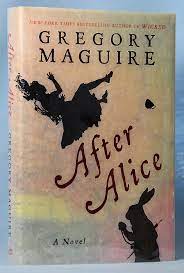
Maguire is best known for his work retelling the stories of Oz’ famous characters (and inspiring the subsequent Broadway play) but as the library didn’t have Wicked, I decided to take a look at Maguire’s other fairytale works.
After Alice is just as implied where a minor character from the original novel, Ada, falls down the rabbit hole a few minutes after Alice. In her search for her best friend, Ada meets all the famous characters who confusingly lead her to the infamous tea party and croquet, just a few minutes later from the original tale.
This is interspersed with the events of the real world above the rabbit hole and outside the looking glass as Ada and Alice’s family members “search” for the missing children but are too caught up with their own adult liasons and nonsense to be effective.
Maguire’s prose is a perfect homage to Carroll’s with its irreverant musings about architecture dipped between riddles about writing desks and early Victorian etiquette lectures. It also has the era’s pompousness in being taken with their own fancy words. All creating a confusing medley of events and conversation that befuddled me as a reader much as Alice, Ada, and children in general are befuddled by the adult world. In Wonderland and in Oxford.
As such it is not exactly the easiest text to go through because it makes a point to be nonsensical. I did question some narrative choices. Ada’s adventure is a bit lackluster as it’s a repeat of Alice’s although she strikes me a bit more interesting as Ada is a stigmatized, solitary child due to her limp and curved spine. Most adults around her pity her prospects and it is such disability that has robbed her childlike sense of imagination. Wonderland gives it to her for a brief time and she is freed from the limits of being disabled because no one in Wonderland cares.
However, the real world has another POV from Lydia, Alice’s older sister who thinks herself so grown up as she tries to pursue a beau. In this case it is the visiting American, Mr. Winter who is Darwin’s accompainment to her Pater’s house. However, Lydia is still immature as she selfishly follows her own desires to pursue Mr. Winter and neglect her responsibility to watch over Alice, and gets into petty jealousy when Ada’s governness flirts with Mr. Winter too.
Still it is interesting to see the conflicting adolesence of Lydia who is also dealing with the grief over her mother’s death and having no one to guide her to womanhood especially the rigid Victorian mores of it. So it fits the Carroll’s themes of childhood, the gap of understanding between kids and adults and the ridiculousness of the latter. It just seems Maguire was more taken with Lydia’s POV as she takes up most of the second half of the story that you forget Ada is the supposed protagonist.
Then there’s a third child. Mr. Winter’s adopted child, Siam, who was a runaway slave and fugitive in the Americas. Considering the era he lives in, he doesn’t have much of a childhood even after his adoption as he is haunted by the death of his family and the constant suspicion pointed out him by others because of his race. While it is an interesting concept, it feels shoe-horned in much like Darwin’s inclusion and simultaneously uncomfortable. Maguire is so consistant with his Victorian-era homage, that the portrayal and treatment of Siam as an ignorant heathen to be pitied, condescended to and mocked by others is just ugh. His inclusion felt unnecessary and took up time that could have been given to Ada.
Although it was sweet that Ada was the first to ever treat him as a kid like her without regard for race or difference.
This book is just odd combining Carroll’s surrealism with tracts on evolution and slavery that clash with each other so much that both topics weren’t explored with much depth or new twist.
2 stars.
 Rachel Reads & Reviews
Leave a comment