The Moonlit Vine by Elizabeth Santiago
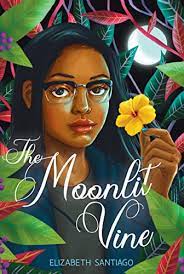
Santiago’s debut novel begins with the conquest of the Caribbean as Anacoana’s daughter watches the conquistadors burn down her kingdom. She and her own daughter are in hiding and she gifts her with a zemi that will protect her and connect her to her ancestors.
In the present day, Tania’s life sucks. Her teacher demonizes her for standing up for a fellow student, her mother kicked her brother out of the house after he gets suspended and family feud only fuel the lack of communication in the family. That’s one of the internal obstacles the family faces as Tania’s parents grow more estranged as well as her mother, Esmeralda, fights with her brother, Benny and his wife, Milagro’s snide insults. The only person Tania can find comfort in is her abuela, Isaura and even then she has to tread lightly because Esmeralda is jealous of how close they are.
But the family must learn to come together to face external threats of an unjust education and legal system that doesn’t value or understand POC and splinters their community.
Santiago’s book delves into several intersecting issues such as the sunk cost fallacy stereotypes Tania’s brother, Alex falls into. Alex was trying to stop a gang fight but gets expelled. Her little brother acts out in class, talking loudly and not listening to the teacher-it doesn’t warrent the response of police arresting him. That’s just traumatizing to a freaking 7 year old. Anyone really, but a grieving seven year old? It highlights how the system won’t let POC get emotional or angry or feel grief, they see such displays of human feeling as a threat due to their own negative perceptions.
It’s exhausting to have to be amiable all the time and Tania is not willing to fall into that which often gets her in trouble with authority figures. It also opens the chasm between her and her mother who chooses assimilation to survive but still deals with the weight of microaggressions, real aggression, and racism.
All together it shows how historical trauma still impacts the present. Know what else is present, the indigenous Taino are still alive and resilient. Here, the fictionalized lineage of Anacoana and the passing down of the zemi, illustrate the importance of their ancestors and WOC sisterhood in an act of magical realism and empowerment. It’s powerful and moving and just plain awesome, but the climatic scene is grounded by the sincerity Santiago infuses her messaging about the support of community and the power of young people speaking up to change things in the system. Something she writes in her author’s note that she hopes readers will take away is to not be afraid to use their voice.
Si Se Puede: The Latino Heroes Who Changed the United States by Julio Anta, illustrated by Yasmin Flores Montanez
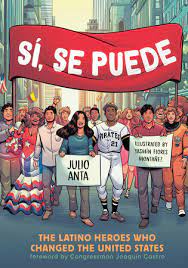
Anta’s nonfiction graphic novel takes readers and the protagonists through an interactive museum highlighting Latinx’ history in the United States and their impact in science, battle, and entertainment. With a vibrant palette and easily digestable language, Anta not only informs readers of little known individuals like Lt. Manuel Chavez who prevented the Confederates from taking over the Southwest and Mario Molina who proved that humans were contributing to global warming, but also highlights the greats like Cesar Chavez and Dolares Huerta, Rita Moreno and Roberto Clemente. It’s a nice mix of added history of individuals that are known and totally new information.
But he also highlights how their presence has always been part of U.S. history, influencing events in the Civil War, in NASA and their immigration across borders is not a new thing but have arisened because of U.S. intervention in Latin America governments. He also introduces some complex subjects like colorism, the term “Latinx,” conquistador’s invasion and repeatedly reminds the audience that Latinos are not a monolith in how they view these issues and history.
A great book fo Latino History month or any month in the classroom.
Once Upon a Quinceñera by Monica Gomez-Hira Harperteen
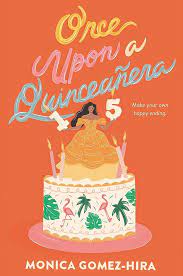
Carmen is heading to Miami to work as a princess for DREAMS party planners, making the dreams of little girls come true, and also earning credit for her graduation.
The less exciting component is having to work for her cousin’s quincenera under her domineering, passive-aggressive Tia Celia. The same duo who kiboshed her own quinceñera after her cousin, Arianna got drunk at a party that was totally not her fault 4 years ago. She also has to work her ex-boyfriend, Mauro who caused the drunk cousin-cancelled quincenera incident and dumped her that night.
It sounds like the worst telenovela nightmare ever, but it’s a YA novel so Carmen does get a happy ending sort of.
Yes, her getting back with Mauro is a given even though there is some tense love square shenanigans between her, Arianna, Mauro and Alex that doesn’t make anyone look good before Carmen snaps back into maturity. While, I felt Mauro should sweat it out a little more after he so blantantly used her in the past and insulted her (the guy said she was a booty call that he could never take seriously since she’ll end up pregnant or on the pole. Disgusting. It’s her biggest insecurity too so mega-disgusting), I slowly got into their reunion. Slowly.
Same with Carmen becoming friends with Arianna again. Well, actually I could get behind the cousins becoming friends again and learning to support each other through their jealousy. Same with Carmen learning to control her envy and bitterness and not let it consume her or distract her from her goals.
What I could not get over was her Tia’s constant bad-mouthing, saying Carmen was just like her mother-a irresponsible slut, always seeing the worst of her, and just petty passive-aggressiveness. Tia Celia’s supposed to be an adult and wow, she’s one to talk considering her husband was original Carmen’s mom’s boyfriend. Yes, such drama. At least Gomez didn’t give Tia Celia a redemption like she did with Mauro and Arianna, she was an example of how sometimes you must learn to deal with toxic family members. At least, it gave some good mother-daughter real talk scenes.
This book brings on big feelings and really shows the chaos and stress that comes from quinceñeras. I mean it has all the biggness of American Sweet 16s with the passion and tempers of codependently close Latino family that will get into your business all the damn time.
Dating Makes Perfect by Pintip Dunn
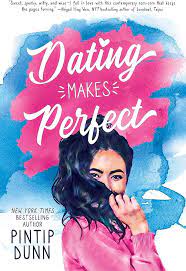
The Tech sisters don’t date, but when Winnie’s older sisters refuse to get married until they had twenty years of dating practice-her mother decides Winnie must start right away. Only by date, these are fake dates under specific conditions so she can be prepared for real life. She gets the experience but none of the heartbreak according to their logic. The dates are also ripoffs of famous rom-coms, and it’s with her ex bff and current nemesis, Mat. So much for no emotional stakes.
Inevitably, the fake dating turns real but first there’s some romantic entanglements as Winnie intially tries fake dating Mat while real life flirting with her crush, Taren. But that soon amicably fizzles as the UST mounts between her and Mat.
Seriously, the UST was fire. Mat’s feelings were intense and yes, he manages to make threatening hot. Like nonviolent threatening but more like arrogant, smug bastard hot. Between their past history (he had a crush on her but did not handle it well) and his hotness, I was itching for them to kiss already so when they did it was so good. I was very invested as you can tell.
But now that they’re real life dating, there’s a new forbidden aspect as they have to keep up the act to circumvent Winnie’s parents rules on no touching/feelings etc. They’re soon found out and Winnie must make a choice and stand up for herself.
Which comes to the internal conflict and development that can make or break the book. Dunn does a good job illustrating how Winnie changed from when she was young, becoming a studious rule follower. It develoed from her secret insecurities that she’s always in her sisters’ shadows, but the one thing she can do better is by being obedient. All under the mistaken impression that it makes her parents love her when in reality their love is unconditional. This led to some great sister and parental scenes.
Which brings me to Winnie’s mom whose actions may seem extra, they come from a good place. She’s not a stereotypical, controlling tiger mom. She just doesn’t want them to hurt or make her mistakes. Which ends up hurting the daughters. Basically, she gets her own arc in learning to let them find their happiness on their own even if it means some suffering. That’s what life is.
Though her plan while crazy was very fun to read. the rom com dates Winnie’s mom suggested was supposed to illustrate that romances like that aren’t real. They were my favorite parts. It included karoke like Best Friends Wedding, lobster date, Shopping like Pretty Women etc. It really added to the lighthearted atmosphere. Readers will also enjoy how the Thai rep and culture is interwoven in the story especially with Winnie, Taren and Mat as they bond over cultural commonalities, other students just don’t get.
Kween by Vinchet Chum
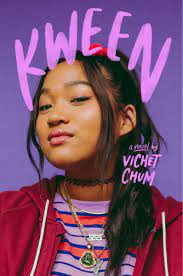
Soma and her sister have been having a difficult time with their father’s deportation. While Soma’s sister, Dehvy is freaking out about planning her wedding without their mother, Soma has been having difficulties in school, stewing with the injustice and imposter syndrome she feels in regards to her heritage. This is only amplified when her spoken word poetry video goes viral and even better, she gets accepted into the local spoken word competition!
Spoken word is a powerful medium for Soma to reflect her name (Soma is the name of a famous Cambodian snake queen who founded the country) and her ancestry, processing her feelings about Ba’s deportation, the immigration system and ancestral stories in general. But she has fears in letting all these issues out in public, fearing misunderstanding and miscommunication and just plain stage fright.
I’ll admit, the novel gave some serious Lilo and Stitch vibes with Soma being the slightly eccentric younger sister whose loud opinions ruffle everyone’s feathers while Dehvy struggles with her wedding and being a guardian. Obviously, I enjoyed it very much because of this.
But Soma’s struggles are very real as she tries to figure out herself. She doesn’t feel Asian enough compared to other contestants and students. She has no connection to the truamas her parents name when speaking of Cambodia’s dictatorship. If she speaks about their history, is she commodifying her parents’ story? Or worse, like she’s trying to use Ba’s story for sympathy. No matter what she does, she feels like she’ll be judged as not enough and that her intentions will be misinterpreted. Yet it’s a risk she has to take because her words have power that can invite others to share and spread connection.
This also has major impact on her interactions with her frenemy, Evie whom her best friend, Sophat (best hype man ever!), keeps trying to push them together to friendship with their commonalities. The issue is that Evie is unashamedly commodifiying their heritage that they haven’t really experienced and co-opting it as her own. But part of that is just Soma’s own projection and she soon learns that they can coexist and there’s room for both of their Cambodian-American experience.
Her teacher, Mr. Drakos is someone else whom she butts heads against most of the time but he turns out to be less of a misguided boomer and someone who has wise words of wisdom in regards to her complicated feelings of her culture and how to embrace and heal from the generational trauma.
Oh, and yes, there’s a cute first romance but it kinda fell to the wayside with everything else that is happening in the story and less interesting compared to the family and internal arcs.
A powerful debut that hits in you in the gut and the heart and shows how elaborately awesome Cambodian wedding traditions can be.
Where the Crawdads Sing by Delia Owens
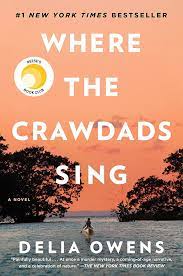
I know I’m a bit late to the game here since interest in this book was revived by the movie and the controversy a few years ago. But my friend said it was really good so I dived in.
First off, Owens has such a soothing lyrical prose, precisely detailing the marshlands and the small southern community Kyra where lives at the fringes. It helps that she was a zoologist and lends her eye to Kyra’s botanical and animal observations as she sees the ruthless parallels between animal existance with human carelessness and pain as every person Kyra loves hurts her and abandons her.
It’s at one part, one part mystery investigation and overall, coming of age story for Kyra as she loses her trust in humans, learns about love and sexuality, struggles with abandonment, shame and harrasment in the murder trial and then finding love again. She’s a moving protagonist and Owens keeps you so firmly on your side that even I was second guessing whether she could be capable of murder.
However, it has its slow parts, and since it’s so focused on the coming of age, the murder feels a bit hushed even as it flashes back and forth between past and present. It just doesn’t feel as sensational and impactful on the community as Owens implies it is in the narration. Still it was nice to see that Kyra does have some friends and family supporting her in the wings.
Going Bicoastal by Dahlia Adler
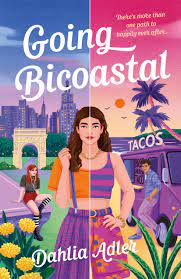
Natayla “Tally” Fox has a choice to make this summer. Spending time in NY with her beloved Dad, shaking things up and finally getting the nerve to ask out the Redhead she’s seen around the city? Or going to LA to do a summer internship under her estranged mom and end up hitting it off with her fellow intern who isn’t so anal after all?
Adler’s concurrent narrative devotes every other chapter to LA and NYC, depicting a summer of twists and turns that bring Tally exactly where she needs to be-finding what she wants to do with her life in college, finding common ground with her mother, and a cute significant other to make out with.
I enjoy the Jewish rep in the book as Adler goes out of her way to emphasize the cultural importance it holds for Tally to celebrate Shabbos and keep kosher, even as it sometimes leads to what Tally assumes might be awkward situations when it comes to turning down pork.
Adler packs in a lot of other LGTBQ rep too, showcasing the diversity present in today’s generation with smooth nonchalantness because everyone should be accepted. She also does it with sensitivity as Tally demolishes some myths regarding queerness and Judaism, and what it means to her to be both.
Since Adler is balancing two narratives in one, the significant others feel a bit superficial, hinting at a deeper backstory that never gets explored. I almost wished they had their own POVs so I’d get to know them better, they were interesting. Same goes for the surface-level look at Tally’s choice to go into design as well as her finding a new relationship with her mom whose been absent for the five years of the divorce. Oddly, enough I felt like Tally bonded more with her mom when they were thousands of miles apart in the NYC thread than when they lived together in the LA one.
Still it’s a fun summer rom-com in a choose your own adventure style. Worth the look.
Superman: The Harvests of Youth by Sina Grace
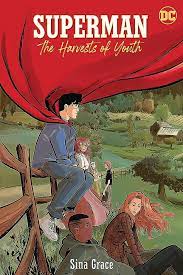
The latest novel from DC Ink has Clark Kent facing a fight maybe he just can’t win. Set during his adolescent high school years, Clark is already using his powers to help others but one of his classmates commits suicide, it sets off a wave of hatred and online antagonism.
Featuring several original characters alongside established ones like Lana Lang and Lex Luthor, Clark’s sweet farmboyish personality is in full view here. Grace does a great job in highlighting Clark’s optimism and belief in the good of people. Yet this fight with mental health is stumping him and brings up his own extentisial questions about his own mortality (what could kill him? Can he even die? Will he be forced to watch everyone else he loves die from murder or old age?) and his abilities. What’s the use of being the strongest man in the world if he can’t help his friends when they’re struggling the most.
Of course, that’s not always what his friends want. As Clark fumbles the ball several times when his girlfriend, Amy (the sister of the classmate) points out that she doesn’t want him to look at her with pity like she’s a broken girl who needs to be fixed. Sometimes she needs to grieve alone, not have him make her happy.
He also gets blasted by his other friend, Gil who’s going down the incel path after breaking his ankle and ruining a chance for a skateboarding career. Bitter, he becomes consumed with the idea that his friends are leaving him, and that everything is everyone else’s faults. He’s the victim etc.
There’s no easy answers, but Grace does a decent job in juggling the many characters and many threads. Yes, things get wrapped up but it’s not neat and emphasizes the importance of community healing. Clark’s formative years are such a goldmine to explore with Clark figuring out his powers and his role in the world, how to protect the ones he loves without falling under the weight of caring for everyone at the expense of his own mental health.
Rez Ball by Byron Graves
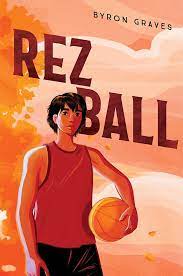
Tre has big shoes to fill when he joins his rez’ basketball team. It’s been a few months since his older brother, Jax, died in a car accident and the grief is still present. Moreso, as Tre takes Jax’s place on the basketball team with the expectation that he’ll excell as his brother did and bring them to the championships. In fact, his brothers’ friends say that they’re glad he’s there because it will be like Jax is back with them. Not much mention of Tre’s own worth.
That’s partly why he’s attracted to the new girl, Khiana, who doesn’t have all these images and baggages attached to him and his brother. He can just be. But as basketball season heats up, his friendship with Khiana takes a nosedive and his star rises. Soon, he gets pulled into JV where older players are threatened by his prodigy status, the parties get more tempting and everyone is putting the rez’s reputation on Tre’s shoulders.
Graves’ debut is an excellent look into the process of grief in the family and the joy/difficulties of sports in uniting a community. Largely based on Graves’ own experiences playing basketball at Red Lake where people really believed that the perception of the Obijiwe would be bolstered by basketball successes-they could be seen as proud warriors again.
Kilala Princess Vol. 1 by Rika Tanaka, illustrated by Nao Kodaka
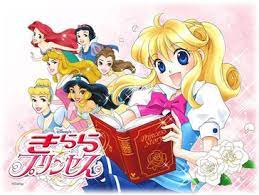
This Disney-manga will surely be enjoyed by those who are fans of Sophie the First, and the younger set. Kilalal is an average young girl who dreams of being a princess like her favorite Disney heroines. While all signs point to her best friend being the princess of the school, it’s Kilala that ends up kissing a sleeping prince and having to rescue her best friend from being kidnapped. On the way she gets to meet her heroines like Snow White and face off against the Evil Queen. It’s pretty much wish fufillment but that’s what makes it fun, and the illustrator, Kodaka, does a lovely job blending the manga style with the more simplified Disney cartoon.
Beauty and the Beast: Lost in a Book by Jennifer Donnelly
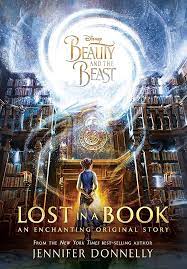
I was really excited to read this as I enjoyed Donnelly’s mermaid quartet when I was in middle school. Also Belle is my favorite heroine. But it didn’t live up to my expectations.
Don’t get me wrong, the premise is interesting. Set during the time frame when Belle is trapped in the castle and just getting to know the Beast, she is still spending most of her time in the palace library. There she surprisingly gets sucked into one of the stories. It’s a land called Nevermore with lords, princesses, intellectuals and playwrights who get Belle and her literary love. She finds her people that she’d never found when she was stuck in the provinicial town. It’s in Nevermore where all her dreams come true of having adventure, being a respected member of the community and seeing her father again. But the paradise is really an elaborate chess game concocted by Love and Death to settle their own scores. Predictably, it’s with the help of the Beast and her own epiphany about real life over fantasy that saves the day.
The reason I was disappointed despite the plot is because I literally read this last month with Hale’s Kind of a Big Deal. The two were written years apart but Hale was more inventive in how she approached the premise, using it as a chance to commentate on literary tropes and the temptation of fantasy; exploring why her protagonist was lured by the fantasy and what she could change so she could be content with reality. Belle’s story was limited in characterization since it was trying to fit into the movie, there couldn’t be too much character growth from either Belle or Beast because that would occur after they fell in love.
Also the choice to have Love and Death pull the strings and narrate the plot vaguely reminded me of The Book Thief, where once again Zusak utilized the character of Death in a more compelling way compared to Donnelly’s Love conquers all message here. I mean, that’s a very on Disney brand, but lackluster. So yep, pretty disappointed at it takes elements from other books without a new spin.
Kiss the Girl by Zoraida Cordova
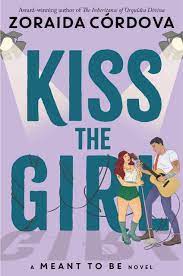
I love Cordova’s romance novels (under the name Zoey Castile) so I was excited to see how she’d tackle the little mermaid’s. Here, Ariel is the star singer of her family band, The Seven Sirens run by their controlling dad-ager, Teo. After the group retires (really a publicity stunt for a bigger comback), Ariel decides to take the chance to explore the outside world. Armed with a wig and an alias, Melody, she soon catches the eye of Eric Reyes, lead singer of the upcoming band, Star-Crossed.
You just know, Ariel’s deception will bite her later as it is already generating lots of speculation in the tabloids of why Ariel is missing in the latest interviews and her father’s ready to blow a gasket. But it gives her an opportunity to get to know Eric better withut her fame interfering, and she gets to experience normal things like doing her own laundry, eating hot dogs on Coney Island, song-writing with a like-minded individual no matter how much she denies the attraction. Eric, here, is characterized as an utter romantic but even though he falls for Melody at first sight, he is cool enough to let her call the shots and delighted to show her his favorite sights on tour.
They’re just so adorable together which makes it hurt when the truth is revealed as it’s clear they get each other more than others as they bond over the pasts of their parents’ immigration stories and feeling the need to prove themselves with the music as an outlet that has slowly become commodified for Ariel. Eric reignites her love for it again.
But that’s not all the drama as Teo seeks to break them apart with carefully said truth-inspired lies. Teo gets the big bad treatment for his controlling ways over his daughters’ lives and finances and for screwing over Odalia Garcia (the story’s Ursula), his former songwriting partner. I like the twist Cordueva delivered in switching the good/bad roles of Teo and Odalia so she can comment on the music industry’s misogyny, and having Odalia being an aloof yet level-headed manager to Eric and Ariel.
Other characters get a spotlight too like Scuttle as the tv host of latest music updates, Vanessa being Odalia’s sister and Eric’s closest confidante even though she initially appears witchy because she doesn’t trust ‘Melody” to not break Eric’s heart, and Max as the band’s lovably, goofy drummer with a big appetite. You can tell Cordova had a blast incoporating references to the movie from all the sea-related descriptors to Ariel calling herself a little guppy, the mermaid/siren mythology and more. It’s a fun book and I can’t wait for more from the Meant to Be series.
Books I read this month
Book of a Thousand Days by Shannon Hale, The Heir, The Crown and Happily Ever After by Kiera Cass, The Rose Years series by Roger Lea McBride, The Time Travelling Fashionista trilogy by Bianca, Concrete Rose by Angie Thomas, Goldilocks: Wanted Dead or Alive and The Enchantress Returns by Chris Colfer, Never After trilogy by Melissa de la Cruz, Don’t Ask Me Where I’m From by Jennifer De Leon, Si Se Pueda by Julio Antes, Half upon a time trilogy and Once Upon Another Time trilogy by James Riley, Prince of Nightmares and Thorns by Linsey Miller, Realm of Wonders by Alexandra Monir, Thunder Girls #1-4 by Joan Holub and Suzanne Williams, Where the Crawdads Sing by Delia Owens, The Seven Husbands of Evelyn Hugo by Taylor Jenkins, Going Bicoastal by Delia Adhler, Ruby Red by Kirsten Gier, Broken Throne by Victoria Aveyard, Family Tree quartet by Ann M. Martin, Royal Academy Rebels by Jen Calonita, The Belles trilogy by Dhionelle Clayton, Twisted Tales anathology edited by Elizabeth Lim, Monster High: Hopes and Screams, and I Only Have Eye for You by Heather
 Rachel Reads & Reviews
Leave a comment