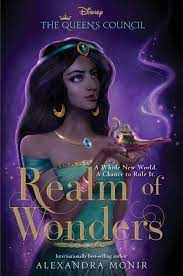
It was supposed to be the month of Jasmine’s wedding, but this book starts with a funeral.
The sultan is dead and Jasmine has less than a week to wrap her mind around the fact that her beloved father is gone, and she is to be Agrabah’s first sultana ruling solo.
But not everyone is excited about this historical event, digging in their heels that Agrabah would be better ruled by a male, any legitmacy or knowledge Jasmine has be damned.
So it’s up to Jasmine to prove herself against the ursurper on the throne while battling a supernatural danger and ministers that threaten to tear her and Aladdin apart.
Monir clearly has a lot of love and respect for Jasmine as she takes the qualities that fans admire from the movies, her care for her people, her interest in travelling, her compassion, and willingness to take a stand-they all serve her well as she enters this new position.
Thing is, she’s always known she was to be sultana but it had always seemed a far away concept. One that she would have time to adjust to. Unfortunately, her gender, her age and her previous desire to live outside the palace walls count against her as she notices her minsters’ hesitance and disrespect even as they prepare for her coronation.
Then her second cousin, Karim, comes for the funeral and soon reveals his true nature and his true origin. He is Jasmine’s younger brother, a bastard from a grief-fueled dalliance and he has come for the throne, highlighting his battle experience and maleness as points in his favor. Worse, several of Jasmine’s ministers and her commander have thrown their support for Karim. Loyalty to her father apparently doesn’t translate to loyalty to her.
With the choice split down the middle, the compromise is that they compeate for the crown in trials that will test their ability to rule. Trials that are rigged in Karim’s favor, Jasmine notes as she hears each task. From justice where she must choose which thief deserves to lose his hand, to choosing a “suitable” cosort to mock battles when she has never trained to wield a sword.
Luckily, Jasmine has several allies on her side beside Aladdin like her faithful maid, Nadia, several of Aladdin’s old street friends, and Princess Shirin.
Jasmine comes to recognize how hard it is to rule as a female in a man’s world, how she’s constantly held to a different standard and expected to bend to the male’s way of ruling. By that I mean, the expectation that she hold the same qualities as other sultans (and Karim) have to rule. With ruthlessness, with battle, with focus on the gentry and beneficial contacts. That if she doesn’t do so, she’s too soft, and too emotional. Too female and young.
That’s not what Agrabah needs. As Jasmine had learned from Aladdin and continues to see as she walks the streets in disguise and witnesses her fellow nobles’ dismissive attitudes, justice means nothing if you don’t meet the poor with compassion, understanding for why they’re stealing and trying to solve the problem.
Strength and battle-fever don’t mean anything if you’re not trying to strengthen the kingdom, not your ego.
That’s why Jasmine stays even as others point out it would be easier if she ran away, it would be accepted if Karim ruled and she travelled the world with Aladdin as she planned. Yes, she may have dreamed of escaping the palace walls once but Jasmine sees her responsibilities and that she’s meant to lead her people. She cares for Agrabah, Karim does not.
So it’s time to change the story. A reoccuring theme Monir highlights as Jasmine utilizes the power of stories to sway and win the public’s favor and some of her challenges. For stories not only unite cultures and universal ideas, but they help people envision the impossible. And yes, the famous Arabian canon One Thousand and One Nights may have a vital piece to play in here.
But what is Aladdin, Agrabah and One Thousand and One Nights without some magic? The genie may not be in the book with his boisterous blue presence, but his personality still makes himself known. Plus there’s ghuls, ifrits and afsungars! Monir creates a eerie, powerful supernatural feel as Jasmine sees her father briefly come back to life, warning her to trust no one and find the book.
What book, who knows? Still a dangerous shadow and hallucinations haunt her as she struggles to solve the mystery of her father’s sudden death, and the riddle he left her before Karim finds the book first.
It’s spell-binding and wonderful as Monir weaves this culturally and imagery rich tale that immerses the readers in the gleaming palace to the hidden street corners and forgotten underground vaults.
Jasmine shines in this novel but other characters get their spotlight. Aladdin is still his charming, bashful self. He’s more comfortable as a street rat than a noble in training which is why the ministers want them to break it off. Yet Jasmine loves him for these qualities too, how he grounds her and she can be her true self around him. He is her bridge to the common people of Agrabah, and he has plans to help them which she desperately wants to bring into fruition. They want to create a new, better world together. (Yeah, I wanted to make a whole new world pun but I stopped myself.)
Yet Monir is realistic in depicting the difficulties of an interclass relationship with how much pressure Jasmine is under, cutting at Aladdin’s insecurities as well. It’s hard to see them falter, but it’s equally wonderful when they come to each other’s aid because they love each other. You know they love each other every time they kiss. If this wasn’t a Disney book, you know Monir would be going there considering how much Jasmine and Aladdin seem interested in their wedding and never having to have walls between them again. It’s silly but it’s nice that Monir is willing to let them be so affectionate with each other.
Monir is also realistic in that Jasmine has her female allies but they are similar positions to her and don’t automatically become allies because of it. She has one female minister, Parasia, but she doesn’t stand up for Jasmine like she expects. Rather she is bitter that there is traditional expectations of maleness that Jasmine doesn’t meet, but Parasia doesn’t do anything to support Jasmine or help her. She’s okay with not changing the status quo and resenting it.
Princess Shirin is in a similar position to Jasmine. She’s the first born daughter but her younger brother is slated to rule because he’s a boy. While she believes in Jasmine’s capabilities and offers to spy on Karim, she is also taken in by Karim when he offers her power as his potential bride. She’s unwilling to see that being Karim’s intended won’t give her more agency or power. She’d just be propping him up like a suitable trophy wife just as she’s supposed to stay invisible and supportive of her brother/father.
But Jasmine still has support of other female rulers and a few powerful female figures to draw upon as she learns from the Queen’s Council and finds the creativity and courage within herself to seize her moment and do the impossible.
This was an excellent book, and I smiled as I read it the whole time. Fans will enjoy the returning Aladdin characters like Prince Achmed, Abu and the aforementioned Genie presence alongside dimensional original characters expanding Jasmine and Aladdin’s circles of friends. The concurrant magic and political intrigue plots build in its intensity, and reveal new layers to Jasmine (and a bit to Aladdin) that allow her a moment to shine while commenting on the historical traditions that have limited women’s role in this era (and can apply to any era). Yet it has an inspiring touch throughout with its emphasis on staying true to yourself and that one should rule in a way that benefits the people even if it breaks with tradition.
5 stars.
 Rachel Reads & Reviews
Leave a comment