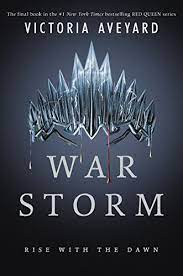
The Red Queen saga comes to its epic conclusion with a very apt title. Mare and company are fighting three simultaneous wars-on the homefront against the Maven/Lakelander alliance, and within their new Silver-Scarlet Guard-Montfort alliance who obviously disagree on the endgame when Maven is off the throne. The Silvers want Cal’s rightful return but Montfort and the Guard are not going to tolerate another king would be tyrant.
And Mare is going to have break her heart apart facing the two men who she thought she loved and whom she betrayed and they betrayed her in turn.
I know it sounds like it’s about love, but really that takes a backseat to all the political manuvering the characters are carrying on behind the scenes. Mare continues to stand with her cause and after all she endured under the heel of Silver kings, no one can blame her from deciding to not support another one. Her heart is a different story as she loves Cal but cannot reconcile with his choice to continue his destiny on the throne when all signs point to a changing future-a democracy of Silver and Red.
Mare’s development is at its peak here. Yes, guilt and terror still haunt her but readers can see a much more clear-headed and confident Mare. She’s aware that closing herself off to emotion will turn her to the path of the monster she fears she could be, to being like Maven. Only by living feeling it, she can get through her terror.
It also makes her more useful in the field even though every death count weighs on her, she’s in it for the bigger cause that the Reds may have better lives after the war is won.
Just as in the previous novel, there are more POVs, including Evangeline, Iris, Cal and Maven.
Evangeline provides insight to the machinations of the Rift Kingdom headed by her father as well as her growing discontent with her role as Cal’s betrothed. Their kingdomm represents the traditional view of Silvers as gods and all that jazz but Evangeline can’t play along anymore.
While it had been interesting to see Evangeline’s POV in the previous novel, this felt like her voice was dragged on too long and came across as repetitive with her three modes being: worred about Elane, struggling and doubting societal expectations and fear of breaking away from her responsibility in the ultimate family betrayal.
Also, I just felt less invested because I don’t really know Elane. While Evangeline and to some extent, Ptolemus had been humanized, Elane is just there. A shadow just like her power and I don’t feel the chemistry or understand the encompassing love Evangeline feels for her because she’s off the page so much. She’s a sexy lampshade and she has no real personality to latch on to.
Iris, the Cyget nymph princess has the fortune to be a new player after her mysterious introduction in the previous book. She is immediately set apart from the others with her spiritual Lakelander ways and Aveyard excels in creating a distinct kingdom and family ties so different from the Norta politics.
Iris and the Lakelanders have no ties to Norta beyond the crumbling marriage with Maven and it’s exciting to see the double-crosses and counter-offensives they plan so they can wreck vengence after the death of her father and to take advantage of the divided Norta so they can rule over both lands and possibly hit Montfort next.
So her POV felt necessary and relevant to the greater world unlike Maven and Cal’s.
Each had three chapters to themselves near the end which came as quite a surprise but superfluous. Maven’s in particular was a disappointment as it gave no insight to his mind that readers couldn’t have gotten from Mare’s observations of him. I was actually expecting more as his increasingly sloppy calculations and his stretches of alone time implied that he was being driven mad by the whisper of his mother but there was little sign of it when readers read his chapters. He seemed cold and rational, and sane like the Maven of the first two books rather than this.
Two of Cal’s chapters also suffered this issue as we could have gotten the same scenes as exposition from others. No new insight execpt in the second chapter dedicated to his POV which had a surprisingly poignant revelation concerning his feelings toward his mother and how it relates to his choices to keep the throne even when he wants to create a better world and have Mare at his side.
It’s unfortunate as his few chapters could have done more to redeem him from his embarassingly stubborn insistance at playing king when his fatal indicision dooms him to disappointing both Silvers and Reds and at the mercy of his two counter-agenda advisors, his Uncle Julian and fierce Nanabel.
He was actually annoying in how he refused to sacrifice some soldiers. I know it must weigh on him, but choosing not to sacrifice a few, he led them all to bloodshed. I hate to make a Hiroshima comparison but it was basically the same situation and Cal failed to act every damn time.
But it does keep things at an exciting edge where readers wait to see how all the chess pieces fall and whether Norta would be able to evolve its government and its views in sharp contrast to the seemingly ideal democracy that is Montfort.
Which brings me to another surprise. Okay, maybe not a suprise to anone who looked at the maps at the start of each book but apparently this whole fantasy series has been set in the U.S. this whole time. The characters’ travel to Montfort makes it clear as it is described to be in the CA region bordered by the Pacific and the Rockies, on the lookout for the Prarie warlords. Lakeland is presumably the Canada/Great Lake region, Piedmont is in the desert-esque South and Norta in the Northeast. Plus one of the newbloods is said to be from the Floridians so yeah, it’s America set long in the future but it’s America.
I feel conflicted about this revelation as I feel like it loses the magical fantasy aspect of this world with its special powers and feudal system. On the other hand, it does make its themes about the importance of equality and democracy more meaningful to the American reader and it makes easier to imagine the landscapes. But I wish it had stayed magical fantasy land.
Other nitpicks I have is that some plot threads felt like they were dropped like Cameron’s presence that had been so vital in the previous books. I guess it’s good that she has feel some peace in just defending rather than killing but I miss her voice. The other newbloods that Mare had helped to find have little to do especially Luther Carver whose death powers seemed to have potential to be a key plot point and just nothing. Same with the idea that Julian would be searching for why the newbloods have mutations. I suppose that one makes the most sense to drop to ponder on how some things aren’t meant to be known but I think others may be disappointed.
Not that the cons outweigh the good. I feel like Aveyard’s conclusion presents a hopeful yet realistic stage for Norta to rebuild in a way that represents Silvers and Reds on more equal ground. All the characters feel like they’ve reached reasonable happy endings and I appreciated Aveyard’s choice when it comes to resolving Mare and Cal’s unresolved ideological differences in a way that isn’t a total cop out.
While I didn’t know what to expect when I first started this series, I’m glad I gave it a chance as it presented a riveting fantasy that doesn’t hold back the horrors of war and revolution and the sacrifices one must make to change the world.
3 stars.
 Rachel Reads & Reviews
Leave a comment