Queen Charlotte by Julia Quinn and Shonda Rhimes
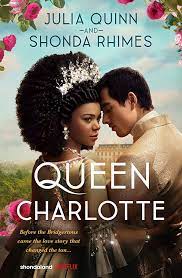
Although I finished the Brigderton series the other year, I am a completist so I had to read this companion book even though it is connected more to the tv series than the original novels. I’ll admit, since it said companion I thought it would be more like a prequel to the events readers will see in the series but it isn’t. It’s more like a novelization of the first five episodes, only it goes in chronological order and has no flash forwards or framing device.
Not that it is a complete waste. Novelizations often give deeper insight to the characters as we can see insidde their heads rather than interpret their facial expressions in the silence.
For instance, readers are able to get inside George’s wandering mind malady as his inner dialogue rushes together and flies away when stressed. You also feel more connected to the characters as it adds little tidbits like how Charlottes enjoys apple strudal in the winter and Brimsley’s reoccuring fear of his corpse being stomped by Italian grape stompers and a goat.
In fact, Agatha’s words about palace walls are more impactful here than in the series as she informs Queen Charlotte of her impact as a symbol for the great experiment, that she is able to wield power in her position rather than sulk over her feelings of being constrained and controlled and hidden away.
Quinn’s humor and witty banter are still highlights and the love story is very sweet even though it doesn’t have the instrumental soundtrack of Wildest Dreams or whatever. Plus it is nicely balanced with the show’s themes of women maintaining and asserting independence and power within limited means.
There Goes the Neighborhood by Jade Adia
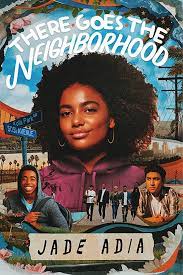
Rhea’s summer was supposed to be a time of laziness, graffiti and bonding with her two best friends, Diego and Malachi. But that quickly comes to a halt when the encroachment of gentrificiation kicks into high gear, threatening Rhea’s friends with eviction. She cannot stand the thought of being split up and so hatches a plan to use people’s fears against them. They’re gentrifying her block because they think it’s “safe” so what if she and her friends start a gang. A fake gang whose smoke and mirrors will drive developers away until someone gets murdered.
While this was advertised as a comedy, it is more like a coming of age-summer summer hijinks turned murder mystery. It was sort of comedic in a surreal way in commenting how white people think they can get away with ridiculous stuff because of how rich they are.
Nonetheless, the coming of age story is what sucks you in. Readers can immediately understand why Rhea is so posessive of her friends but her arc of learning to expand her circle to include the new kids in town (Marley and ), seguing into the learning to taking a chance on change.
This nicely connects to the book’s broader themes of Rhea’s short term approach of creating a gang which she believes will get results faster than the activism and law cases creating by white savior college kids. Rhea can be very stuck on her sometimes black and white (and very judgemental first minute) impression of others and won’t listen to the alternative. Obviously, it gets her in hot water with the murder mystery but works well in the long run and Rhea manages to never veer into annoyingly stupid.
I’m not putting this into much detail since one should read for themselves, but I believe Adia does a good job in demonstrating how gentrification negatively affects communities by sucking the diversity and displacing long time residences without offering them the better economic means gentrification is supposedly offering.
The book also has a meaningful refrain that even though these kids are doing this dangerous, grown up thing, the kids are still viewed as adults because they’ve been forced to grow up faster thanks to racism, gentrification, shootings, creating a life is not fair mentality.
This was just a great book full of distinct, dynamic characters (Love Auntie Inga!) that include girl supporting girl friendship, LGTBQ and autism rep. It doesn’t shy away from heavy stuff but is also lighthearted as well because black life is not all about pain and oppression as Adia writes in her author’s life note but full of black joy, community and sneaking into movie theaters with your best friends.
First Ladies by Margaret Truman
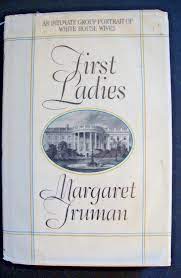
A former first daughter, Truman gives an in-depth and inside look into what makes up a first lady. The undefinable job that sets the tone for the adminstration yet hold unsaid, and complex responsibilities.
Instead of going chronological, Truman puts the ladies in groups like general ladies (Mamie and Julia Grant whose military life helped them for the presidential runs), the ones murdered by newsprint (Rachel Jackson, Lou Hoover, Grace Coolidge) and others to create surprising connections like how Julia Tyler was considered the new Dolley Madison for her subtle political acumen and perchant for hosting galas, Lincoln was the first to redecorate the White House and recieved similar pushback as Kennedy when she started her project though only one became a success for it.
She also objectively looks at the vital roles the wives play in support to their husband and how it can go wrong like the public/political partnerships of the Reagans, Clintons and Carters; the oversupportive partners of Polk and Adams and so on.
She also devotes chapters to individuals like Mary Lincoln, th supposed worst first lady according to some polls which Truman argues in the next chapter belongs to the petty, power-hungry Florence Harding. And of course, one to Jacqueline Kennedy.
Not only does she go over numerous documents and unknown anecdotes but she has unveiled a new layer and iscarded some myths attributed to presidential wives like the hateful Plastic Pat moniker and Ms Nixon, the staunch independence of the supposed prudish Lucy Hayes and so much more.
Basically, if you want to learn of the First Wives from Washington to Clinton, this is the one for you and gives you a greater appreciation for the thankless position that none of these women expected but tried their best to excell.
Behind Every Great Man: The Forgotten Women Behind the World’s Famous and Infamous by Marlene Wagman-Geller
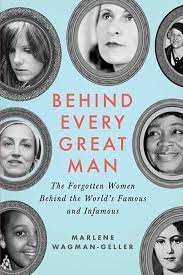
We all know this very saying but Geller seeks to pull back the curtain to reveal how these wives and girlfriends behind the scenes were often inspiration and/or enabled their significant others to make their magnum opus of legacies without a word of thanks (I’m starting too see that genius has a side affect of narcisissim).
Some of the more interesting profiles out of the forty that caught my attention were-Winnie Mandela who took a more violent extremist approach in fighting against aparthaid while her husband was in jail, leading to estrangement when he got out.
Katsurba Ghandi who accomplished many of the things her husband did to start the Indian Independence Movement against the British (making salt, choosing nonviolence, starving herself literally to death in jail in protest), attracting female followers to the movement yet is completely forgotten. Also she managed to do it without being a creep like her husband who apparently slept naked next to girls to test his lust.
-Eva Braun was one of the few to go against Hitler’s personal orders of modest German womanhood and Geller makes an inteesting “both sides” argument as to the extent of what Eva knew or cared about Hitler’s politics.
Anna Fleming, whose pregnancy prevented their ususal sadomasochist sex routine, prompted him to start writing the famous books on sauve OO7.
-Most people know about poor, insane Zelda Fitsgerald but it was Fitzgerald’s mistress whose rocky family backstory and zest for life that inspired The Great Gatsby.
And that’s just a few of the profiles. Initially, Geller’s writing took some getting used to as she seemed to insist on putting pop culture references to be hip or funny I guess, but I was able to get over as I got further into the book. And the ones that were connected to the couple (like the numerous references to Fitzgerald’s other works) felt clever and fun.
The Light We Carry by Michelle Obama
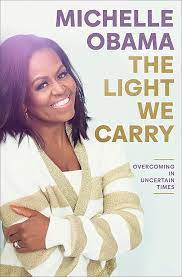
Obama’s second book came about during one of the most uncertain periods in the world. The COVID pandemic where the stress and isolation were compounded by the seeming endless stream of bad news and ineffectual policies and hate crimes. Fittingly, this book offers advice interspered with personal, humerous and honest stories in the calming tones of a woman who knows how to face a crisis. As Obama says, these are some tools that help her and may not work for everyone. Still, the relatable stories and sensible explanation make them very accessible.
Such lessons include decoding fear. This is not the same as facing fears as decoding them means to understand the cause of the fear. What’s more fear is sometimes not abject terror but confronting newness that makes us uncomfortable which we mistake as fear.
When faced with an overwhelming task, start small which helps build confidence in doing bigger things whether it is trying out a new hobby or going for local government.
One cannot forget the importance of hugs which Obama dovetails into being more open with acceptance or at least when it comes from parents to kids because kids can be easily influenced by one sour look that affects their mindset in the future, focusing more on the negative than the positive. This also relates to reflecting on the moments where people judge us, they haunt us, but they don’t hold power but rather become fuel to overcome.
Even This I Get to Experience by Norman Lear
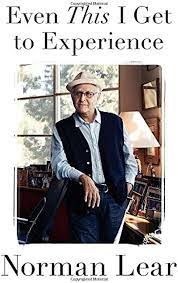
This memoir by Norman Lear was written in 2014, when Lear hadn’t reached his 100th year and all the adventures he’s had as an octagerian, this one is still a great read. Maybe he’ll come out with another posthomnous one.
Point is, Lear is a national treasure for how much he has contributed to American comedy much as Betty White did onscree. Split into four parts, Lear discusses his childhood especially with his smarmy con artist father whose run from the law left a rocky path for the rest of his life and family relationships. However, the family dysfunction provides lots of material and we can see how much humor matters when dealing with tough subjects.
That’s what much of part three deals with (part two was his years in the army during WW2, college life in Emerson and start in Hollywood)-the creation of his shows, his pursuit of truth, tolerance and hilarity as a conduit to both and the subsequent battles with network censorship. Not only do you get the juicy insider knowledge of the making of these shows but the politics of the times and the evolving viewship and discussion on topics like interracial marriage, abortion, drugs etc.
Not that Lear points to himself as a bastion of the modern American hero. He is honest about the failings and failst in his life like the dissilution of his first marriage, being an old father, and mistakes he made in dealings with friends and coworkers. But that honesty and clarity of thought only make it a more endearing read and full of wisdom.
Drawing the Vote: An Illustrated Guide to Voting in America by Tommy Jenkins
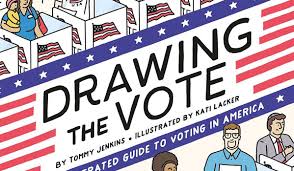
This easily accessible graphic novel emphasizes the importance of voting by taking readers through the its tumultuous history-just what have people fought and sacrificed in order to get the vote from the beginning of the Revolutionary War to Women’s Suffrage to Civil Rights Era campaigning against segregation, one message is repeated. Your vote matters!
Now, it may be hard to believe that considering the apathy, fearmongering and fake news that characterizes today’s political processes. Jenkins covers this too as voting history sheds light on the the rise of the Tea Party which helped to lead to Trump’s election, electoral college, gerrymandering and the many strategies utilized by political parties to surpress the vote. Because, again, your vote matters! And those who are trying to make it harder for people to vote know that.
Armed with facts, statistics and media studies, Jenkins pounds the point that when people go out and vote, they can make changes because when you vote in local elections, you vote on representatives that reflect your values which contribute to who votes in the electoral collage, who becomes Senator or Rep. which in turn, affects how lines are drawn in voting districts and the creation/dissilution of voting requirement.
I know it seems like a lot, but it really is understandable as you read through, and you have a greater appreciation for what others (including your ancestors) have done in order to get the chance to vote and you are part of that history wen you exercise this increasingly fragile right.
Buuut I still don’t get who votes in the electoral collage. He didn’t mention who it is made up of. Google doesn’t seem to kno either so. . . that’s a little creepy.
We are the Power: How Nonviolent Activism Changes the World by Todd Hasak-Lowy
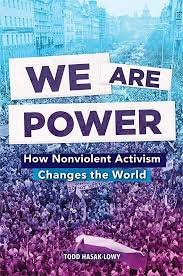
Hasak-Lowy starts his book with a very factual point. When we think of history, the major events that first come to mind are full of violence-World Wars, Vietnam War, Civil Rights, Holocaust. Paints a depressing picture of human nature, doesn’t it?
But history is more than wars and violence and Lowy seeks to show readers how powerful the people can be when they take a different path. In fact, there are 198 methods one can use when participating in a nonviolent revolution. Without raising a finger, people can change the world as evidenced by six major human rights movements. Indian Indepence, UK/US Suffrage, Project C spearheaded by MLK, Chavez’ Farmworkers Movement, Czeckslovakia’s Velvet Revolution and The Climate Change Movement.
While providing a history lesson that doesn’t sanitize the struggle and retribution piled against the activists, Lowy shakes up how one may commenly see nonviolence. These are not people who passively look the other way to avoid confrontation. They are courageous because they choose to show their values by not stooping to the other’s sied tactics and contribute more pain to the fight. No, they directly challenge their opponents and reject the idea that the oppress lack power.
By choosing not to fight, they may end up hurt as consequence, but it only empowers bystanders to reconsider the values as they did during the Civil Rights Movement/Farmerworkers. By seeing the violent practice of racism, one can see its more than just an ideology by brutal violence. Unpalatable to the people, it lead to amendments and integration for the people.
Okay, now I’m basically stating the main points of the book but it is very moving to read it yourself and taught me a lot of things I didn’t know before like the connection between Chavez and MLK, Ghandi being inspired by Thorou, and just the Velvet Revolution in general. It’s a comprehensive and worthwhile read and I would suggest it for classroom discussion in schools as to compare why wars are talked so much more often when nonviolent revolutions like Mandela’s fight against aparthaid, Optor (Resistance! in Siberian) fighting dictactorship through pranks, ACT UP drawing attention to AIDS among others, are underrated history.
Ariel and the Curse of the Sea Witches by Cleary, Brancati, Greppi, Leoni and Fornaciari
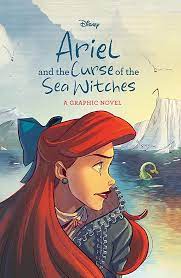
This short graphic novel adventure will interest little kids as it continues Ariel’s adventures on land. Newly married and newly appointed Princess to Denmark, Ariel and Eric travel to Greenland to oversee the construction of a new port. While the port is looked on with excitment by the local Inuits as a symbol of technological progress (the ships are going to the Hudson Bay Colony in the New World oh la la la) and job opportunity, Ariel becomes concerned about the endangerment of the aquaecology as the port promises more traders to spoil the pristine landscape.
That concern is compounded by her meeting the Artic mermaids led by the bitter Queen Arnaaluk whose own failed relationship with a human has made her distrustful and wrathful of any humans who come on her territory or hurt her people. Neither side is willing to budge on the issue and only Ariel whose understanding and love for both worlds has the capabilities to bring peace to the peoples/mers.
The drawings are crisp, fitting in with the Disney style so each character is immediately recognizable yet distict in its quick lines and vivid coloring (I especially enjoyed the pages depicting the Northern Lights). Plus, it provides such dynamic action scenes too like Ariel rescuing Eric once more from a watery grave. It also depicts a chilling panal of blood in the water which is so hard to draw so bravo. The book is interspersed with Ariel’s diary entries and realistic drawings that give insight to her mindset as well as helpful exposition that graphic novels sometimes lose in coparison to prose.
As for the story, I enjoyed the details that can be easily drawn to its historcal equivalent like the Royal Trading Co. instead of the Danish East India co.; the respect the artists had in depicting the traditional face tattoos of Itta, Tanaraq and other Inuit characters; the idea of Arnaaluk being a “what could have been” compared to Ariel’s happy ending; the light discussion of the very real consequences that come from imperial progress which leads to displacement, enviromental damage etc.
However, the latter part is what keeps it from being great. As the book clocks under a 100 pages, the authors cannot go in-depth on the real difficulties that the situation presents. The happy ending Ariel achieves feels bittersweet. Even though the message is sound with the idea of communication and negotiation being the way to go and people should listen to each other, it feels unrealistic as readers will know what will happen in the future. More traders, more enviromental damage, more displacement, so this is just stalling the inevitable.
Also I was waiting for some conflict between Ariel and Eric. Eric was so for the construction and while he initially pushed back on Ariel’s concerns, he eventually sees she’s right and reflects how his views on “others” (mermaids, the marine enviroment) have changed. They’ve become real to him and he regrets that he hadn’t considered them before making his decisions before.
That is a nice subtle arc for Eric but I was waiting to see them actually fight. Ariel seemed so sure that she and Eric were on the same page for everything, it would have been interesting to see how she would handle a fight that reflects on how they’ve been raised differently and their sides represent the experiences that come from being raised human/mermaid.
SoulSmith by Will Wight
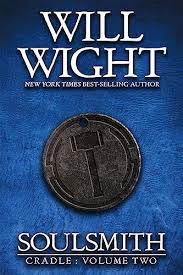
I kinda regret waiting a whole month before getting to the second book because I needed a major refresher onn the world and magic system that only gets more complicated from here as Lindon seeks to go from Copper to Iron and must go through the chores and trials of the smithers to do so.
I said before that Lindon’s journey felt a little bit predictable and that continues here. BUT, Wright rectifies this by having Yerin play a bigger role (with more chapter time dedicated to her and her uneasy mentorship with Eithan) that adds some ambiguity to what exactly Fate has in store for Lindon. Plus Wright introduces a new nemesis (or possibly frenemy) come in the form of Jai Long of the Fisher clan who Yerin and Lindon make a humilating defeat of.
And yes, I still found the magic system to be confusing, it was very powerful described which made the fight scenes epic to read and surprisingly meaningful as Eithan explained Lindon’s next steps to im and how to achieve the energies in his soul.
A Midsummer’s Nightmare by Kody Keplinger
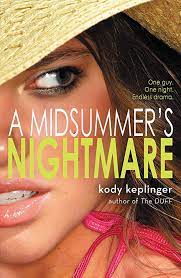
Whitley Johnson is not the girl you bring home. Sarcastic, and apathetic, Whitley’s one bit of happiness comes from the short surge of tequila when she goes out at parties. And one can’t blame her between her distant dad and her neglectful mother. She hasn’t been happy for a long time but she’s excited for the summer when she can have her private time with Dad, discuss collage and just chill.
Only for her Dad to spring a surprise move and a surprise family on her. He’s getting married at the end of the summer, and the kicker is that her stepbrother’s the guy that she slept with at the graduation rager.
It sounds like a summertime hell and it is at first. But this perfect suburban family (whose name is Caulfrield but is nothing like the morose fictional character) ends up surprising Whitley with their acceptance and force her to confront some hard truths about herself and what it means to be in a family.
Whitley, on the page, seems like an unlikable character as she’s very jaded and cynical. But Keplinger writes with such raw honesty that you just can’t help but root for her even as she stumbles over the same mistakes because you understand that they come from a place of abandonment, some selfishness and self preservationand there are moments of genuine care for others even as she hides between a coldhearted bitch facade. What can I say, I’m a sucker for protagonists who are flaed yet self aware.
It helps that she has a great supporting cast with the Caulfield family from sweetheart Bailey to Nathan who is just an awesome love interest with his own past demons and charm which juts makes the forbidden aspect of their relationship so titilating.
Honestly, it’s a mindfuck as they already hooked up without knowing about the future family thing so. . . like it would have been perfectly fine if their parents weren’t marrying. And technically, they aren’t related at all and haven’t grown up with each other (and won’t be since they’re both going to collage) so there’s no siblings vibes. But you hear the word stepsiblings and it’s icky. But they’re still so good together? It’s just very conflicting.
Whatever the romance helps her grow as well as her friendship with Harrison who sis somewhatthe stereotypical gay friend but also they acknowledge and joke about it so I guess it’s okay?
Besides the coming of age aspect, Keplingerhas an overriding theme of policing women’s sexuality and the double standards that come with it when Whitley’s hit by the small town prejudice against her casual hook-up stance while no one smears Nathan or any of the other guys she kisses/ There’s some dark stuff with sexual assault mentioned that is not fully resolved but in a realistic way in my opinion.
This may actually be my favorite Keplinger book as it shows her range in creating a layered protagonist, slow burn family relationship, hot romance, feminist undertones and just characters who make mistakes yet show they’re capable of growth even the adults.
Once More with Chutzpah by Haley Neil
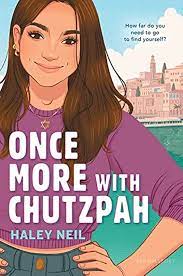
Tally has only two goals when she joins her temple exchange program to Israel. Getting closer to her roots and fixing her twin who is still reeling from a fatal car crash. In his depressed state, he hasn’t socialized, hasn’t written music and hasn’t applied to BU and Tally can’t let all their plans for the future go down the drain without trying to help.
But what starts out as a trip to help her brother get his groove back turns into a coming of age journey for Tally herself as she grapples with her identity and the many facets of herself that she has tried to avoid.
This was a lovely surprise for me as much as it was for Tally. Of course, there is what is advertised in the backprint where Neil sheds light on the diversity of the Jewish disasphora and how it is not homogeous as people believe. There are conflicts in belief between the Orthodox and secular, there is racism within the community and the idea of half-Jews are a question mark that Tally grapples with as she feels “less Jewish” compared to other more devout students in the group.
In fact, Tally does a lot of overthinking. It comes with her anxiety as Neil aptly demonstrates the careening thoughts that are irrational but feel very realistic in the moment. It’s something that Tally believes she has under control until the big twist midway through.
I won’t say what it is but I was so surprised even though it was obvious in hindsight. Nonetheless, it was a great plot point that forced Tally to confront her growing anxiety and her attempts to help her brother were a poor coping mechanism to distract herself from the negative thoughts she wouldn’t allow herself to feel.
It also brought another issue to the fore which was Tally’s sexuality as she identifies her feeling of prudish and sometimes repulsion to kissing despite her crush. It was an interesting angle as the potential crush is developed enough to be adorable but takes a backseat to Tally’s own journey with enough potential for future trysts.
I enjoyed seeing Tally’s new friendships as they highlighted different issues and views on how Judaism is seen by its own community and even lightly treads on the complicated topic of the Palestine-Israel conflict. Though it emphasizes that this is only one perspective and readers should see more from Palestinian and Israeli voices themselves than just the word of Jewish-American protagonist and the author writing.
Nonetheless, it does make a point about how important it is for the Jewish community to have a homeland to feel safe after the Holocaust as I feel these poignant paragraphs discuss.
“It’s important to contextualize these horrific events because they didn’t happen to people who existed in the generic long-ago time but to real people, really recently. There are people still alive today who lived through it. That’s not going to be true soon, and that scares me because it’s too easy to designate events to the past tense and forget.
And repeat.
I keep thinking about my family. The great-great relatives who were stripped and shaved and tattooed and starved and gassed and burned. Treblinka. That’s where they were sent. I have the name now.
How can that have happened in a time with cars and phones and medicine? How are we still allowing people to be murdered based on who they are or where they were born? Why don’t we as a people ever learn our lesson?” (Neil 136)
“I think about a phrase Safta taught me. Le’olam lo. Not in this world, never again. We can never let this happen again. We will never let it happen again. There’s a point when you need to say that children should not be murdered. There’s a point when you need to take action to make sure they’re safe. Be it from Nazis, be it from white surpremacists, be it from government officials, be it from lunatics with guns. Be it from people you thought were safe, who can end up being the most dangerous of them all. Le’olam lo.
Never again.” (Neil 140).
Chilling, right?
I thought it was a fun book that thoughtfully weaved several complex topics with humor and sensitivity. Plus it had some nice imagery of the beauty of Israeli and made me want to visit at least once despite the security and check points. Also, Tally is a musical theater nerd and each chapter was a song from a musical (including Fiddler on the Roof obviously) so it gets extra points for that.
Other books I read this month.
(Eight Cousins & Rose in Bloom by Louisa May Alcott, Polly French and the Surprising Stranger by Francine Lewis, Black Beauty by Anna Seawell, Beautiful Joe by Marshall Saunders, Donna Parker at Cherrydale by Marcia Martin, The School for Good and Evil: A Crystal of Time and One True King by Soman Chainani, Emmie and Friends #1-6 by Terri Liberson, Queen Charlotte by Julia Quinn and Shonda Rhimes, The Two Princess of Bamarre, Fairy Haven and the Quest for the Egg, The Princess Tales and Ever by Gail Carson Levine, Roller Girl and All’s Faire in Middle School by Victoria Jamieson, Lassie Treasure Hunter by Charles S. Strong, Rin Tin Tin’s Rinty by Rene Martin, Annie Oakley in the Ghost Town Secret by Doris Schroeder, Sand Dune Pony by Troy Nesbit, More than Courage by Patrick Lawson, Toby Tyler told by Dorthea J. Snow The Maze Runner series by James Dashner, Where the Stars are Scattered by Omar Hassan and Victoria Jamieson, There Goes the Neighborhood by Jade Adia, Hey, Kiddo by Jarrett, Tiger Lily and the Secret Treasure of Neverland by Cherie Dimaline, Annette and the Desert Inn Mystery by Doris Schroeder, Dale Evans in Danger at Crooked Canyon by Helen Hale, Wild Animals I have Known by Earnest Thompson Seton, The Lennon Sisters in the Secret of Holiday Island y Doris Schroeder, Beverely Hillbillies: Saga of Wildcat Creek by Doris Schroeder, Fable Comics edited by Chris Duffy, The Adventures of Bobby Coon, Paddy the Beaver, Poor Mrs. Quack, Longlegs the Heron, Jimmy Skunk, Grandfather Frog, Danny Meadow Mouse, Happy Jack, Bob White, Jimmy Muskrat by Thornton Burgess, The Frog Princess series by E.D. Baker, Heist Society by Ally Carter, Drawing the Vote by Tommy Jenkins, Ariel and the Curse of the Sea Witches, A Midsummer’s Nightmare by Kody Keplinger, Once more with Chutzpah by Haley Neil)
 Rachel Reads & Reviews
Leave a comment