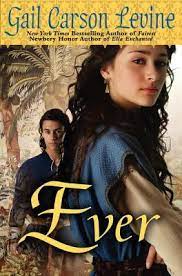
Olus is a lonely god, the youngest of the Akkran gods at seventeen compared to their thousands of millenium thus he is unusual fascinated by mortals or “soap bubbles” as his parents call them for their fleeting, ephermeral lives. On one such sojourn to the mortal realm, he travels to Hyete as a goatherd and spies Kezi.
Kezi is an average girl whose belief in Admat is unbreakable and it is to him, the god of everything and everyone, that she prays to when her mother falls fatally ill. But the price for her mother’s health turns into her inadverted sacrifice and Olus will do anything to save the girl.
By turning her immortal. Can these unlikely lovers defy fate?
That sounds like an interesting premise, right? Too bad the execution turns this potential epic into a surface-level drama.
Having read several of Levine’s works, I know what she’s capable of so that’s why I make my disappointment is so blunt. The world seems to be a take off of ancient Mesopotamia or Sumeria with its clay tablets, importance of loom and nature, and celebrations focused on death, marriage and life. While there’s a few paragraphs about what the cities are like, and the differences between Akkra and Hyete, it doesn’t come to life. Which is a shame since ancient Mesopotamia is just so monumental when you see the ruins and mosaics so it’s heyday glamour should be emphasized especially when she’s including gods into the world.
The characters have a similar problem as to the descriptions. The bare bone descriptions are there but it is so simplistic. Each chapter is 2-4 pages at most, alternating between the two and it feels like I’m listening to the minds of pre-teens rather than teens approaching young adulthood. They just speak their feelings like “I’m happy. Now I’m worried. Now I’m happy again. He points to an orage. I take the orange.” The sentence structure is just monotonous.
There’s no further insight in their internal monologues or self-reflection which unfortunately dims the adventure when the two go through their respective trials to become a champion and a heroine respectively since the conflict is solved within two chapters.
It’s even more disappointing since Levine brings up an interesting conflict with Kezi and her family’s belief in Admat who seems to be a very wrathful god since he requires Kezi as sacrifice but the rub is, Olus asks around to the other gods and the god of wisdom and no one has heard of Admat?
Does that mean he doesn’t exist? Is he just hiding? If he doesn’t exist who made his religion and his belief system? Why did they create this god who is supposed to care for his subjects be so vengeful?
These are all interesting questions and one can easily draw parallels to real life religions and gods as people ask if the same God who cares for us is someone who hurts us a lot too? How do you reconcile the benevolent god figure with the angry one?
But Kezi who should feel the most conflicted about her whole belief system possibly being based on nothing is at most, mildly distressed and easily gives it up for love. So that story element falls flat too.
Of course, there’s a few classic Levine comedic lines and one stirring love speech but it doesn’t make up for the simplistic tale that should be brimming with danger and action fitting for a godly epic.
2 stars.
 Rachel Reads & Reviews
Leave a comment