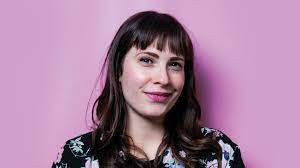
Stephanie Cooke is the editor/writer of original middle grade graphic novels, ParaNorthern and Oh My Gods! As well as popular franchises as MLP’s Camp Bighoof and Archie: Love and Heartbreak Special. She kindly took the time to answer my questions and divulge her early inspiration, writing process and what’s coming next.
1. What were your early inspirations (comic, movies, franchises etc)?
Growing up, I loved the His Dark Materials series, all of Tamora Pierce’s novels, and the Enchanted Forest Chronicles. As well as classics like Anne of Green Gables too, which was a staple of my childhood as someone with ties to Prince Edward Island. I didn’t read a ton of comics as a kid because I simply didn’t have access to them but I did read a lot of Archie Digest comics, so that was how I got started reading comics.
Eventually, the Sabrina the Teenage Witch sitcom would also become a massive influence too. All of those had a really lasting impact on me throughout my life.
2. How would you describe your writing style and its evolution?
I think I write from a place of passion. My stories tend to form around things that I’m excited about or want to put my own spin on. They’re all very much the stories I would’ve loved to read growing up. I don’t know that I have a particular style, per se though, unless you want to count puns as a “style” choice! But I evolve as I read and consume more things that I enjoy, and listen to constructive feedback from my peers, editors, and other professionals who help me grow.
3. You’ve gotten to work with a few IPs-besides being such a fangirl moment, what is the process? Are there guidelines, pressure, creative leeway etc? What was your favorite one?
Yes! All the IP that I have been fortunate enough to work on has always involved project bibles filled with continuity, core story pillars, guidelines, etc. but I don’t think I’ve ever felt really restricted creatively by any of those. They serve to help keep creators on brand and give them easy ways to stay on track with established characters and worlds.
That being said, I don’t know that I have a favourite! I’ve had so much fun with every IP! But I think getting to work on Epic! Originals’ series, Time Buddies is up there since they let me really run wild with some of the ideas and stories. And my upcoming My Little Pony mini-series, Camp Bighoof, was such a delight! They let me create an original Equestria cryptid for that, which I still can’t believe is a thing that’s happening.
4. Greek myths have been interpreted and retold in a million ways, how did you set out to make Oh My Gods your own?
Greek mythology is another thing that I was deeply obsessed with growing up. I spent a lot of time at the library reading books on myths. So playing in that sandbox and getting to put our own spin on gods and goddesses was always something that I wanted to do.
But those characters and stories can be extremely problematic with a lot of very bad stuff happening to and around everyone. So playing with mythology for a middle-grade audience can be tricky. We wanted to take the core of certain myths and beings and insert them into an all-ages world where anyone could enjoy our spin.
So it was a bit of a mix of having ideas for what those gods and goddesses could look like in certain story settings and then bringing those characters to life in an appropriate way to a younger audience.
5. You have an extensive outline before working, what was your intent when you envisioned the modernized designs of the Greek gods and Karen?
Similar to the above, it was trying to give them a refreshed look that incorporated bits and pieces of the characters core identities. My co-writer, Insha Fitzpatrick, came up with a lot of mood and aesthetic boards to help out our artist, Juliana Moon, but mostly we just trusted Juliana to do what she does best—create incredible characters and designs that best represented the story we wanted to tell.
6. You incorporated some Wiccan rituals into the supernatural ParaNorthern, how did you pick and choose which ones to include and which to invent?
Mostly it was writing the story the way I saw it first, and then seeing what sort of spells and things I wanted to include to help further the story. I used a mix of spells from resources like The Witch’s Bible but tried to add or tweak small elements in them to make them unique to Abby and the world of ParaNorthern.
7. Where did the idea of killer bunnies come from? I hear Monty Python had a bit of inspiration for yours.
It was! That’s truly exactly where the idea came from. I absolutely adore The Holy Grail and I was enamoured with having a “villain” or “bad guy” that isn’t really bad, per se. So the chaos bunnies came from a place of wanting to play around with that as well as my love of the Killer Rabbit.
8. The Racc Pack is a humorous take on the heist genre, how did you go developing Oceans 11-esque tale?
Whitney Gardner approached me after reading ParaNorthern and asked if I would want to work on something together. She suggested a raccoon story and I was immediately on board. From there, we brainstormed ideas on what a raccoon story could look like and we settled on an obvious choice: a story that involves garbage! And instead of having to scavenge every night, what if the raccoons found a supply that helped them sit pretty through winter and beyond? So we began formulating a heist from there and developing the story around all of that. It was a lot of fun to put together.
9. Since those two, are I very action-packed, how do you collaborate with your illustrators in laying out such dynamic scenes?
It really depends! In the scripting stage, I tend to write on my own until I’m happy with the story. I sometimes consult the rest of the creative team but usually I’m problem solving as much as possible solo. So in that case, being a pretty visual person helps with that. I like to draw for myself and that allows me to be able to see the page as I’m writing it.
But in the case of something like Racc Pack, Whitney sometimes sees what I’ve written and either expands or condenses things to better suit the story with her art. I’m all about that! I trust my collaborators to be able to reinterpret what’s on the page and bring the story to life, even if it isn’t exactly how I wrote it.
So the long story short is that it depends!
10. What skills overlap or you utilize between your roles as writer and editor?
Good editing is storytelling at its core. Editing is fundamentally understanding what comprises a good story and what might be hindering something from reaching its full potential. An editor doesn’t force change on a story, edits are a conversation about how the story can achieve the creative team’s ultimate goals. So with being an editor and a writer, for me, it’s about knowing story and the elements of a story, how to ask questions and problem solve, and being able to communicate.
11. Your debut YA graphic novel is coming out, how does it differ from middle/lower grade graphic novels? (Like bigger panels, more words, content etc)?
You’ve pretty much got it!
Middle-grade graphic novels tend to have fewer pages, panels, words, etc. You really want to subscribe to the less is more model. With other age groups, you can be a little more loosey goosey with that but I do thing minimizing the number of panels per page is always important. But that said, you don’t have to be as strict about it. Plus, usually the lead characters are of the age group that the story is being written for.
So in the case of Pillow Talk, we have a couple of college students who are trying to navigate the world outside of their childhood homes and figure out who they are. I think there’s a lot of my writing staples in Pillow Talk but it’s also a little more serious in tone overall, and tackles some bigger topics and themes than I have before. So I’m really excited to see what people think of it since it’s my first big foray outside of writing for younger audiences.
12. Any news you can share about what’s coming next for you?
Aww yeah! My Little Pony: Camp Bighoof #1 is out later this month on July 26. Animal Rescue Friends: Making New Friends is a collection of stories I edited and that’s out in November. The Racc Pack is out in January with the second instalment of the series coming out later in 2024. Pillow Talk will be out in March. AND the video game that I’ve been writing just came out—it’s called Pekoe and it just launched early access over on Steam. But we’ll have lots of updates and new info coming for that over the next little while.
And then hopefully I’ll have even more news to share soon!
 Rachel Reads & Reviews
Leave a comment