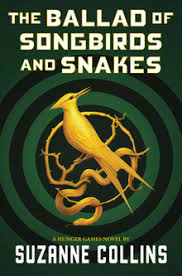
This book was certainly full of surprises.
I’ll admit, I didn’t read this when it first came out because it seemed unnecessary. I mean who wanted a book about President Snow? And about yet another District 12 tribute, especially as we already know what will happen?
But those low expectations were probably a good thing as it blew me out of the water when Collins dives into the man behind the monster.
10 years after the Capitol defeated the District rebels, everyone is still rebuilding. Snow’s family, one of the most prominant and part of the Old Guard rich are barely surviving day to day since their munitions empire blew up with District 13. Coriolanus’ family is trying to keep up appearances and he knows his only chance of success is to get the scholarship that would pay most of his way to University.
And he just knows his mentorship (the first ever program) during the Games will clinche it for him even if Dean Highbottom hates him. But the Dean certainly is making it harder for him as he is paired with the girl tribute from District 12. At most, he can hope for a good showing and maybe impress the Gamemakers with ideas of how to improve audience engagement and viewing.
However, Lucy Gray Baird catches his eye and the eye of the rest of the Capitol with her haunting song at the Reaping and he starts to believe he may just have a chance.
Just as before, Collins puts a lot of care into world building as she expands on living in the Capitol. It’s nothing like the snazzy, flashy world of Lady Gaga outfits and plastic surgery. It’s plain, dreary, and despite the Capitol’s propoganda that things are improving, Corionalus doesn’t feel the improvement. The streets are still riddled with bomb marks, or with gaping patches, food is still a luxury and the tvs blare with messages about the Games’ importance in reminding the Districts of their inferiority.
Coriolanus’ generation, in particular, have dim memories of the early years of circuses and war parades. Dominant memories only include poverty, bombings and starvation veering into cannibalism, metaphorically and literally. No one really likes the Games, rather they just work at trying vainly to reclaim the riches and positions of their parents’ glory years as if their opportunity to climb up the ranks would be just as simple in this era of scarcity, and reconstruction.
Likewise, the 10th Games is as primitive. The technology isn’t advanced though there are shades of it mentioned that readers will recognize for their final products. Instead, it’s held in a delapidated sports arena with a handful of weapons and obstacles for the tributes to fight with.
The mentorship program with the senior class’ honor students are the first to try such ideas as betting on tributes, interviews and sponsoring food in order to encourage viewership. For the students, its a chance at a better grade; for the tributes, it’s still life or death but there is a little more chance of food.
Such contrast between the privilege Capitol life and the dire circumstances of the Districts is the main theme of the book as Coriolanus’ eyes are opened a bit (before closing shut) of how inhumane and cruel the whole system is. That maybe the people from the Districts are not animalistic barbarians, but human kids. A crazy concept.
But that idea is butt up against the ideas of society, control and chaos as the Head Gamekeeper, the insane mad scientist Dr. Gaul pushes the students to think hard of how people can enjoy the violence of the Hunger Games as quality entertainment, furthering her ideas of humanity’s innate violence.
She sees it as the unveiling the truth about humans and over the course of the book, Coriolanus begins to agree.
Like any person, Coriolanus thinks of himself as noble, and good. He even acknowledges he has such flaws like obsessiveness, but he views that as a good thing as it makes him much more smart and observant than other classmates whom he derides as show-offs, fakers, etc. The war had unfairly put the Snows at a disadvantage, potentially losing their apartment and their reputations. All the while, giving favor to such people like the Plinths-a family from District 2 that bought their way to everything Coriolanus believes he deserves.
In spite of his selfishness, Collins easily swept me, as a reader, onto Snow’s side as I can see his justifications for his more heinous actions and understand why he is still in favor of the Games despite beginning to see Lucy Gray as a human being.
After the war, with the starvation and the death of his parents, Snow felt helpless. The Games and the Capitol’s rules promise control. The Games will keep the Districts in line and if they make it better and more ruthless, play up the glitz so the Capitol citizens will ignore moral quanderies, even better. It will ensure the Games longevity, and reinforce the idea of District kids as little more than animals to be oppressed in fear of violence. It will assert the Capitol’s dominance and their rules as good for society, the only thing keeping them civilized. It’s a classic philosphy, are human beings partial to goodness or violence and what role society’s social contract plays in keeping the world from going into chaos.
Control is the ultimate goal and one can see it in every bit of Coriolanus’ character from the way he observes everything, packing away his feelings so he may best take advantage of the situation. Even when it comes to his loved ones like his cousin, Tigris, he doesn’t get close to her or share his feelings nor offer the same. Any potential for ruining his image of her or bringing up the uncomfortable, he veers away. It’s all about what Coriolanus wants and he doesn’t want to think about difficult decisions that threaten his black and white worldview.
Even in the moments where he feels bad for someone else, the slightest bit of empathy, he is able to move on quickly to thinking how it will affect him and what he can do next, the next scheme to get what he wants out of someone else.
As for Lucy Gray, she is the first girl who seems to care for more than himself. But even that has its limits.
She’s an enigmatic and charismatic character, Lucy Gray admits that herself. She’s a Covey which she continuously clarifies is not District nor is it Capitol. A Covey seems to be a traveling troupe and its her talents on the stage that allow her to flourish in this new, more engaging Hunger Games as her songs, and her flirtatious make her very popular with the crowd.
It also draws in Coriolanus who soon co-opts her success with his own hopes for achieving Hunger Games mentor glory. She also draws him by sharing hints of her past, and perhaps, it is because she’s about to die that Coriolanus shares his secrets too (his feelings about his parents, his feelings of desperation during the war etc.) and falls in love with her, caring about her safety even more than winning at times.
I think it’s a bit of trauma-bonding in Lucy’s case as Coriolanus is the most sweet and sympathetic to her plight, risking his life at times for hers. But that’s from the outside.
Readers are privvy to Coriolanus’ mind and can see how Coriolanus views her as his girl almost immediately, growing easily jealous and possessive which gets worse when they officially get together. There’s also the fact that his classism flares up when he continuously states that Lucy Gray isn’t like the District kids, she’s different, she’s practically Capitol-esque. But he’s also moody as the slightest disagreement in regards to freedom and the war makes him think of potentially turning on her, that maybe she’s more District than he first thought.
This sort of thinking clouds everything Coriolanus experiences including his interactions with his foil, Sejanus Plinthe. Born in District 2, Sejanus is an out of place, idealistic soul who detests everything the Capitol stands for and despises the Games. He just wants to go home, or at least help people, making him a forever outsider from the Capitol and the District 2 who believe he’s a sell out.
Almost comically, he believes he and Coriolanus are friends despite Coriolanus hating how he ends up cleaning up Sejanus’ impulsive messes to help others whether it be feeding the tributes or trying to stage a jailbreak. It’s sad to see such a kind soul crushed by the harsh reality of this dystopian world in comparison to his “friend” who thrives on it and sneers at Sejanus’ ideals, never understanding why Sejanus would miss District 2 and try to blend in more in order to enjoy the advantages of the Capitol. Coriolanus only sees Sejanus as ungrateful.
Coriolanus can be pretty much diagnosed as a sociopath with how he charms and manipulates, able to discard people and emotions easily. But his thinking of how he can manipulate someone else makes him paranoid as he believes that even though others are inferior, they are also like him in that they are manipulative as well, making him even more distrusting and willing to turn on anyone at the slightest misstep or disagreement.
Even as Coriolanus accidentally racks up a body count one can almost root for him as Collins immerses readers into his head. Seeing his machinations, seeing his rare caring side towards Tigris and the Grandm’am you almost want him to win because he works so hard and he doesn’t want to die which is very sympathesizable.
So, this was a great book (even if I still think it’s unnecessary), prompting big questions about society and humanity while deeper contextualizing the Hunger Games world and its characters.
4 jabberjays.
 Rachel Reads & Reviews
Leave a comment