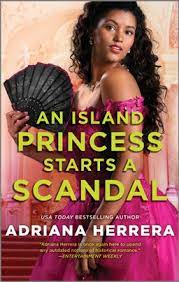
The second book is always interesting to read as you may encounter sophmore slump after the dazzling debut or it exceeds expectations. Herrera’s novel, of course, is the latter as it is just as layered and wonderful as the first in Las Leonas series. Anyone who loves historical romance should go read it and this time, I’ll try to keep the gushing to less than three pages as the wildest Leona sets out for a summer of shameless debauchery and finds true love instead.
This takes place in the midst and after Luz Alana’s book. Luz Alana may be looking for investors but Herrera jumps right out of the gate with having Manuela search the sultry corners of Le Bureau. She’s engaged to be married to a man she doesn’t love. She can’t as she’s a man, and she’s more into the sapphic pursuits. But Manuela is pragmatic that these last months of freedom are her time to connect with the love inside herself that she has long denied. The pleasure of being with other sapphists and lo, behold she falls into the arms of violet-eyed Amazon.
Of course, her first kiss is dashed with the clock striking midnight and she leaves without any mode of communicating or even exchanging names.
In the daytime, it seems like a silly pursuit to search for her mysterious tryst but first she has to settle a land sale with a stuffy old duchess. Yet another part of her life she is exchanging for money. Herself into marriage, her land to a duchess, all to save her family who are hiding their near poverty from the rest of high society.
I’m sure you see what’s going on here that the stuffy duchess Manuela thinks she’s meeting is actually the trouser-wearing, imperious women she met last night, Duchess Cora Kempf Bristol. Immediately, Manuela negotiates a new deal even though she knows her impulsiveness may make things harder when they inevitable split up. In exchange for the land that Cora needs to build the first South American railway, Cora will be Manuela’s guide to the saphhic world of Paris.
It’s delicious as Herrera constantly builds upon the tension, the push-and-pull banter between them that it was only the third chapter and I was as impatient as Manuela.
But no. Cora has spent her whole life proving herself to be just as good, even better than the men in the business world who scorn her. She’s spent decades amassing power, and money, depending on the men’s avarice that’ll tolerate her presence despite her gender because they know she’s reliable and holds all the favors over their heads. Yet Cora must always be on her guard. One scandal and all those years of hard work will fall apart just as when she’s about to make the biggest coup of all and introduce her stepson back into English society. She cannot blow it for the sake of her island princess when she’s still hardening herself from the last scandal.
As you may notice, Cora quickly starts calling Manuela an island princess, then her island princess, a sure sign that despite all the walls she tries to build up, love has already struck its arrow into the icy duchess.
But she tries, Herrera injects some humor into the seduction game. Cora promised eight events where Manuela can mingle with women like themselves. But it’s not in the dancehalls and pleasure houses that Manuela imagined. No, it’s a lecture on sapphic beetles that can bore anyone to tears.
Nonetheless, even in these boring outings, Herrera shows the women poking past their walls and reservations, crawling under their skins and hearts, defying the first impressions they see in each other.
Cora had viewed Manuela in the same way as everyone else. A South American heiress only concerned with her material comforts and being beautiful. Even Manuela sees that of herself, noting she’s the only one of her friends who doesn’t have a passion that drives her like Luz with rum and Aurora with medicine. That’s why it is easier for her to accept this loveless marriage. Stability and material comfort is all she wants after the years of poverty and watching her father being beaten by debt collectors.
It’s her duty after her clandestine kisses with an investor’s daughter contributed to the financial loss of her family. It’s not like she can get married to her real love like the rest of them. It’s the only option for her and her guilty conscience. Her friends are free to follow their dreams despite the scorn but Manuela has her parents to think of, it’s not worth the path of resistance.
But Cora soon sees past the flirtatious smiles and happy demenour that Manuela has layers of her own, a deep sadness and even strength in the way she carries on with her duty and loves with abandon. Manuela is more than an ornemental object to be paraded around and sold. She’s a loyal friend, an artist with true skill and passion and interest, someone who brings sunshine to Cora’s life like a tropical storm.
But Manuela doesn’t see that in herself, not until she meets other sapphists who forgoe a different, harder path than she and soon that life, the life of being with the woman she loves, doing the art she enjoys, it seems possible. Making it all the more heartwrenching as the time ticks closer to her wedding. She had been able to brave because it seemed such dreams were impossible, but they aren’t. Not for these Parisians and Cora may be Manuela’s reason to stay.
As for Cora, she has built up a fearsome reputation. She’s been called a bitch and worse for how she takes up space, boasts her accomplishments, use blackmail and other ruthless methods, she wears pants. She acts like a man and is unapolegetic about it. But the double standards are in full force, constantly putting Cora on the defensive and wanting to prove all the men, from her late father to her current “collegues” (if you could call them that with their open hostility).
Yet Manuela sees around the corners, and the small slips from Cora’s friends that she’s a generous women even if she won’t show it. She fights for the rights of other women no matter their race, or sexuality. She pushes forward but she only does these deeds in the dark so it won’t ruin her reputation. And all Manuela wants is to be able to be a safe space for Cora to let down her walls.
I could split thus book into two parts. The unresolved sexual tension, will-they-won’t-they dominates the first half as the two learn about each other. When they finally get together is when a more mature, and certainly more emotional part comes in and Herrera digs into the layers that surround their complex situation, staying true to the historical difficulties they’d face as lesbian women of color as well as their own personal hang-ups that hold them back.
Once again, Herrera’s writing is top notch as she switches from sizzle to heartbreak to overwhelming joy that you root for the couple every inch of the way. I also feel like their characterizations were full of depth and that it touched on very real themes that resonate to today.
You may think this queer love story is implausible. You’d be wrong as Herrera continues to ground her series in fact, researching the thriving queer community in Paris which was one of the few ones that welcomed people of color. That among other details like women needing a permit for pants, Des Lessep’ humilation with the Panama Canal and the fate of women in exile.
Once again, women coming together to lift each other up and female friendships are at the forefront from Las Leonas supporting Manuela to reach for happiness and reject her marriage to Cora’s friends and aunt gently pushing Cora to do the same despite her past wounds.
In fact, in one of the most moving scenes (perfect for June’s LGTBQ month) Aurora accompanies Manuela to Le Chat Tordu (a real historical lesbian cafe) where Manuela internally worries that Aurora would be disgusted. That her support of Manuela’s sapphism was as long as she didn’t see it. Aurora’s speech that she’s glad Manuela can have a community, a safe space for women like Manuela to find the support/understanding that Aurora and Luz can’t provide.
“Tears clouded Manuela’s eyes at the matter-of-fact words from her friends. Aurora didn’t munch care what Manuela did, as long as it made her happy, as long as she was safe,” (Herrera 169).
And the friendship feels continue when it comes from Aurora who is the one who is most against Manuela’s rash decisions, the one who is able to stand on her convictions that Manuela usually compares herself negatively as one not strong enough to lose her comforts. In fact, this book has quite a bit of Aurora. We already learned from Luz’s that she was the most sensible of the group, and humorously squemish about live sex shows. This one expands on her character in showing her undying loyalty, her discomfort when it comes to making moving speeches and her hot temper.
It all just makes me more excited for when she and Apollo finally succumb to their explosive love full of ambition and pride.
Besides, Las Leonas, female painters (some being real historical figures like Flora Tristan y Moscoso who wrote the essay that birthed the female unionization movement) are in the semi-spotlight following Manuela’s avid interest in art, providing some reader education as well as a new passion for Manuela, though she denies it, as the women discuss unionization and creating a collective fueled by the new trend in poster-illustration, children’s illustration and more. This is 1899, a time where commercial art begins to flourish and starts to be seen as a viable career option, even for women, that it hadn’t been before.
Also flower imagery in a queer book, it had to be done.
The female support is something Cora struggles with, a fatal flaw in her armour that she supports many philanthropic causes and investments but she doesn’t give them the attention or support in public. She refuses as she is set on the idea of beating men in the men’s world, unable to swallow her pride to see that it will never happen, and nothing she can do will ever be enough.
She’s trying to play a system that is stacked against her and it is making her miserable. Being a woman who turns a blind eye to their ruthlessness, and becoming just as vicious is making her miserable. She can’t measure herself against their ruler that strikes her down at every turn. Manuela makes her see that.
This is a similar fight for Manuela realizes with the same elite community who her parents live to impress, the same rich people who would turn their backs on them in an instant if they knew the true state of their finances.
Even with all this talk about strength, the book is also about vulnerability as Cora sees in Manuela and Manuela challenges in Cora-“Behind all the vapid smiles and salaciousness, there was a brittleness Cora recognized. The brittleness at he heart of any person, who understood that if she dared show the world who she truly was, it would scorn them,” (Herrera 80).
They bring out the best in each other, something both lost as they tried to conform to the world. Cora is someone who protects and cherish Manuela, something she has never felt, being the trophy heiress she’s seen as. Cora sees her strength but then Manuela finds it herself, realizes she is someone who can stand on her own and speak the truth against her parents who always put themselves and their reputations first. She did the same for them, but now she wants to put herself first, and not settle for crumbs.
Once again, making another triumphant quote I have to share-“Because she was thowing herself away. Allowing her parents’ selfishness and Cora’s ruthlessness rob her of hope. She was using their carelessness with her as an excuse to give up o herself. . . Just because the society she’d been born to condemned her for who she ws didn’t mean she had to live her life as if she deserved their scorn,” (Herrera 317-318).
Really, Manuela’s journey to loving herself is just as beautiful as her love with Cora.
Speaking of which, Manula challenges the duchess to do better, to think beyond the next scheme to create a meaningful legacy to be proud of than the emptiness of reaching for power. Power is never enough. To reach for happiness, to be herself and love herself over the validation of others is more worthwhile
While this is a book of princess and white knight trope, it is also a moving one about two women leaving the people they thought they were to forge a loving future together and thrive.
Herrera knocks it out of the park with her historical detail, emotional rollar coaster, including the underlying history of queer women and people of color that is so often ignored, female friendship and power, and deliciously steamy romance in a sex-positive way (the scene where Cora takes Manuela to her room was supurb) with moving protagonists. Just amazing. Love is love is love.
Plus it mentioned Ecuador (among other Latin American representatives), that always gets a bonus point on my blog.
5 pink flowers!
 Rachel Reads & Reviews
Leave a comment