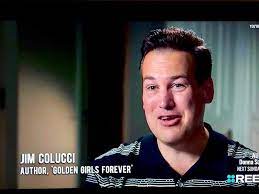
Jim Colucci is a freelance writer and commentator on today’s and yesterdays entertainment offerings, especially sitcoms. Writing for such outlets as TV Guide, The Advocate, and his blog, Must Hear TV, Colucci has also written comprehensive companion guides to such hits as Will and Grace, All the Family and of course, The Golden Girls. Colucci graciously took the time to answer my questions on the impact of sitcoms, writing companion guides, the Girls’ LGTBQ fandom, and of course, favorite Golden Girls episode.
1. You’ve been a mainstay in the entertainment business, what were your tv influences?
I was always influenced by sitcoms more than dramas, perhaps because sitcom problems are usually neatly wrapped up within 23 or so minutes. The shows have almost always been aspirational, showing us the ideal of who we could be, rather than who we are. (If I wanted to see who we are, I certainly could find examples both good and bad in real life in suburban New Jersey. I didn’t need the TV for that!)
Growing up, on some level knowing I was gay, with somewhat conservative parents, in a household rightfully dominated by the needs of a disabled sibling, brought with it a great deal of pressure to achieve. All those factors also just made me “different” – which would turn out to be a good thing later on life, but which would also make me stand out in the way that kids don’t want to among their peers. Television was both the perfect escape for me and the perfect tutor. My parents planted me and my disabled brother in front of “Sesame Street” several times each day, hoping that it would spur him to talk and read. It didn’t work for him, but as a result, I read before age 2.
My first TV loves were “The Electric Company” and a local New York children’s show, “The Magic Garden.” Soon after, shows like “The Jeffersons” and “Good Times” showed me people I wouldn’t regularly have encountered in my mostly white suburb. “All in the Family” and “Maude” taught me about politics. “The Golden Girls” and “Designing Women” brought me into a world of hilarious wit but also activism, bringing perspectives on social issues more progressive than what I would have encountered at home.
“Moonlighting” became appointment viewing for me and my whole high school friend group, who would gather together every Tuesday for a new episode, and quote the lines throughout the week. “The Mary Tyler Moore Show,” “The Bob Newhart Show” and “Newhart” were well-constructed and starred actors with impeccable comic timing.
And I did watch quite a few hour-long shows/dramas; “Dynasty” and “Falcon Crest” brought high fashion and high camp. “Charlie’s Angels” and “Wonder Woman” were just ridiculous fun. My dad, who didn’t usually pay much attention to scripted TV, always reminded me when it was time to watch “Wonder Woman.” I was glad that he was taking interest in one of my shows. Now of course I get that the appeal was Lynda Carter in her costume.
Later on, TV helped me deal with being gay and come out. I can thank “thirtysomething” for being a pioneer in depicting two men together. And I loved that on Showtime’s sitcom “Brothers,” one of the titular characters, who was gay, was presented with dignity, and made it seem possible to be out (and he was Italian-American to boot!) By the late 1990s, as I was making the coming-out journey myself, “Will & Grace” inspired me.
I lived for the clever parody and expert comic bits contained in the “Get Smart” reruns I watched after school – and when the show was then moved into the wee hours of the morning on Channel 5 in New York, I would try my hardest to stay up until 2AM to see it. Unfortunately, I often fell asleep.
But nothing beat “I Love Lucy,” which ran both at 9AM and in an after-school timeslot, and was of course the font of all kinds of comedy, from physical to character-based to joke writing, the show that invented it all. I remember one night in junior high, miserable from having gotten my braces tightened that afternoon, the only things that could cheer me up and make me laugh were “Lucy” after school, and then the brand new episode of “Laverne & Shirley” that night at 8:30 on my local ABC station; it was the one where they get hired as extras in a Troy Donahue film, playing cavewomen clumsily swinging on vines. Who wouldn’t laugh at that?
It’s really hard to discern which shows shaped my sense of humor and what I think makes for good television in terms of form and structure, and which ones shaped my character and sense of self. I guess the answer is that the best of the shows I mentioned did both.
2. Why do you think certain TV shows have such a lasting impact? What is the special it-factor?
There are so many reasons why shows stay with us, and I think a show just needs to tick one of those boxes to maintain a good chunk of its original audience. We stay with the shows that made us laugh at critical moments in our youth and development, and enjoy those repeats to relive those feelings.
But for a show to transcend beyond its original audience, and become a classic that recruits new generations of fans, it needs to speak to us timelessly. That means the absolute strongest writing AND casting AND performances. AND storylines that work regardless of changing technology, addressing issues that were, are and always will be a challenge to humankind.
3. Starting in journalism, was the process different when writing companion books?
The process of writing a companion book is different, only because the subject is so much larger to tackle. Usually, in writing stories about current TV shows for magazines, I am asked by an editor to focus on a specific facet of the show – a specific actor, a momentous episode, or at most a season-long plot arc.
But with a book, you know from the start that you’re looking for any and all details about the show, from the earliest moments of its inception as its creator’s idea, throughout all the behind-the-scenes moments of production, to the show’s impact on audiences and society.
So that’s just a much larger focus, requiring more of the interviewees, and requiring me to track down and set up times with more people; oftentimes, I have to be a detective to track them down, years after they’ve left Hollywood. And then there are all the machinations an author has to go through in order to land a publisher, agree on a book’s format, find photos and art, and get all the necessary clearances from a show’s copyright holders, in terms of studios. So that’s one major way that a book requires so much more time and attention than a magazine or online article about a show.
When researching a companion book, I start by researching the show and learning all the stories that have so far been told. Because magazine and online pieces tend to be short and in-the-moment, they don’t often report deeper stories from behind-the-scenes that took longer to unfold in real time. So although I’m looking to hear any and all stories to determine what should go in a book, I know I’m striking gold when I encounter a behind-the-scenes story that is somewhat complicated, or takes place over years. Then, the odds are that it’s a story unknown to fans, and will be unique content for my book.
4. In doing interviews, what is your main focus?
In doing interviews for a book, there are the obvious questions that apply to everyone, whether actor, writer, producer, etc: At what stage of the show’s development did you get involved?
What did you think of the show before you joined?
What is your favorite episode?
Why did you leave the show?
When did you sense that the show was winding down?
And then of course there are questions that you have in mind for specific people, asking writers about any episodes for which they are credited, and asking actors about any episodes that were huge developmental moments for their characters.
But beyond that, I enjoy having a free-flowing conversation with each interviewee, and seeing where it takes us. Oftentimes, once the memories start to flow, the interviewee is surprised about how much they remember, and stories come out that they’ve never told before. So I find that by letting them just flow, we end up getting to a deeper place.
Of course I’ve done my homework, so that I can prompt them here and there to keep things going, or ask probing follow-ups. And that’s one reason why I prefer to record all my interviews, because I find that trying to take notes keeps me from being fully in the moment and asking the right follow-up questions. Plus, going back and transcribing the interviews later helps me hear them afresh a second time, often weeks later, and helps me decide as I’m transcribing which quotes will be important to include in the book.
5. What sparked your idea that Golden Girls deserved an in-depth book on the show and its impact?
I am old enough to have grown up in the era before the Internet, meaning that the only place to get information on my favorite shows, or read interviews or hear behind-the-scenes stories, would be in magazines and the Sunday newspaper Q&A column. That, or via a published book; however, I often found that the books I bought about my favorite shows seemed quickly-produced and superficial. I often knew more about the show than the author seemed to, just by being a viewer – and worse yet, sometimes the books contained incorrect information.
When I started writing magazine pieces for TV Guide, it only made me more interested in writing longer-form – i.e., a book – about the shows that inspired me. Even with the asset of the Internet, I still found that most pieces, by virtue of their limited length, didn’t go into the depth that I and other crazy fans would want. So I vowed that if I ever got to write a book about a TV show, my book would be so detailed that it would give the feeling that I always wanted, of being able to crawl inside your TV and look around the set.
And the first show I would want to chronicle in that depth was “The Golden Girls,” because it was a show with the absolute best writing and acting talent, and a show that was proving to be timeless, growing rather than shrinking in its popularity. And I knew the impact the show had had on particularly the LGBT community. I couldn’t believe that although quite a few lesser shows had been the subject of one or more books, no author had written about “The Golden Girls!”
Honestly, I think that’s because of our society’s built-in ageism and misogyny; an author who would think of writing about the Girls might also end up buying into all that. I know that I myself often heard from publishers, “Who would want to read a book about a decades-old show about four old ladies?”
6. How did you decide on structuring the compendium (ie. focusing on the show concept, bringing together the cast, each girl, then the episode selections)?
Writing a TV companion book, there are some obvious structural pillars you want to use: a chapter about how the idea was conceived, a chapter about casting, a chapter about sets and costumes, a profile of each actor, and a writeup for each episode.
From watching the show, I have a good idea about what episodes are important in terms of their impact, or their casting or their fan-favorite moments, but I also leave space to cover episodes that may come up in conversation, where I learn a juicy, behind-the-scenes story I hadn’t known. Truth be told, I end up doing a writeup on each and every episode, and then have to start cutting them once the publisher tells me we don’t have enough pages.
With the overall structure in mind, I actually take an approach that I think a lot of writers would find to be backwards – and I know that certainly a few of my editors have; at a certain point, they usually start clamoring for pages in the chapters that contain more general, overall statements about the show, but I prefer to start with the smallest, most specific facts, and write those more general chapters last.
My approach is to work from the specific to the general. That is, when I hear a story from an interviewee that happened during the production of a specific episode, whether it’s about a joke getting cut or a bit of business they performed in the moment, that’s the kind of stuff I work with first. Because those stories can go only in one place: in that episode’s writeup in the episode guide.
So in structuring the book, I look first for all the episode-specific facts and stories, and then the set- or wardrobe-specific facts and stories, and keep working outward, from the specific to the general. Then by a certain point late in the process, whatever I have left is probably a more sweeping statement about the interviewee’s feelings about the show, which I can then work into my more narrative chapters.
7. Golden Girls has long been known for its queer demographic. How did you find out about all the connections to the LGTBQ community the show spurred?
As a gay man who adored the show, it didn’t take any research to realize the Golden Girls’ queer appeal. Moreover, when I would talk with other LGBT people, I would hear about their fandom, too.
In 2006, I was lucky to get time to interview all the actresses, plus the major writers, directors, etc. But then I was having trouble getting a publisher, for several reasons. For one, I wasn’t able to get a clear answer about photo clearances.
But also, I kept having the same experience. My agent would approach a younger, and often either female and/or queer, person at a publishing house, and they would be super excited about the idea of a “Golden Girls” book; but eventually, they’d have to come back to me and sheepishly admit that some more senior executive didn’t “get it.” And there’d be that quote about “Who would want to watch a show about old ladies.”
And so it was so fortuitous when I met the editor-in-chief of the LGBT-focused publisher, Alyson Books, who was starting a brand new line of pop culture guides, at a wedding, and we struck up a deal for me to write a queer-focused book about the show. No photos, but just stories about the show, and especially about episodes that were particularly important to the community.
In “The Q Guide to The Golden Girls,” which was published in 2006, I hypothesized about why the show was important to the community.
For one, I think gay men like me liked the bitchy repartee, and how Dorothy was always ready with a withering put-down, particularly when someone from the outside would threaten any of the Girls; how many of us wish that we could have such strength and rapier wit, rather than thinking of the perfect rebuttal only in the car on the way home?
I also think gays like that these Girls are always perfectly dressed, always have a steady supply of handsome dates to take them to endless formal charity benefits, and are always perfectly made up and coiffed, even when they wake up at 2AM to share a cheesecake. They also have sex, and they enjoy talking about it with their friends.
But most importantly, I think the entire LGBT community relates most to the concept of the Girls as a chosen family. So many of us have experienced less-than-perfect relationships with our biological relatives, and here are four women, only two of whom are biologically related, who call themselves a family. The Golden Girls brought attention and validation to the surrogate family structure, something we’d all been living with, and were delighted to see depicted so lovingly (and hilariously) onscreen.
Beyond my first-hand knowledge and what I learned from the actresses themselves – there’s a clip on YouTube of a Paley Center panel in Los Angeles where I asked a question from the audience about the show’s LGBT appeal, and Betty White told a fun story about the gay bars all along Santa Monica Boulevard in West Hollywood playing the show for a half-hour, and then returning to blasting thumping house music – I also asked around.
There’s a feature in both the Q Guide and “Golden Girls Forever” where I ask celebrities – almost all of them LGBTQ+ — what they liked most about the show, and why. Their answers were hilarious, and proved what I already suspected.
And it should be said, the Girls themselves – that is, the four actresses – were all known for being LGBTQ+ allies, even back in the day when such a stance would be controversial.
Estelle Getty was one of the first celebrities to address the need for fundraising to fight HIV/AIDS, and was a tireless ally. Betty White, Rue McClanahan and Bea Arthur had worked with members of the community for decades in Hollywood and in theater in New York, and counted gay people among their closest friends. When she heard about the plight of homeless LGBT teens, thrown out by their families, Bea Arthur was so moved that she provided for the Ali Forney Center in New York in her will. That’s all stuff that I knew going in, and that was reinforced when I talked to each of them. It’s one of the reasons I was so happy to be able to honor the four of these wonderful women in print.
8. Was there additional material that you wanted but weren’t able to fit in?
SO much!
Recently, my editor on my latest book, “Love Boat Forever,” told me that she’s worked with authors who come up short of the word count required in their contracts, and I couldn’t believe it. Because with me, the negotiation has always been what the editor can cut.
With “The Golden Girls,” there was a lot of back and forth, and my editor was great, in that she was able to convince HarperCollins to provide us with two more “signatures.” (As I learned during this process, a “signature” is an increment of 16 pages, which is the unit for book publishing, having something to do with the binary way paper is folded.) So that was 32 more pages, and we were able to squeeze ALMOST everything that I absolutely could not live without into the book.
Still, I warned her when we had to cut the writeup for the episode “The Case of the Libertine Belle” that fans would be quite unhappy with that – and sure enough, that’s what I hear most often: “Why is that episode not in your book?”
Well rest assured, it was written, and made it as far as layout, with never-before-seen photos. I keep hoping that someday, HarperCollins will want to do an expanded second edition, where we can restore that and so many other little goodies fans will love.
9. Favorite cheesecake moment and/or episode?
My favorite cheesecake moments generally involved St. Olaf stories, because I loved how demented they were, and could sense the writers’ enjoyment in coming up with something even more bizarre week after week.
My favorite was a moment when Rose was talking about her grandmother: “Boy, I remember when I was a little girl, when we’d get depressed, Grandma could always cheer us up. She’d take out her dentures and she’d take a healthy swig from the aquarium, and then she’d put a flashlight under her chin, and we could watch the goldfish swim from cheek to cheek. We could have watched it all day… but visiting hours were only from ten to four.”
That imagery is just so surreal, it makes me laugh just to think about it.
As far as episodes, I always say I’m a fair-weather friend to “The Golden Girls,” in that each episode usually has something so wonderful in it, that I usually say my favorite episode is the most recent I’ve seen. But the one consistent answer I have given is “Ebbtide’s Revenge,” where Dorothy’s never-seen, cross-dressing (or at least that’s the term everyone used in the ‘80s and ‘90s) brother Phil dies, and his widow, Angela (Brenda Vaccaro) comes to Miami for the funeral (why is the funeral in Miami? Who knows?!)
I like to say the episode is like a sampler platter of everything “The Golden Girls” does well. It’s got all the expected, non-politically correct jokes about “cross-dressing.” It’s got a feud for Sophia. It’s got great Rose, Blanche and Dorothy moments. And then it tears your heart out at the end, when Sophia gets serious, and admits she feels she failed as a mother because she had a child who was different, and ends up crying for her son. Boy, did Estelle prove in just those few moments what a powerful actress she could be.
The show got to have its cake and eat it, too, in that it got to make all the jokes about Phil, but of course acknowledged his humanity at the end, so that he doesn’t end up as the butt of a joke, but instead as someone’s beloved child. I find that so powerful.
10. Favorite Golden Girl and why?
I am also a fair-weather friend to the Girls! There’s so much I admire about each of them!
Estelle Getty’s comic timing, and yet also her dramatic ability when needed.
Rue McClanahan could do anything, from drama to comedy, and gave Blanche an accent and a physicality that was uniquely her own. I like to just watch how Blanche walks, clicking her slingback heels all the way down the hallway.
I often remark how Betty White had the hardest job of all, because unlike the other three Girls, when Rose says something funny, she usually doesn’t mean it to be a joke; she is being earnest, and so Betty has to look like she doesn’t know she’s saying something funny, all while saying it with perfect comic timing.
But in the end, I always come back to Dorothy. She’s tall, sarcastic, and even Italian-American; I can relate. And nobody could do a double- or triple- or as many times as needed-take like Bea Arthur. She was a master class in comedy.
11. Any upcoming news you’d like to share?
I truly have the best job, in that I get to decide what show I want to dig deeper into, and then spend years doing so, meeting everybody I’d always wanted to meet behind-the-scenes. “The Love Boat” has been the ultimate experience in that regard, because not only was there the fabulous main cast, who became like family to us over nine seasons of Saturday nights, but also just about everybody who was anybody in the ‘70s and ‘80s appeared on the show. So I was able to track down and talk with hundreds of them.
And I have to say, the pandemic had a silver lining for me, in that so many of these people were now available to talk, with nowhere else to go during lockdown. And it shows how much they all appreciate what a fun and nostalgic experience “The Love Boat” was, because so many of them said to me after an hour on the phone, “Thank you for taking me out of 2020 and pandemic and politics and bringing me back to fun, sunny times in the ‘70s on the Lido Deck!”
I think Charo probably said that to me, too, but who can tell. We talked for an hour, and I took four tries at transcribing our interview, but I still have no idea if I got any of it right! When the book “Love Boat Forever” comes out in spring 2024, we’ll find out!
You can find out more about Jim Colucci and his work in publishing and television through all relevant social media as well as his website: https://jimcolucci.com/
 Rachel Reads & Reviews
Leave a comment