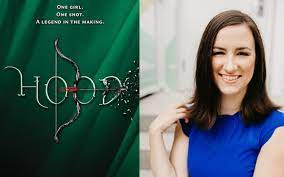
Jenny Elder Moke is the author of Hood, and the Samantha Knox series combining intense historical research with thrilling adventure. Here, she kindly took the time to discuss her inspiration, research and what’s coming next.
1. Where did your writing journey begin?
Shortly after I graduated from college, I found myself working at an independent publisher in Austin, TX. It was such an incredible learning experience, and really gave me a great insight into the business side of publishing. But the creative desire was still there, and I needed a way to fulfill it. I’d always been too scared to write a full-length book, so I set myself a challenge that first year: just write a full manuscript.
To this day, it was the most fun I ever had writing a story. I didn’t have any expectations, any voices I needed to silence, I just got completely lost in the story. I wrote it in a fever state, and when I got to the end I realized I probably needed to learn how to actually write. So I signed up for a local creative writing class, and that was the beginning of my journey to becoming a published author.
2. There are so many Robin Hood retellings, including Robin Hood’s daughter (Yours is one of the rare ones not using Rowen), what inspired your own take?
There was a BBC show in the early 2000s called Robin Hood, and I thought it did such a great job of walking the line between being fun and funny, and tackling serious storylines. It inspired me to do research on Prince John, which is when I learned that the bad guy from all the Robin Hood stories actually became king of England for twelve years. I was outraged for Robin and everything he fought for, but it got me thinking – what would Robin Hood look like decades on from the stories most of us know? How would he keep fighting the good fight against a tyrant who now held the highest seat in the land? And since I knew I wanted it to be a YA I knew his daughter was the best way for me to have a fresh take on an old story.
3. With such beloved characters, how did you tackle the expectation hung onto the after happily ever after when it came to Robin and Marian’s marriage/family?
That’s actually where I had the most fun developing my own story. I love to take structures we know – like the Merry Men, and Robin Hood, and archery – and use that to support a new story on top of it. I knew readers would have very specific expectations, but in this case I really wanted to hold to the spirit of the most well-known Robin Hood stories, from Howard Pyle’s The Merry Adventures of Robin Hood.
4. A major plot point is Isabelle’s questioning of her faith, how did that connect with your own Catholic School background?
Ah, you did your research! I think the question of faith, the search for meaning and purpose, is inherent to humanity. I think it’s healthy for young people (really, people of all ages) to question what they’ve been taught, why they’ve been taught it, who taught it to them, and what they wanted them to believe. It was important for me that Isabelle question where she came from in order to move forward to where she needed to be.
5. What do you think it is about Robin Hood and his Merry Men that draws readers back to the stories?
I think it’s that timeless battle of the good guys versus the bad guys, the little guy taking on the giant, the desire for someone who will stand up for those who can’t stand up for themselves.
6. Sam, Bennet and Jo are so distinct yet their personalities mesh perfectly so they make a crack-shot adventure team. How did you develop the characters and did they change from your initial vision as you started writing?
They definitely changed and grew a lot from the first time I ever wrote them. In my initial draft, Sam was much more timid and Bennett was more of a playboy (I know, I really can’t imagine it either).
But eventually, through many (many many) rewrites, they eventually grew and filled in the spaces between each other until they really represented all aspects of a strong team. I like to think that Bennett is the brain, Jo is the brawn, and Sam is the heart. On their own, they’re each unbalanced, but together they balance each other out.
7. Sam/Bennet are refreshingly mature in their buildup and communication. How did you plan their dynamic?
The thing I love most about Bennett, that tends to really annoy readers, is that he’s the most practical of the three of them. He’s always the one who says the obvious – that something is dangerous, that they should get the authorities involved, that they should turn back. It’s not much fun in an escapist adventure, but he’s absolutely the person you want in your corner in the real world. And I think it’s important for him to play the level head for Sam’s headstrong adventuring. She needs someone to pull her back sometimes, and he needs someone to push him out the door (of the library).
8. What drew you to archeology/occult in the 20s in particular?
The 1920s were a fantastic time for archaeology. There were so many discoveries in the decades leading up to it, and then the ultimate find of the century – King Tutankhamun’s tomb. It brought in a wave of interest in archaeology, and ushered in a lot of new technology in the field. It felt exciting and new and unexplored, which was a great place to put a girl like Sam.
9. There is so much historical detail involved in the series like archeology techniques/debates/innovations, ancient cults and myths, creation of ciphers etc. What is a day in the life of your research like?
SO. MUCH. RESEARCH. I don’t know why I do this to myself, but I always pick stories that require layers and layers of research. This series in particular was a doozy – Celtic mythology, archaeology methodology of the 1920s, medieval Dublin architecture, the list goes on. Usually when I get a story idea, I spend a few months just researching, reading everything I can about the subject. Then as I’m planning my story and writing the first draft, I’ll do spot research (like losing two hours of my life trying to figure out the size of porthole windows on a certain ship).
10. Were there any interesting details/legends that you found but weren’t able to include in your fictionalized adventures? Are there any you’re excited to explore next?
So many. I’m constantly reading about interesting things and trying to figure out how I can write a story to incorporate them haha. One of my favorite details to share from Hood is the fact that sisters in the Middle Ages actually wore their hair shorn (shaved). It was supposedly to make them more pious, but it was often forced on them by male priors or abbotts, and probably had a lot more to do with these men being too attracted to the women otherwise. But it would have been so distracting to the story for Isabelle or Marien to be bald that I chose not to include it in the story.
11. Favorite scene to write (from any of your books)?
Ohh, that’s a tough question! I think any scene I get to write with a lot of fun banter and great dialogue is always a favorite. One of my favorite scenes to write in all of my books was the treasure hunt sequence through Curse of the Specter Queen. It was one of those scenes were I thought it was so crazy and outlandish I could never pull it off, and then I researched for days, and wrote the whole thing in a single session. To this day, it remains one of the most fun things I’ve ever written.
11. Any news on upcoming books you’d like to share?
Absolutely! My next novel, A Spark In The Cinders, comes out June 6th this year! It’s a Cinderella reimagining from the perspective of one of the “wicked” step-sisters, and it was so much fun to write that I can’t wait for readers to meet my girls!
 Rachel Reads & Reviews
Leave a comment