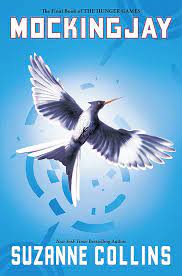
The final book in the gut-punching trilogy asks us readers to choose which cute boy is cuter and. . . okay I’m joking. While I can see parts where Collins pushed back against the urges behind the scenes for more love triangle, Katniss and is undoubtedly the star of this book as she tackles the horrors of a war, and revolution and the unending cycle of violence.
Since the end of the disasterous Quarter Quell, and the bombing of District 12, Katniss’ mental state has only gotten worse. While the surprisingly thriving albeit strict District 13 has helped her recover in many ways, the PTSD and memories haunting her mind leave her confused, paranoid and on edge. Possibly forever. But she can’t show that angst because she’s still on camera as the symbol of the rebellion. The rebels need their mockingjay as each district turns against the Capitol, and Katniss realizes the game isn’t over, it’s just changed.
Collins is pretty explicit about the commodification of violence and appearances as she notes the use of propos and propoganda to bolster the rebel cause, how Katniss is instructed and controlled to get maximize effect for messaging and her ironic statements that her stylist team is needed to get the “attractive” amount of grit and suffering.
And while they are trying to get Katniss’ best angle, the war rages on, costing countless of innocent lives in hospitals and in the trenches, all which weigh on Katniss. Just as Katniss is changed by her experience in the games, making her hardened and more pragmatic, Gale has become more ruthless. He’s willing to, to use hunting terms, get inside the “predator’s” aka the Capitol’s mind and mimic their tactics in order to salt the earth. This includes killing their own spies, and civilians, forgoing any mercy.
But what is ‘crossing a line’ in war? That’s what Katniss questions even as she admits that she’s a hypocrite to do so especially when her hatred and rage cloud her judgement. Nonetheless, Gale’s willingness to quash everyone in pursuit of the cause, willingness to die for the cause, turns him into an extremist that Katniss can’t fully trust. Severing that romantic line and the friendship.
Peeta’s choice as romantic lead seems obvious but is also blown to smithereens thanks to the Capitol’s torture and hijacking of his mind so that he has forgotten most of his memories and views Katniss as the enemy. It’s heartbreaking as Katniss’ loses each of her support systems one by one, adding to her isolation.
Honestly, the book is weighed down in its realism. There are bright moments (Joanna and Katniss bonding, Annie and Finnick’s wedding, Buttercup reunion) and a happy ending. But Collins is committed to showing the ugly physical damage and the deep psychological scar on Katniss as she loses herself into depression and mental breakdowns piled by the responsibility heaped upon her by uncaring, power-hungry authority figures that seek to replicate systems that will perpetuate more violence. Katniss even laments how she despises everyone, including herself because humans are simply that detestable a spieces repeating this fruitless acts of mass pain and violence for no good reason.
Nonetheless, that apathy kept me hooked as Collins maintains her suspense, sympathetic characters, unraveling Capitol/District secrets, and the use of Katniss’ paranoid mindset allows readers to question the motives of everyone like Coin, Snow, Gale, Haymitch etc. Plus her descriptions of the horrifying booby traps, and futuristic weapons of this new hellscape, the unique technology of the world and the tight worldbuilding remains a high point. I also cannot forget the memorable Hanging Tree song which remains haunting in movie-melody and in song meaning.
Most of all, I applaud and appreciate the deep themes that Collins tries to portray in this trilogy and her willingness to go dark with a pragmatic and sometimes ruthless heroine who is independent, caring and possibly the most human.
And because I can’t resist: “May the odds be ever in your favor.”
 Rachel Reads & Reviews
Leave a comment