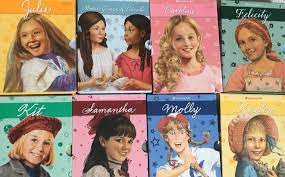
Since I have almost finished my American Girl collection (4 more to go, woo woo), I decided to do a little retrospective on the series that has touched so many childhoods and have surely sparked my interest in historical fiction.
My retrospective will be primarily focusing on the arc of the series since they’re pretty formulaic with some exceptions like Kaya, Julie, etc. In fact, I was pretty surprised when I was reading to find the character arcs that spread out across the book. It’s always amazing when you’re able to find new layers in the books you read and I’m also able to find greater historical connections now that I missed when I was little.
Kaya: Kaya’s series is set before direct interactions with colonists so you don’t have that part of history hanging overhead but there’s still some major problems she has to deal with such as coming of age, proving herself and enemy raids. The arc that I was able to pinpoint is about Kaya learning to become part of the greater community, no longer a child, but as a grown-up girl who doesn’t need her elders to watch over all her decisions. Though that still crops up when Kaya makes a mistake.
This sort of arc makes sense as the Nez Perce were very community-oriented where individualism doesn’t matter as much as making sure you’re helping everyone. Part of that is finding her role in it which comes from honing her gifts with Swan Circling, trying to train High Step and so on. Part of honing her gifts also leads to confronting her flaws like her impulsivity and thinking before she acts, sharing her feelings, all which help her become a wiser person.
Felicity: Felicity is all about independence befitting a series all about America gaining independence from England in the beginning of the Revolutionary War. However, Felicity’s independence stays primarily in the local sphere of her town and are represented in a variety of ways. There’s Felicity helping her beloved horse, Penny gain physical independence from the mean Mr. Nye; There’s the political independence of Felicity forgoing the rules to help alert the local militia of the British plot to steal gunpowder; And there’s the apprentice, Ben who’s hevaily involved in the revolutionary fervor and teaches Felicity of the ideals of patriots.
Besides the focus on independence, there’s also a reoccuring theme of the soft power of feminine as Felicity learns from her etiquette lessons on how to stand up for her beliefs as a patriot by not drinking tea, by taking up the housework when her mother is ill, there’s power in women’s work even if she’s not carrying a gun. It also lightly touches on the liberal patriot vs conservative divide as Felicity’s friends and some of her family are split as to whether the colonies should leave Britain’s strong arm. It encourages Felicity (and the readers) to see beyond politics and maintain those friendships despite disagreement. Plus there’s the requisite coming-of-age arc of Felicity learning to become more responsible and upholding her duty as the eldest lady in the house.
Josefina: Josefina’s story arc is clear from the beginning as readers are told of the death of her mother and how exciting it will be to meet their Tia Dolares, maybe they’ll be able to learn more about her and feel closer. This is especially something Josefina wants as she had the least time with her mother. I appreciated how the series explored the difference sides to navigating grief from trying to maintain connection through Navidad traditions, anger to how Tia Dolares seems to be trying to change the way things have been at the ranch, like she’s trying to replace their mother, and of course, acceptance. Tia Dolares has a major role in this arc as each book builds on developing Tia Dolares’ new role in the girls’ lives and readers can see the acceptance from the girls changes bit by bit, and highlighting the growing connection with their father.
Kirsten: This also struck me as one of the more bland series but that just might be because I’ve never been into prarie life. However, I find that it did a preety good job in depicting the basics of the immigrant experience. Growing up in a new country certainly adds to some of the struggles as Kirsten learns to deal with grief, gaining more responsibility by helping her parents on the homestead ontop of learning a new language so she can fit in. It’s very Little House on the Prarie, yet realistic because I forgot how bad somethings were on the prarie like the guy who froze to death and their house burning down. It’s a series that definately deserved another look. It also provides an interesting contrast to another immigrant girl, Rebecca which I’ll talk about below.
Addy: The series did an excellent job of depicting the heinousness of slavery by putting a very personal face to it through Addy so readers can empathize with her. Plus highlighting again that’s awful to put children, and just human beings in general through slavery as if their less-than. It doesn’t hold back with Sam losing his arm, the family being split up, discrimination in the north and so on. But it is not all tragedy.
The series also focuses on the importance of freedom, and the meaning it has for Addy’s family and other former slave. They’re building a community of their own, helping those who have escaped just as they have even as it hints at the divide between rich free blacks and their poorer bretheren.
Samantha: Samantha’s series takes place near the end of the Victorian era and the beginning of the 20th century which is why this series arc is all about change. The class divide is starting to disintigrate, not only through Samantha and Nellie’s friendship but as the rich begin to take some interest in the rights of the working class and the end of child labor, promoting interclass mingling. However, it takes time for this to happen as prejudice against the poor is a big feature through others’ cruel treatment of Nellie. There’s also focus on women’s rights clashing with traditionalists like Grandmere as Samantha learns what she wants to follow and begins to embrace the new age.
She’s also embracing her family as different as it may be from others when she goes to live with her Uncle and Aunt and adopt Nellie’s sisters. I also enjoyed how the series had Samantha learn about others and recognize her own place of privilege and that she can wield her wealth for the good of others as she did when she learned about Nellie’s factory life. This was actually quite common as Carnegie began a “Gospel of Wealth” trend that believed the rich should use their wealth for the better and give it away to help others. Something Grandmere sort of references as she tells off her guests’ dispargement of Nellie and Samantha interacting by saying that Samantha is using her position to help someone else, being a teacher and most importantly, a friend.
Kit: Living in the Great Depression is pretty depressing as you can imagine from the nickname of the era but Kit’s series is anything but as she has an FDR-lite attitude in trying to keep up hope. Thriftiness and being more open to team work and helping others is a big theme of the series since no one can spare a dime (I’ll stop with the puns now). Kit’s uncle providing an excellent contrast with his miserly attitude in not helping anyone else making him the antagonist of the series, showing the wrong way to look at things. All together it is a greta example of what the government was trying to convey with a “Things will get better” rhetoric as it’s the American way to get by with the help of your friends and family.
Molly: The first American Giirl series about the homefront, Molly has a lot to learn. Rather the war provides almost a framing for Molly’s life as so many things are consumed by it from class activities to rationing which makes sense since the war was one of the times when everyone in the US was truly united in the effort. However, even though war-talk is everywhere, it doesn’t feel real to Molly, it’s more like a game. So her series arc is more about her starting to understand the seriousness of the situation especially as she talks with her English guest, Emily about the true cost of war. Plus the camp color war providing a nice metaphor for war mentality of the era. She still is a bit selfish at the end of the series though, and I feel Nanea’s series dealt with this era a lot better.
Julie: I guess my history isn’t up to snuff because I thought all these things happened in the sixties. Well technically late sixities but the issues of the enviroment, women’s rights? That’s all seventies and Julie is learning to deal with all the change coming her way. Much like Samantha, her story is about family and where she wants to stand in the new waves of change taking over America. While Samantha has a blended family, Julie is focusing on her parents’ divorce which was still a pretty big deal then and her second book deals with her feeling like she’s different because of it.
It’s also more “political” in that it deals with all the social changes of the era like feminism, disabilities, sexism and enviromentalism. Julie is usually on the side of right as she belives in that America can be changed for the better, but also grows through these movements as she learns to keep going despite the hardship and scorn heaped against her.
Rebecca: While Kirsten does keep some traditions from Sweden, her immigrant experience is primarily focused on assimilation and embracing the opportunities America offers. Here, Rebecca’s immigrant story focuses on combining tradition with the new dreams and betterment America offers. From accepting Christmas decorations while lighting the Hannakuh candels, helping her family while secretly fueling her own dreams to be an actress which was a big no-no for a good Jewish girl, Rebecca’s arc is all about appreciating the melting pot of the immigrant community in America and appreciating thise diversity.
Marie-Grace and Cecile: This was unique as it’s the only series with two perspectives rather than one thus has three stories instead of six. But even though it has two sides to every story, both girls are in agreement in enthusing the uniqueness of New Orleans’ culture and life.
However, they both do have their own mini-arcs in the three books they have as Marie-Grace learns to help others and reacquaint herself with her home and be part of the community again after her time away. Meanwhile, Cecile humbles herself a bit to help with her family and share her musical talents while dealing with the discrimatory Americans.
Caroline: Even though Felicity’s series showed that the US has no time for British control over them, the War of 1812 proves that somethings have to be fought again to make the message stick. Caroline is stuck in the middle of it as her father, a prominant shipbuilder, gets involved and captured. She has a much closer view to the battles than Felicity ever did so fittingly, her arc is all about making tough choices in war such as burning down shipyard, sacrificing her boat for blockade, and being a thief. Caroline learns to put her wants aside for others in war and in her personal life as she navigates with friendship issues. She also learns to deal with separation from her father during war and a new closer bond with her mother.
Maryellen: One of the first books in the new BeForever line, Maryellen is in the fifties though it’s not all sunshine as the stepford-like depiction media shows us. Maryellen struggles with the eternal debate of conformity vs standing out. A huge theme in the fifties is that conformity as everyone wanted the ideal American dream shown on new tvs and cookie cutter suburb homes. Luckily, Maryellen learns how to be exceptional is worth it even though she recieves some initial scorn when she does unpopular things like befriending Angela whom Maryellen’s friends distrust because she’s Italian. A perfect representation of Cold War suspicion that was rife in the era.
Maryellen also gets into science as she promotes the new polio vaccine, a personal mission for her since she recovered from polio. It is sadly relatable today as Maryellen struggles to prove to people that it is a good thing to eradicate such diseases. Same with her trying to assert herself among the boys as they work on their science project. However, it’s not all about Maryellen vs the world as she also learns to confront her flaws by becoming more responsible, be more open to her big, rambunctious family and recognize the importance of teamwork in using each other’s differences and strengths.
Melody: Now, we’re at the actual sixities. There’s still rights to be fought for, and Melody’s focus is on the Civil Rights Movement. I really admired how it delved into different parts of the era from the opportunity Motown gave to black musical representation, the Church community that provided strong foundation for the non-violence protests, as well as the beginning of black feminism and black power that Melody learns from her cousin.
Despite the power and excitment of the movement that many believed things will change for the better, there is still a lot of systematic racism to fight against. That’s why Melody’s story is all about finding courage in the face of fear and hatred such as when Melody loses her voice after the AME Church bombing. She also learns to be a leader and the many ways to protest against discrimination. Because theer’s a large cast in Melody’s family a concurrent theme is about keeping family close while following dreams that differ from expectation as well as the importance of faith keeping them together.
Nanea: The second series focused on WW2 homefront, Nanea is much closer to the war after the Pearl Harbor bombing. She knows it’s not a game, it’s scary from seeing the soldiers burned and drowning to her friends leaving for the Japanese concentration camp. That only makes Nanae more determined to help out on the homefront. It’s an uncertain world but doing so gives Nanae some control and responsibility. It also harkens to how they used such acts to prove their patriotism in the face of discrimination for being different from mainstream American society. I do wish it dealt a little more with talking about the Japanese concentration camps when Nanae’s friend is forced to leave but I suppose it makes sense since the characters wouldn’t be aware of the unfairness at the moment as they would in hindsight.
Courtney: These eras are just getting closer and closer, I suppose a 90s girl will be announced any day now. Meanwhile, Courtney is an 80s girl and it is highlighted with her total tubular lingo and her addiction to the arcade. Courtney’s arc is also about family, this time with step-siblings and grief as Courtney doesn’t understand why her stepsister is suddenly so nasty to her aftre having such a content childhood together. Why does the “step” matter so much? Courtney is also dealing with living in the second wave of feminism as her mom campaigns to become mayor as many question can a mother do her job and be a mom? It’s an infruriating question alongside her questions of arcade game female representation. I’ll admit I haven’t gotten my hands on the second volume yet, but Courtney’s arc definately deals with the questions surrounding what females can and cannot do, and family.
Claudie: The latest American Girl deals with my favorite era! The 1920s. However, it’s not all Gatsby parties in Claudie’s world. Rather she’s living in the height of the Harlem Rennisance which sparks Claudie’s creative dreams. Surrounded by artists, dancers and the like, Claudie wants to have a special talent like everyone else, she doesn’t know what it is. Only the first volume has been released so what Claudie’s gift has not been answered but the arts is the core of the book as Claudie calls for the aid of her friends to use their various arts to help others and promote community. And why do we need arts in this time? Lots of reasons as Claudie’s story details the disparities between black and white people, lynching, evicitions and her father’s shellshock, opening Claudie’s understanding to how cruel the world can be and how art can be a small part to healing.
And there it is! I hope you enjoyed my thoughts on these memorable touchstone of books and dolls in American childhood.
 Rachel Reads & Reviews
Leave a comment