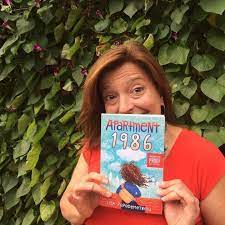
Lisa Papademetriou is the author of several lower and middle grade books with genres ranging from realistic fiction (Apartment 1986, Homeroom Diaries) to her fantasy novels, (Dreamway, The, Wizard, the Witch and Two Girls from New Jersey) and more that readers are sure to love and recognize. Here, she kindly took the time to talk about her catalogue and what’s coming next.
1. Some of my favorite books of yours came from the Candy Apple imprint, how did you come to work with them?
Before I was a writer, I was an editor. I worked at several large publishing houses, including Scholastic, so by the time I became a full-time writer, I already knew quite a few editors personally. When Scholastic started Candy Apple, someone recommended me as a writer who could come up with sweet, funny stories. It was just luck that I got hooked up with that line of books!
2. When writing the Accidentally quartet, did you have a clear vision for where all the characters would end up (redeeming Fiona, Amy realizing she may have feelings for preppie Preston, Lucia becoming queen bee, etc.)?
No, I didn’t. I had a clear sense of the characters, but I didn’t know where they were going. In the end, they were more complex than I originally planned.
3. Another imprint you worked for was Disney as author of several Disney Fairies books. How did it work when you were one of several. Did you share notes on the universe and characters so it would stay consistent? Were there guidelines?
I was actually an editor at Disney Press and did some of the development work on the Fairies series, but most of it was derived from Gail Carson Levine’s book, Fairy Dust and the Quest For the Egg, which was—in turn—based on the fairies in Peter Pan. In a series with several authors, the writers will submit their ideas to the editor, who is in charge of making sure that everything is consistent. We writers read the books that came before ours, of course, so that we know the characters and events. And there are guidelines to keep everyone on track. But part of being a writer for a series with multiple authors is being able to work that way—almost collaboratively.
4. When writing The Homeroom Diaries, did you draw from your own
diaries and memories from high school?
Homeroom Diaries was co-written with James Patterson, who came up with a lot of material in the book. That said, some of it was pulled from my own experiences. Many of the moments between the friends were based on feelings and relationships I’ve had. There’s a cafeteria scene in which someone starts a food fight, and another character makes a somewhat self-important speech about not wasting food, and in the middle of the speech, he gets hit in the head with a chilidog. That happened to me. I was the speechmaker, and someone flung an entire loaf of bread at my head.
5. What was it like working with the illustrator to combine Margaret’s
narrative with her doodles?
That was so much fun! As I was writing, I came up with ideas for the illustrations and noted them in the manuscript. Almost always, these would come back from the editor with a note to “make funnier”. So I’d try to push the humor as much as possible, until it seemed like it would be a good illustration. But, of course, once the art came back from Keino, it was a whole other level—better than anything I expected.
6. What were some of your favorite fantasy tropes that you got to utilize in The Wizard, the Witch and Two Girls from NJ? What is it about Tolkein’s Middle Earth that resonates so strongly with readers over time?
I think Tolkein’s Middle Earth resonates with readers because most of the characters, settings, and situations are archetypes that are familiar to us from centuries of fairy tales. Magicians, kings, warriors, dragons, dark forces, and—in the middle of it all—children who save everyone. Because that’s what Hobbits are, really. Tolkein describes them as being the size of a child and I think, subconsciously, that’s what they register as to readers. In the Wizard, The Witch, and Two Girls from Jersey, I loved working with the pompous elves, the annoying animal sidekick, the dragon, the giant spider, the witches, the wizard—all of it. But I also loved writing a “buddy comedy”, one in which two girls with nothing in common have to work together for a common goal and become friends.
7. Your latest book, Apartment 1984 deals with the protagonist, Callie slowly learning about her family’s, particularly her father and her grandparent’s estranged history, eventually helping them see things in a new light. How did you balance Callie’s coming of age and finding herself amidst all the pressure to have cool things like concert tickets with the story about her uncle and grandparents?
Sometimes I think of writing like juggling. You throw a ball in the air, then another, then another, and you hope you’ll catch them. That’s how life is—it’s full of problems big and small, and it’s full of conflicts that seem to be about one thing but are really about something else entirely. But the main thing about Callie is that—even though she has all of these silly problems and she doesn’t always make the best decisions and she doesn’t really sound super-smart—she is very smart. People underestimate her because they see what they expect to see, not who she really is. Everyone in the book is like that.
8. The Dreamway has an Alice in Wonderland-esque dream world
adventure, only bolstered by such characters like the Door Mouse and
Cole’s increasingly changed moods to violence. But as you also explored dreams, memory, nightmare and all the components connecting them with emotions, did you draw on psychology and such spirituality regarding the importance of dreams?
Yes, I did. I wanted a way to represent Cole’s anxiety and depression that was not literal. The point of fantasy is that the metaphor reveals reality. Cole being trapped in a nightmare was a representation of what his fears were doing to him.
9. You are also the creator of Bookflow.pub, a book writing platform.
Please explain what they do and how you came up with the idea?
Bookflow is a tool for writers who are working on a novel and need help staying motivated and organizing their plot. I founded this after teaching in a master’s level writing program. Most of my students were fantastic writers. They came up with great characters, constructed beautiful settings, wrote great dialogue, etc. But they often had trouble coming up with events and writing them in a way that made sense. I wanted to make a tool that was a bit like a mentor, that could help support them with checklists and a format that encourages thinking through what happens and why.
10. Anything else you’d like your readers to know or exciting news?
I’m planning to launch a new book on writing in March! It’s called Secrets of the Plot Goddess and will be available on Amazon.
 Rachel Reads & Reviews
Leave a comment