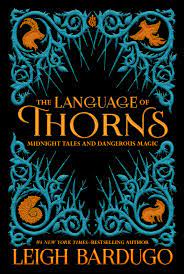
These Midnight Tales by Leigh Bardugo collect stories from Ravka, Kerch, Fjerda and more showcasing her talent of taking that grim undercurrent of the original tales and delivering some universal truths about humanity and their desires for love, happiness and family.
The first story, Ayama and the Thorn Wood is one that most resembles a classic fairytale. It begins with a reference to the myth of minotaur as the king’s second son is a born a monster so he throws him an underground maze. It follows a Beauty and the Beast/Scherzade-esque tale when the son escapes the maze and plunders the countryside. After he massacres the soliders sent to subdue him, the king gives out a bounty for anyone who can convince him to leave the kingdom alone.
Ayame is the plain second daughter of her family. Overshadowed by the grand beauty that is her older sister, Yeva to the point she’s treated like a servant. So she’s an easy choice as they won’t be too sad if she gets killed but they can recieve a grand fortune and a more suitors for Yeva if Ayama succeeds.
Ayame does so as she is used to dark corners and manages to gain the beast’s respect when she tells him a story that makes him feel. A story with a dark truth rather than a happy ending and he agrees to leave the kingdom alone. But a good fairytale follows the rule of three so this goes on two more times, Ayame telling a story to secure the beast’s promise, slowly falling for him and the way he listens to her when everyone else ignores her.
It delivers a great lesson on the cruelty of scrapegoating and tyrants and I found the refrain that “Stories don’t have to be happy but they must be honest” to be very powerful.
The second tale of The Too-Clever Fox is like an aesop fable. Well a dark aesop fable but one nonethless as it describes the clever fox, Koja who always uses his wit to cheat death be it his vain mother or the hound dogs. But then, the animals begin to go missing in the woods and everyone fears its due to the supernaturally powerful hunter, Lev Jurek. As the most clever of them all, Koja is sure he can stop him by allying himself with ‘s fearful sister.
I don’t want to spoil the twist lesson but I will leave that nothing is as it seems and that you must be aware of your weaknesses because someone will take advantage of it.
The Witch of Duva is Bardugo’s take on gingerbread houses and witches in a small town with a haunted wood. Nadya is having a hard year from her mother’s death to her older brother leaving for draft and her father’s remarriage to the beautiful yet cruel, Karina who fits evil stepmother trope to a T. The story plays out as an a true crime suspense with a fairytale glaze as Bardugo tightens the noose with each missing girl, snow blowing and trapping Nadya inside with her cruel stepmother to the point she cannot stand it anymore and fears for her life. However, Bardugo continues the theme of people are not who they see, and uses this story to point out on what people want is different what they need and what you want can hurt.
In Little Knife, Bardugo addresses the question of whether three tests are a good way to get a good husband. The beautiful Yeva is adored as her beauty puts everyone in a trance. Everyone wants to be her husband so her greedy father sets forth a task for people to win her hand. An easy task that he’s sure the prince will win but the begger Semyon succeeds instead as he has the river at his command. So he sets forth a second challenge and a third to save face and prevent his daughter from marrying Semyon. The lesson is a good one as it reminds readers that just because you use something doesn’t mean you own it, and I believe many will be satisfied with Yeva’s choice for marriage.
The Soldier’s Prince: Bardugo brings the Nutcracker’s point of view to the center in this retelling of The Nutcracker. Here, he develops his own sense of personhood, his own will and allows Bardugo to explore the nature of projecting dreams onto others or toys in this case and learning to break free. I especially enjoyed the sinsiter underccurrent of illusions and entrancement blurring the lines of reality and fantasy.
When Water Sang Fire has a meaningful title as the mermaid prince, Roffe is seeking for the magical gift of finding a fire that continues to flame underwater. As sixth to the throne, this can be his chance to impress his father and become king and he goes to the talented yet outcasted mermaid, Ulla. If that name sounds familiar to Ursula it should as Bardugo creates a tragic yet poignant backstory for her. The reason she is outcast for her grey skin, dark eyes and rumors that her father is someone else. Nonetheless, she is a powerful singer able to create gardens and bring storms, and her power is only increased with her best friend, the redheaded, demure Signy who desperately loves the prince. This all comes to head when they attract his attention during a royal banquet and are invited to go to shore for the summer thus sparking the magic gift hunt. The themes of isolation and love carrying on in their adventures on shore and Ulla unexpectedly finds out the truth of her past which turns her world on her head compounded by the people she loves most turning out to be darker monsters than mers think her to be. . . well this one ended up being my favorite and a brilliant way to end the anathology filled with darkness and grey.
A lovely collection of grim fairytales that add magic to the world and give a greater sense of the morals and lessons children in the Grishaverse glean from these stories as they grow up, shaping their world.
 Rachel Reads & Reviews
Leave a comment