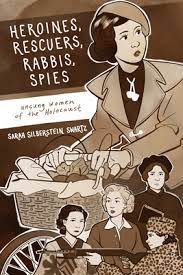
This is an important book. Discounting the rise of ahate crimes that you can see every day on the news, but survivors of the Holocaust are slowly dying out. It is an event that shouldn’t be forgotten and I certainly think people will remember but hearing and seeing witness account do stick more.
This book is a good addition to the history books and living catalogue. Swartz chose to highlight those who survived and lived after the war because living fufilling lives was another way to defeat the Nazis who had taken so much from them.
Only one of the women profiled here did not survive, but she had made her mark despite her recrds being hidden and forgotten. Rabbi Regina Jones came from an intellectual family that valued education, Regina taking a particular interest in theology.
She had the goal of becoming the first female rabbi, her thesis debating this particular point showing that Biblical arguments and historical context that the only prohibition came from societal constructs than Torah law. She did get to be named the first female rabbi but not before years of pushback and demoted roles as rabbical/pastoral assiatnce which is where Jones was put to offer comfort and help to elders, children and women but not allowed to preach or lecture.
Nonetheless, Jones was satisfied with her position as being able to teach fellow women about the Torah and interpreting in a pro-feminist lens for her students to consider becoming rabbis as well. This became more important after Jones was transferred to the concentration camps where she comforted and prayed with her fellow Jews, keeping faith in the dark times.
Unfortunately a majority of her work was hidden in Nazi archives and forgotten where even her former mentor and contemporaries that survived neglected to mention her groundbreaking work as the first female rabbi until she was rediscovered and appropriately honored in the 90s.
Swartz also focused on two non-Jewish women who risked their lives to help others. One was Yukiko Kikuchi Sugihara. You may remember her as Chiune Sugihara’s wife. Yes, that Sugihara, the Japanese diplomat who went against the orders of his superiors by writing hundreds of visas for Jewish refugees to escape Latvia/Lithuania/etc. through the Trans-Siberian railway to Japan. What many don’t realize that the Sugiharas made this brave decision together and she and her aunt had a vital role in helping convince her husband to do the right thing. They paid the price as the family was demoted after the war where they had languished in a prisoner of war camp in Russia. While their work went unnoticed, he was eventually recognized as Righteous Among Nations and Yukiko worked to share her husband’s story.
Swartz also takes this book to share the stories of her mother, Regina Zlotnik Silberstein and aunt Ruth Zlotnik Altman. While they may not be as traditionally impressive as other women in this book like photographer/guerilla Faye Schulman or the director of the Department of the Collection of Witness Testimony and savior of the Ringelbaum archives, Rachel Auerbach. But they demonstrated the every-day courage and strength it took to live through the war that should be highlighted like the others beause they represent the breadth of experience and the stories that make up the threads of the Holocaust and the Jewish community as a whole.
It’s a short book but packs a lot of punch. It’s also a good eductional resources providing map, timeline and glossary for readers to better understand the subject and pique interest for more.
 Rachel Reads & Reviews
Leave a comment