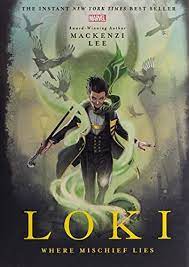
Since I enjoyed Lee’s Gamora and Nebula novel, I decided to check out the first of Marvel Icons. Luckily, I know a little about what Loki does in the MCU since The Avengers is the only MCU movie I’ve seen but that doesn’t matter as this is an origin story where we take a fun historical romp through Asgard, and Industrial London as Loki struggles with his place in Asgard and such things as choice, destiny and stories.
We set the scene in Asgard where Loki has long been the unfavorite child as he shows less muscle and less warrior skill than his brother, Thor. Even so, he still believes he has a chance for Odin to pick him for the throne, he just has to prove himself and keep his magic at bay. Although that’s hard to do when it’s a simple, essential part of him like it is his mother, Frigga. However, his powrs are manifesting more strongly than the simple tea party tricks his mothers does, adding to his feeling of being an outcast.
The only one who understands him is Amora, the apprentice of the court sorceress. An orphan, she is equally alone and feared due to her strength and unwillingness to exhibit any control. She revels in defiance and Loki wishes he could share that confidence instead of feeling utterly shamed every time his father lectures him. Nonetheless, she is a bright spot in his life and his partner in crime.
The latter is very important for on this importan Feast Day that happens once a decade, Odin looks into the Godseye Mirror so he can see the future and prepare fortifications for future attack. Unlike other Feast Days, what odin sees horrifies him and flees the room with his closest advisers and Loki is certain that it is related to him. A fear confirmed when he evesdrop. Odin saw his son lead an army of the undead to Asgard and though no one says it out loud, they all think its Loki. Even Loki but he has to see for himself so he and Amora sneak to look at the Godseye themselves and break it. Amora is subsequently banished and Loki continues to sulk and try to win praise from his father’s one good eye but the damage is done. He is always the decepitve, slippery bad boy who will bring about Ragnorak.
No matter what Loki does, even with Thor accompanying him, the blame lays on him. The world seems to be conspired against him so he is completely uninterested when Odin punishes him to Midgard to investigate some mortal murders while his brother searchs for powerful amplifers. It just shows where he stands.
However his time on Midgard with the Sharp Society reveals some real magical murders going on and a chance for him to make a choice for himself in a world that sees him a villain.
Lee has a history masters so of course, she does an excellent job in describing the grime and dust of factory-overrun London when Loki lands, emphasizing the creaking wood, piles of dung and ever-cloud skies tht confirm his low opinion of Earth. But the humans do surprise him, and despite his wishes he is a sentimental fellow and admires their strength and is saddened that they don’t realize how worthlss they are in the long-run and in Odin’s favor. Just like him.
Honestly, if I revealed more I’d be revealing the big twist on Midgard so I’ll focus on the characters I can talk about such as Thor and Loki’s dynamic which is a classic golden child/scrapegoat dynamic that twisted in that Thor does show genuine care for Loki but is also wary because he genuinely believes in his rottonness too. There might also be the fact that he benefits from Loki being always seen as the villain and maybe he does have that genuine heroic nature of following the rules.
There’s also the relationship he has with Amora that is admittedly dysfunctional and manipulative and he’s aware that she loves to goad him and can be an awful influence but there is a sort of sweetness in that he doesn’t feel lesser when he’s with her. That they revel in their power because they know they’re powerful, it just society limits them.
Loki’s interactions with Mrs. Sharp and Theo were interesting as it allowed Lee to pontificate on the inequalities of human society in regards to gender equality and loving who you love as Asgard doesn’t deal with those social constructs.
As for Loki himself, Lee perfectly balances the sarcasm, suavity, the never let them see you as inferior facade that Loki holds, his one bit of defiance with the insecurity beneath. And of course, the dramatics. There’s nice bits of humor sprinkled throughout but it is mostly introspective as Loki juggles with trying to break out of the story that seems to be set for him, sometimes contends with being the villain they see him as and just trying to work out what the best choice is for himself.
I know it’s a short review but all the good stuff are spoilery so I’ll just leave with plenty of Loki exploration that fans will love as it makes him sympathetic but for the more purist Loki is God of Chaos fans, he admits to his evil plans too and his easy ability to manipulate. So not too oversanitized to the hero side and not entirely irredemable. Lee also includes fun references to myths like Loki’s trip to Alfheim he notices he doesn’t feel cold as other Asgardians do which references how Loki is part frost giant.
Anyway, another enjoyable look into the extended Marvel universe and a treat for the instasiable Loki fan that wants more focus on him tha his fabio-look alike brother.
 Rachel Reads & Reviews
Leave a comment