With these nonfiction books about underrated role models!
We are Here: 30 Inspiring Asian American and Pacific Islanders Who Have Shaped the United States by Naomi Hirahara
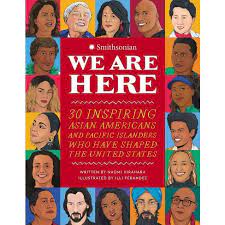
This is another book in the Smithsonian Learning lab series that puts focus on thirty Asian American and Pacific Islanders that have shaped the US, just in time for the 25th anniversary of the Smithsonian Asian Pacific American Center.
Now for those who think this will focus on the usual suspects of Chinese, Indian, Korean etc. Think again. This is an inclusive book that looks at the roots and routes between Asia and the US that has been sought for as a road to commerce and navigational success. These include Native Hawaiian, Micronesia, Polynesia and others aka Pacific Islanders. It also includes Middle Eastern because even though you may immediately think the Middle East is its own separate thing, it is technically in Asia and are intertwined in the community experience.
While it has some memorable people like Dwayne “The Rock” Johnson, and Philip Vera Crus (the cofounder of the Farmworkers United Movement with Cesar Chaves and Dolares Huerta), here are a few that I found particularly fascinating.
Eddie Aikau (1946-1978): He was a dedicated surfer from O’ahu, Hawai’i who had intially been uninvited from the Duke Kahanamoku championship because he was a native Hawaiian, a discrimination that existed for several decades despite inventing the sport. Nonetheless, he was able to come the next year and did amazing feats like surfing forty foot waves and represent the US in the 1972 Olympics.
Due to his skill, he became a waterman to watch over surfers in North Shore and rescued 500 people in eleven years. Not one soul was lost on his watch.
Unfortunately he was lost at sea sailing back from Tahiti. He had joined the original crew of the Hokule’a, a double hulled canoe built according to the ancestral ways of Pacific Islanders that traveled to Tahiti and back as a way of reclaiming Hawai’ian identity. “The Eddie” surf competition was created in his honor in 1984.
Channapha Khamvongsa (1973-): Born in Laos, she was one of the many immigrants whose family moved to the US after the Vietnam War. She loved her life in the US and put her herself to help people, volunteering with the Red Cross and other charities. As she grew she learned about the secret war in Laos where the Us dropped two million bombies (small bombs) on the soil where they remain today. Hidden and killing innocent farmers and children in the countryside.
She grew up earning degrees in public policy and working in such philanthropic organizations as the Ford Foundation and NEO Philanthropy before founding Legacies of War, dedicated to raising awareness and clean up of Laos’ undetonated bombs. She has helped injured families, supported refugees still suffering the trauma of war and lobbied $30 million to work to clear those bombs.
Amanda Nguyen (1990-): A star student at Harvard, Nguyen survived her sexual assault to find out her rape kit would only be kept on file for six months and she’d have to petition the state every six months to keep it in storage even though the statue of limitations lasts 15 years. She launched the nonprofit, Rise and helped create the Sexual Assault Survivor’s Bill of Rights to ensure that rae kits will be automatically preserved without charge during the statue of limitations. Though it is a fedeal law, she is working to ensure it passes in all 50 states allongside her new work in Survivor Safe Haven providing essential services and protections to Asian Americans experiencing racism violence. She also works at Rise Justice Labs, an incubator that encourages future leaders of justice.
Mau Piailug (1932-2010): One of the last people to undergo the ancestral ways and practices of wayfinders in his native Satawal. Starting from age 4, he learned the way of sea navigation without western tools from his palu grandfather, a master navigator. He was formally intiated in the sacred and private Pwo rtiual to become a palu. Another Pwo ceremony wouldn’t be held for another thrity nine years. He’d be the one to lead them after he joined the original Hokule’a voyage (from Eddie’s bio above) as a guide. While he disagreed with those who only joined the mission as a scientific experiment instead of a cultural reclamation, he did help the third team by teaching the captain the ancient ways. He kept the art of palu alive by teaching and inducting sixteen other people into Pwo.
Vishavjit Singh (1971-): He grew up in America and the US in a Sikh family though he didn’t embrace the faith until adulthood after studying Eastern philosphy in collage. It was during this time as he grew out his beard and recommitted himself to Sikh tenets that 9/11 happened and Muslims and other little-known faiths began to experience racist violence. To combat the violence he has taken to expressing himself through his cartoons in Sikhtoons to inform and celebrate Sikh traditions. You might also recognize him from pictures of him in NY dressed as Captain America.
Thenmozhi Soundararajan: Thenmozhi was only in fifth grade in Indian when she learned the family secret. Her mother, the first woman to go to college in her family and her doctor father were formerly from the Dalit caste aka the “Untouchables” that were so outside the caste system they garnered violence from upper castes for existing. Despite living in the U.S., when Soundararajan made a film on caste violence, she drew backlash and scorn for “outing” herself as a Dalit with friends and neighbors stop talking to her family and taking away their plates at shared dinners. Since then Thenmozhi has created Third World Majority tracking Dalits and caste discrimination, revealing that one in four Dalits report facing physical/verbal assault. One in three experience educational discrimination and two in three face job discrimination. Now she advocates for caste to be considered a protected category under civil rights laws in the US and globally.
Just like the other book, there are reading guide questions though less comprehensive as Nuestra America‘s as well as a glossary and a QR code for readers to learn more from the Asian Pacific American Center. Perfect for educational curricula or if you just want to learn more.
Revolutionary Women: 50 Women of Color Who Reinvented the Rules by Ann Shen
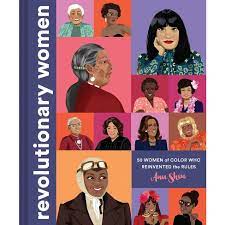
The last in Shen’s nonfiction series of historical women that fought the glass ceiling and changed the world, most are from the US but has other international icons too. This one focusing specifically on women of color. She switches things up a bit from her other works. There are still the brief 1-2 biographies and her whimsical drawings but not all of them follow that form. Some of the profiles are a brief paragraph while their lives and their achievements are narrated through a timeline. Others are done through fun facts that highlight the most important parts of their lives. I enjoyed this as it breaks up the motony and possibly hides unwieldy tangles/scandals like in Zitkala-Sa that bypasses her frustrations in working with the uncaring US government and Rita Moreno’s long list of achievements (but that might just be because she already has several documentaries and books about her). Or lengthen the stories of some that had little biographical information outside their one big achievement like Maria Van Brittan Brown who helped invent the first home security system
Overall, she presents an uplifting and positive portrayal of important, and underrated women, focusing more on what they achieve than what they suffered as she wants to highlight their impact to encourage others who may connect with these role models not to fear the suffering more than the joy of reaching their dreams.
It has several well-knowns like Eartha Kitt, Wilma Mankiller and Naomi Osaka but it also introduces several cool women I never heard about like Ann Lowe who was the fashion designer between such iconic creations like Jackie O’s wedding dress and delivering it to her by hand despite the segregation laws of the time. Another was Joyce Chen who brought Chinese food to the mainstream with her three immensely popular resturaunts, cookbooks and PBS show, Joyce Chen Cooks where she shared the ste and friendship with Julia Child.
Another one that I’m surprised she hasn’t been mentioned before, Jovita Idar, a Mexican American civil rights journalist and activist who fought against the rampant Mexican discrimination, and lynching violence in Texas, informally known as “Juan Crow” laws. Her life mirrors famous black activist and journalist, Ida B. Wells down to racists burning down their newspaper offices and creating suffragette groups to help women of color to get the vote.
A very enlightneing book to add to your Ann Shen collection.
I Am Not a Label by Cerrie Burnell
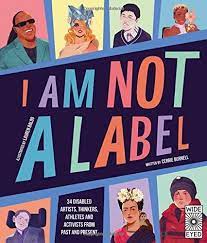
Written by the presenter of Ceebabies, , this lower grade book introduces kids to famous and inspirational figures whose disabilities don’t hold them back. Rather they expand the world and invite compassion and tolerance.
The one-page bios are concise in summarizing the important parts of each person’s life, some recognizable figures are Helen Keller, Beethoven and Stephen Hawking, and their contributions that changed society. She even has three sections dedicated to a certain area like Mental Health, Paraolympic Stars and Hidden Disabilities. Plus Lauren Baldo’s illustrations are charming and has creative symbols and motifs within the margins that will capture readers’ attention.
Some interesting figures I learned about John Nash, the brilliant mathmetician who was the basis for A Beautiful Mind; Victor Pineda whose polio necessitates a ventilator and drew difficulties in education acess. Now he he works as a disabilties activist and created World Enabled which is a database of disabled people’s histories; Redouan Ait Chitt, a Dutch boy born with a missing hip bone, unaligned legs and five fingers who found his creativity as a breakdancer and cheoreographer; Emmanuel Ofosu Yeboah, a Ghanian man who petitioned the King to give him a bike and show that disabled people are not cursed but capable of anything; Isabella Springmuhl Tejada, a Gutamalan fashion designer who creates clothes for people with Down Syndrome like herself (DOWN TO XJABELLE), appearing in Fashion Week and showcasing traditional Mayan textiles; Finally, Stella Young, a young woman with “brittle bone disease”/ osteogenesis imperfecta who seeks to show that she’s not a superhero for living her life and that having a disability doesn’t mean life is miserable. Best displayed in her famous Ted Talk “I am not your inspiration.”
 Rachel Reads & Reviews
Leave a comment