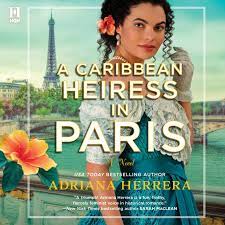
Originally I was going to put this with the rest of my reads for Hispanic Heritage Month post, I loved it so much I had to spill all my thoughts here and now.
First off, Herrera grounds her premise in reality featuring her titular heiress journeying Paris during the 1889 Exposition. Though England and other European areas are known for its whiteness, all utter whiteness due to segregation and racism and rarely shall the two classess meet. But that’s simplifying things. People of color were always present in the past, not just as servants and with steamship travel, those from colonized areas were able to travel to Europe and vice versa.
The main point I’m building to is that the 1889 Paris Exposition was a anniversary celebration of the Revolution and showing off the breadth of Paris’ works and spectacles (for example Eiffle’s Tower which was unveiled and reviled for the first time) and encourage trade between countries. Not just European countries but they invited thirteen delegations from the Americas to show off the beauty and richness of their homeland in each appropriate pavilion.
Isn’t history amazing! The Latin Americas weren’t so isolated from the world textbooks make it seem. They enjoyed Europe’s pleasures while fighting their policies and made business deals.
Just as Luz Alana Heith-Benzan is trying to do. Since her parents’ death, Luz has decided the best way to expand her family’s rum empire is to bring her products to Europe. So she leaves Santo Domingo with her best friends and sister in hopes of making new connections, settle her sister’s future and maybe . . . reach her dreams of tapping into the women’s market by making cordiels for women by women and promoted by other female entrepreneurs and saleswomen.
However, as a young Afro-Latina, Luz knows many doors are closed to her (hence the route towards female businesswomen) including her trusts which is held by a withholding trustee. She is used to men belittling her, laughing her and outright ignoring her when she tries to introduce herself and is with that fire and determination she accuses one Evan Sinclair of doing just that when he messes up her rum display at the Exposition.
Though it’s quickly cleared up that yes, she’s the owner, and yes the should they compromise by getting more tables for both her rum and his whisky. She finds the great Scot to be infruriating and confounding with how easily he accepts her recrimintions while teasing her with suggestions of compromise and offering the aid of his connections. After all she can handle things herself thank you very much as she has for most of her life.
Evan, for his part, is amazed by the bold, sharp-tongued brunette and more than a little taken with her beauty. And while he’d like to bed her, he has other more pressing concerns in mind such as taking down his bastard of a father who sent his mother to a sanitarium, married Ewan’s fiance, generally racist, greedy and abusive, just the Duke is awful. That’s why Evan teamed up with his recently discovered half-brother, Apollo to acrue all his father’s debts so they can own him. Apollo will take his place as reightful heir to earldom and Evan will finally own his family’ distallery without fear of his father selling it out from under him.
There’s one catch, his mother’s lost will gives him the rights to the distallery when he marries.
Luckily, Luz is in a similar conundrum as her trust won’t be released unless the man chooses so (never going to happen) or if she’s married.
Ah yes, the marriage of convenience trope! It works out great here as it always does.
I admire Herrera’s writing in that each interaction between Evan and Luz just sizzle with sexual want and tension, the banter is just top-notch from first meeting to first kisses at a brothel (purely for business reasons, after all brothel madams buy top quality alcohol too). But she also makes their union just seem inevitable thanks to all that they share in common. A single-minded passion for making alcohol and business expansion, care for their workers and fierce love for their family and friends. Both are hot-headed and have a awful habit of trying to handle things all by themselves-Luz because she is used to upholding all responsibilities by herself. Evan because he’s kind of a martyr.
But together, they have each other to walk through the fire. That fierce love applies to each other as well and allows them to finally let go of the reins a little knowing that they have the other to support them. Luz can feel carefree and accept comfort and Evan learns to hope again. They had a moment at the Eiffel Tower balcony, come on! It’s just all so romantic.
But it’s also so much more than romance as you could tell from Luz’s mission statement. She is used to being the other in the room and while Evan’s concern to make others pay attention and respect Luz’s business acumen is admirable. He must be a better ally and allow her to deal with the matters himself rather than escalate violence and hatred by thrashing them just to sooth his own wounded pride in being unable to help.
There’s also plenty of history of women in business, Luz’ grandmother being a rootmaker whose recipe founded their delicious rum and inspired her cordiel line, Aida’s Cordiels. Evan proudly mentions his grandmother, in fact many Scottish matriarchs, were the ones who first began making whisky. They were the founding mothers. And Luz points out the women’s power in selling as their stalls and their consumer power is what helps boost her sales. So yes, lots of historical-recentered girl power, I love it!
There’s also plenty of seeds spread throughout about the effects of colonialism and the broken system that Europe is founded on. To paraphrase Evan yelling at his father, “The Scottish fought the British off their land for liberty, only to forget about such things when they traveled abroad.”
Like I said before, people of color were always present in Europe and Herrera makes that a prevalent point with several of Evan’s family members like his aunt and uncle who form an iterracial marriage with the prequisite living on fringes of society due to racism, his half-brother who is an example of many bastard children from the tropics due to European heirs ravanging their seed all over the colonies for the sake of pleasure and sometimes conquest of Latin fortunes.
Luz makes a point that she is a product of such union, being of Scotch blood thanks to her father, presenting an equal union whose subsequent rum empire lives by their values by allowing their workers (all free people of color) own shares in the business.
She also makes a point about the results of colonialism, pointing out that she doesn’t speak Spanish. She speaks Dominican Spanish, a dialect that is a distinct blend of the language forced upon indigenous peoples overlayed with their own words, slang and the like. They are their own people and culture despite Spain’s attempts to crush the native cultures into pure Spanish assimilation.
Additionally, Latinos were present in Europe for schooling like Ecuadorian doctors from Sorbonne (Bonus point in my book! Double bonus because they mentioned that the man was specifically from Guayaquil, Ecuador. Also isn’t it a tiny bit sad that this is only the second time I’ve seen Ecuador mentioned in any book in my 22 years of life. It’s always Mexico, or Puerto Rico or Cuba which is understandable, they have a vast history but still. Anyway, tiny aside over)
Another example is that Luz and her friends, Las Leonas, attended Swiss boarding school for education and refinement as affluent young ladies.
Which brings me to Luz’s friends, the future protagonists in the rest of the series. Their friendship is clear from the first page despite their contrasting personalities like flirty, bold, fashionable artist, Manuela and studious, reserved doctor, Aurora with level-headed Luz between them as they encourage and ground her in her amazing journey in business and love. Though the spotlight was mainly on Luz and Evan, the few moments where they stand by Luz is just full of warmth and I’m excited to see their times to shine and hopefully more friendship moments.
The only slight hiccup was the second to last chapter which pulls a last minute damsel in distress twist which is a staple of the genre, I’ll admit but. . . I’m just not usually a fan of those. The book usually completely holds my attention based on the romance, family dynamics and social nicities alone that putting in a gun to the head feels like its there to add unneeded shock of action to the story. It’s also usually a catalyst for getting the protagonists to admit they love each other when its already so clear and they had already resolved to admit it so again, unnecessary in my opinion.
But that’s a minor thing compared to the lush historical detail, focus on the super interesting underlying history of women and people of color that is so often ignored, inclusion of latinos and their affluence in the eighteenth century that is also ignored, female friendship and power, and deliciously steamy romance in a sex-positive way (again the brothel scene, it had humor and tension and I just really love it) with moving protagonists. It hit all my favorite notes.
5 larimar stones!
 Rachel Reads & Reviews
Leave a comment