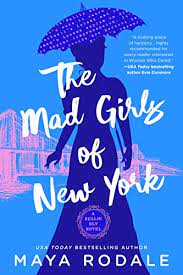
Since interviewing Maya Rodale, I’ve been eager to get my hands on her historical fiction novel on one of the U.S.’s most famous roving reporter in one of her most famous pieces-“Ten Days in a Madhouse” and finally the library has come through!
And you can see the heart of the story in the dedication and the first quote: For women who help other women
Courage in women is often mistaken for insanity-Psychiatrist of suffragist Alice Paul.
That’s the biggest lesson to be learned in this novel and one Nellie bumps up against repeatedly. When she first arrives in New York from her smalltown in Pitssburg, PA, she’s determined to make it big. She knows it won’t be easy because her sex automatically makes it so but she’s has a single-minded determination to make her living and not depend on men like her poor mother had to.
Unfortunately, it’s been months and she can’t get anything but ladies pages. In fact she writes a small expose asking prominant newspaper owners why they won’t employ women (Answers range from Too emotional, too respectable to get the story, inaccurate, don’t need money or they already have one female reporter, they don’t need another). This was a clever way to showcase Nellie’s niche in reporting but allow readers to get a historical insight for how women were viewed in the Gilded Age.
But it’s not only gloom and sexism (okay there’s a lot of that) but Rodale sneaks in some of her snarky humor that perfectly fits Nellie’s bold voice as she asks one newspaper editor if he really thought women only read the ladies pages. It was a revelation to him.
Anyway, Nellie is frustrated until she sees a swooning female, Marian who turns out to be a stunt reporter. A stunt reporter is basically what they called an undercover reporter at the time, and it gives Nellie an idea.
She goes to the New York World and pitches herself as a woman who can expose Blackwell Island Sanitarium-a place where supposedly once in you can’t get out.
She also manages to edge out another hopeful reporter, Sam Colten whom Nellie dubs Mr. One-O-Clock because he had an appointment with Mr. Cockerill (editor of the World), highlighting the boy’s club mentality that allows men easier access to opportunity. He’s important too as he ends up working for the Sun and tries to take her scoop. Yes, there’s some sexual tension too, how can you not when you have two fiercely competitive reporters, writing for truth, justice and reform.
Rodale closely follows Bly’s real life article as she delves into Nellie’s ten days in the madhouse, which seems longer because the sanitarium completely cuts off the women from the outside world (and her editor had promised to get her out in seven days but decided ten would look better in the headlines. Really couldn’t have warned her before, man?). Also living among insane women, treated as invisible by the staff and denied basic rights like good food, clean water and freedom of movement, if you were sane before you went in, you won’t be when you get out.
Which is what Nellie finds to be most heinous. Many of the women commit the crime of being “inconvenient”. Some are just grieving lost loves or children, some were picked up for being too drunk, others are immigrants who just can’t speak English. Tille who becomes one of Nellie’s closest companions on Blackwell has what I suspect to be epilepsy, and she’s dropped off there because her family didn’t want to take care of her anymore. Not all of them are insane, they just don’t fit into the mold of the world and the world doesn’t want to help them.
As Nellie uncovers it is ridiculous easy to be diagnosed insane, just have closest male vouch for your insanity or dress badly or be loud and angry or poor, being poor is a big indicator of insanity. The doctor will look in your eyes and check your heartbeat and that’s how they figure it out (It’s really ironic how people thought they were living in the advent of medical science back then with how incompetent they are) or they’ll just ignore you as they flirt with the nurses.
And the biggest problem with being called insane is that no one believes you when you say you aren’t. That’s what adds great suspense to the story as Nellie has to depend on her editor to get her out of which she has some doubts on his reliability. But she has no other choice, to reveal the truth that she’s a reporter will be met with disbelief because she’s already been diagnosed as insane. PLus they’re on an island so she just can’t leave the building and run off. Worse, if they believe you’re a troublemaker, they’ll start dosing you with drugs or tying you down to chairs or sending you to the Lodge which is even worse.
I cannot emphasize how deplorable the conditions are there and the sadistic state of some of the nurses whom Rodale nobly tries to shed some light on their cruelty without justifying it too much. Even the one sympathetic doctor who wants to help is constrained by compromises, little funds and a desire to keep his job so an even-worse, uncaring doctor won’t take his place.
But as everyone knows Nellie does make it out eventually. Rodale does a fine job of making it a hopeful yet realistic ending with the doctors trying to cover up their wrongdoings after Nellie’s expose which briefly makes her look like a liar. However, the bachlor mayor, Hugh Grant does see past their facade to offer a thorough investigation in the future (as well as some interesting romantic tension for Nellie).
Nellie has made a name for herself at the NYW but it will be a constant push-pull between her and Mr. Cockerill who still doubts her abilities and slashes her stories to make them more gruesome and entertaining while she wants to focus on reform.
But it all leaves plenty of room for more of Nellie’s adventures.
Sam Colton is a decent foil to Nellie and whose brief POVs allow for more exploration of Nellie’s past he tries to get some clues about his new rival. I’m interested to see where he and Nellie’s relationship goes from here.
There’s a third POV from Marian, the stunt reporter that gave Nellie her idea, which I found to be distracting and unnecessary to the story even though it offered more insight to the reforms of the Gilded Age, but it ends up being very importantly in the end so stick with it.
The other characters are well-written with depth with Prayer Girl being particularly entertaining. Rodale also includes other female reporters that are inspired by real life women including the oft-excluded black female reporters of the era. Together, they form a support for Nellie and her ambitions because women need to help other women in a male-dominated world.
I do hope the series continues as Nellie investigated many other interesting stories in her undercover work like fradulent mediums and workers unions besides travelling around the world in less than 80 days. Additionally, not only am I curious about the potential between Nellie and Sam and Nellie and Hugh, but Rodale also hints at a traumatic fire incident in Nellie’s past that killed her abusive stepfather. A fire that she may have started and why she had to leave for New York real quick? I’m interested in that!
So read this if you want an entertaining, socially-informed hsitorical fiction on a barrier-breaker icon, and also check out Rodale’s newsletter that promises short stories detailing Nellie’s adventures in Mexico before she was ran out of the country for exposing the truth. Hopefully a book two will be in the works soon.
 Rachel Reads & Reviews
Leave a comment