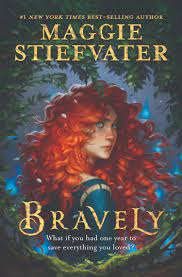
Here’s another one for International Princess Week and I think the princess in the spotlight today should be obvious. Especially since it’s titled Bravely.
I’ll admit I came into this with low expectations as I was not much of a fan of the movie but it absolutely blew me out of the water. Split into four parts for the four seasons, Merida has just as much time to save her family. Ferdach, the god of ruin has determined that Dun Broch is stagnant and must be destroyed in order to pave the way for renewal. But Merida will not let her and her family die with a whimper, making a bargain with Ferdach and the Caillleach (Goddess of life, think Irish version of Gaea), she promises the whole family will have changed and grown and do not need to be destroyed.
Which is a good thing too as another enemy from the South makes a deal with them too. Instead of sending sons or marrying off Merida, they will prove their allyship by visiting three kingdoms on a diplomatic trip-Kinlochy, Eilean Glan and Ardbarrach.
She does have one thorn in her side in the shape shifting form of Ferdach as part of their bargain is that she can only speak of it with him. And he must show her instances of external ruin being a good bringer of change as she shows him internal change is the best way to move forward.
Set several years after the events of the movie (about four years I believe it’s implied), the family is pretty happy and Merida realizes it is true, they are set in their ways. The triplets have grown more distinct, her parents complacent in ruling and they even have a new family member. A flighty, sweet, superstitious servant girl named Leezie that doesn’t do much housework but has become like a foster sister/daughter to the Dun Broch’s.
And since there’s a lot of characters, I’m going to split my thoughts by character.
Hubert-His change is not expanded much. Really, we the readers do not get to connect much with Hubert as he and Merida are separated during their time in Ardbarrach but is sufficient enough to exemplify that change is not always what is expected or wanted.
Hamish- He has become the fearful triplet though possibly the most courageous one of all even before his time in Kinlochy. He was my favorite to see as he embraced his instrumental talent. He’s just very sweet.
Fergus- Fergus remains as loud and boisterous as ever though it is nice to see how th year sheds some nuance to him as Merida sees the complexities she hadn’t before. Also nice to see them have interaction as the movie was mainly focused on Merida and her mother which brings me to. .
Elinor- I can’t say much as it would be spoilery but her origins and her exploits before she became a queen and mother are fascinating and reveal the root of her perfectionistic and regale nature. She becomes Merida’s role model again which is a well-done evolution jumping off from how their relationship was in Brave to a more adult level.
Leezie- Her change is mainly off page but there with some wise advice from a sly figure. While still being Just Leezie, she begins to take control of her flightiness and seriously study her Sight.
Harris- The most intelligent and close-mouthed triplet holds a dark secret that, well his change is what the climax is hinged upon. It’s very exciting but more than that, it’s heartwarming as sister and brother break through the severed communication.
Ferdach-The god of ruin is so much more than what Merida wanted to believe. I mean it is easy to put him into a cold unfeeling box considering his duty and the threat he poses, but he is also honest and truthful. A surprising trait for god but also fitting as a god of ruin and decay he clears the way and his words are clear too. They can be harsh, they can be not wanted, but he is honest. Additionally, he poses a needed contrast with fiery Merida and her family who actually bring change about to the timeless one to someone more human.
The Cailleach- The goddess of life, older than time. She is everywhere and she is pulling the strings in favor, and your favor if it so suits her. She is a true god, the kind mortals can’t comprehend.
Which brings me to the great strength of the novel. Stiefvater majored in medieval history and has family history in the Celtic-Scottish-Irish diasphora and she brings that mythology to the story. She mentions games like Brandubh and adds Celtic languages in pieces without feeling the need to explain them because why would they? It feels real but with the addition of the wisps and gods and Nimble Men (their name for the Northern Lights I believe by the description) It feels like an epic too. Stiefvater weaves in destruction alongside great beauty, the human and the immortal. Life and destruction are not as black and white as Merida had first thought but a balance. And changes are a pivotal turning point that grant insight to human nature.
Additionally, the anatgonist in the form of the warring new clan, the Dáccenarsachtach amply demonstrate the difference between Ferdach’s necessary destruction and the razing death that humans bring upon other humans for the sake of pain, power and control. The plot of warring clans was an excellent idea as it is perfect chance for Merida (and the readers) to see more of the world and makes it exciting to see echoes of legend about the warring states.
It is also clear that Stiefvater did her work mentioning the Roman architecture styles that remain in some parts because of the Roman invasions as well as referring to the courts and trading with Spain and France. Overall, the world building is well done with each kingdom being unique in its culture, architecture, flaws and fortunes and they give Merida something to contrast with Dun Broch’s stagnated state as she yearns for ways to improve and save her family.
Between the god of ruin and the Dáccenarsachtach, Stiefvater does not shy away from dark elements as she vividly describes the destruction that Ferdach can bring with one touch of his hand, leaving haunted images of helpless peoples moments from death in flashbacks and in Merida’s present. As well as the souless sociopathy of the Madman and his followers.
But there is lightness too as she shows the tightness of the Dun Broch families and just how much love they share that bolsters Merida to take such great risks to protect them. As Fergus says in the beginning, they are thistlekin-“They stick together even if you prickle each other sometimes.”
As for Merida, does she change? Well that would be a spoiler but I think Stiefvater does a satisfying job measuring if and how Merida has changed over the course of her journeys. I will say this: Merida is been haunted throughout the story by Ferdach’s assesment of her.
She is “a storm that raises no roofs.” Loud, blustery and seems that she is capable of damage but leaves no mark on the world.
I can’t say if she has changed but she has learned something about time and patience and she has definately matured from the rash teenager she was in Brave. Stiefvater reveals more sides of her, not just her hot headed temper but the weight this bargain has taken on her, her fear, her bravery and her uncertainty against magic and Ferdach.
While I do think the final fight scene could have been a bit more powerful and I have mixed feelings on the nature of Ferdach and Merida’s conclusion with each other, I think the general scope of this book is fantastic combing family, coming of age and mythology together. Really this story should have been titled Epic more than Bravely because that’s how good it was in making me appreciate the harsh, beautiful, mystical world of Brave.
5 shooting arrows.
 Rachel Reads & Reviews
Leave a comment