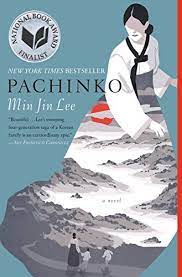
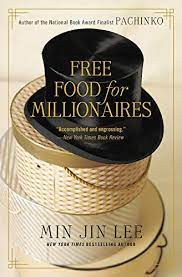
You might be noticing the trend of notable authors having generation sprawling sagas. What can I say, I like the subgenre. As such I enjoyed Pachinko a bit more than Free Food but both are well-written tomes exploring themes of immigration, class, and family.
Her debut with Free Food for Millionaires reveals the true fact that people on Wall Street and other upper market jobs get free food for lunch as if they can’t afford it. Welcome to America. And that American dream is what Casey Han and her family is trying to achieve. After she gets kicked out for pursuing a job which disrespects her father by implying he’s a bad provider, she moves out and begins working full time in banking. Luckily she is a Princeton graduate but it’s never easy when you’re a child of immigrants trying to break into the upper echlons of New York high socity. Alongside Casey’s story, there’s her friend Ella’s failing marriage, Casey’s parents and their marital issues, Casey’s sister, Tina’s differing path in life, her mentor, Sabine and more that explore the aforementioned theme of identity, class, and love. All this echoing Lee’s inspiration from eighteenth century novels like Vanity Fair.
As such balancing career progression with a successful love life is a hard match for Casey who stumbles most of the way to balance both and majorly messes up the latter when she is seduced by the ease and privilege of bachlor, Hugh who represents the Wall Street dream she wants. Ella’s marriage bumps up with her husband who has achieved his dreams of being the top boss and soon falls for his floor manager because it shows off that he can do what he wants just like his white counterparts. That latter part elevates the story by showing how immigrant and cultural backgrounds influence and change their stories from the typical 18th century ensamble narratives that Lee was inspired by. She shows how the Korean expectation of sacrifice and how it clashes with the more modern ideas Casey expects of making a life for herself.
Pachinko is aptly-named. Pachinko is a pinball game machine that is popular in Japanese casinos and gambling dens, often considered vulgar but very popular. And the people who operate these pachinko games are usually ethnic Koreans who are derided as dumb, unsavory, etc. All the insults that are usually given to minority groups. They’re not even allowed to become citizens or get decent jobs thus keeping them in poverty or forcing them into illegal acitivity.
And so it begins with Sunja, the miracle child of her parents, Hoonie and Yangjin during Japan’s annexation of Korea. After several years and the death of her beloved father, Sunja is rescued and seduced by a charming Japanese man (actually a pachinko gangster), Hansu who promptly gets her pregnant. The good thing is that he’s willing to support her, the bad thing is he’s married and Sunja is unwilling to compromise her pride to be a mistress. So he leaves her life and she saves her reputation by marrying Isek, a preacher who was staying at her family’s inn and feels indebted when they save him from a fatal flu. Together, they move to Osaka where Sunja is sure they’ll learn to love each other and love her sister/brother in law who graciously paid for their journey.
And that’s all in Part 1!
From there on it follows the events of World War II and the tragic fallout of the second atomic bomb on Osaka including tragic deaths alongside the day to day living and indignities the family is forced to endure as Koreans. Lee really illustrates the big divide between Japanese and Koreans with the making something out of nothing and quiet dignity of the people as they strive to survive and stand in the face of insurmountable obstacles like Isek’s unjust imprisonment. It also follows the two differing paths of Sunja’s sons, the eldest unknowing of his true father just as Sunja begins searching for Hansu.
The fallout is huge and continues onward to the 80s to tackle the changing values of the children, Japanese-passing because of the intense stereotypes attached to Koreans, Korean-America vs Korean, the pursuit of money and prestige through pachinko and more.
I was fascinated by this since I am so uneducated about Asian politics much less Korean-Japanese interaction or the underbelly of pachinko gangsters and criminals. So it was very much a learning experience. But what really centers the novel is Sunja and her will to do anything for her sons even at the expanse of herself. Lee shows various female and male characters to show the differing standards of stoicism that is expected of both but women are shown to be doubly pressured in terms of family, beauty and well everything.
However, the men have it just as hard as best portrayed with the different lives of her sons, Noa who rejects his schooling once he learns the truth of his father funding his education. He doesn’t want to be aided by blood money and finds a respectable, legal job yet he lies and says he’s full-Japanese, never speaking to his mother again in order to continue with his story.
Mozasu cannot have that opportunity as a full Korean and so goes fulltime in the pachinko business to accumulate wealth though often comes to questions of how illegal is he willing to become in order to provide for himself and gain more money.
There are many more characters and themes I’m neglecting to mention but that just goes to show how complex and tightly woven Lee’s family saga is. She doesn’t shy away from showing the slow chipping away of soul that comes from the fight for familial survival and maintaing sense of cultural self as bonds fracture over time.
As expected, the characters are interconnected even minor ones like friends and mentors because they each reveal a new aspect of this society and the values/motives/double standards that they are influenced by.
Overall, this is a great course for those who love ensamble novels that explore the nuances of class and immigration amidst familial and financial drama across time.
 Rachel Reads & Reviews
Leave a comment