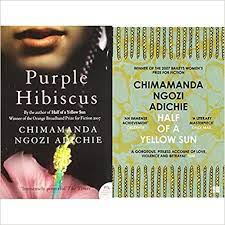
I have heard about her from numerous sources but I finally read two of this award-winning, beloved Ted-Talker and author’s books: Purple Hibiscus and Half a Yellow Sun.
The latter book is a back and forth narrative split between the Early Sixties and Late Sixties of the Nigerean Civil War from the point of views of three interconnected characters: Ugwu, the houseboy to the math professor and revolutionary, Odenigbo; Olanna the inhumanly beautiful wife of Odenigbo; And Richard, a white journalist who falls in love with Olanna’s twin sister, Kainene.
In this intense historic fiction narrative, Adichie doesn’t shy away from showing the terror of war in its killing, raping, bombing, starving abyss and the effects it has on all the characters, especially Ugwu. It is also shows the intensity of devotion the characters have for their cause of the Igbo-created country of Biafra even as it the war turns. I don’t know anything about the Nigerian Civil War so this was all very new to me, but I was as interested as Richard was of the Igbos being signaled out and derided by the Northerners much like the Jews were during the Holocaust.
As expected, the characters are interconnected but they do not really interact much. Well at least meaningfully in the case of Olanna and Ugwu who maintain their mistress-servent relationship most of the narrative. Though Richard does a plot changing interaction with Olanna that shifts their respective marriages around.
But it makes sense as their connections are only to show how interconnected the world is, their personal journeys are personal and are all centered around Odenigbo. Ugwu admires him (with quite a bit of homerotic undertone I might add) and fully believes in the cause until the end even as he loathes the acts he commits in wartime.
Olanna goes through a personal evolution as she loses herself a bit in her marriage with Odenigbo, going so far to accept his mistress’ (a servant girl) child as her own, his mother’s mistreatment and more. This is complicated by the fact that she does genuinely love him but is distanced from it because of hisalcoholism/ depression/war trauma. Olanna has her own grief too after her family’s death, a survivor’s guilt if you will, all things she must deal with on her own.
Richard seemed the most disconnected from the narrative as a white American journalist and intellectual which makes sense. He can go and leave as he wills and Adigi uses this to show the often-times inaccurate perception of the war, that this is just tribal infighting and all Africans are savages anyway. He provides an in to the American reader as well as a mirror in seeing past the colonial perspective of what this war is about. Though I do find his continued exoticisation of Kainenene unnecessary. He holds an almost idolized image of her that gets tired after awhile since it’s clear he doesn’t really “see” her but I suppose that’s just part of the realism of the piece. Richard is educated in one way, seeing past and disputing the Africans = primative rhetoric his collegues espouse, but still fetishizing and romanticizes his crush.
Purple Hibiscus does not have the backdrop of a national war but a cultural one within one family as a fanatical Christian priest regularly abuses his family for not being perfect models of Christian good. Not that the protagonist, Kambili realizes this as they are raised to believe this is life. But after staying some time with her Aunt Ifeoma. She practices a more loving and liberal Catholicism compared to their strict father and they also learn from their elderly grandfather, who still worships the traditional orisha. Kambili and her brother, Jaja begin to realize life beyond their sacred church.
Adigi addresses the colonial assimilation that the father, Eugene is undertaking as well as the weight he feels as an African man in post-colonial Nigeria. It is understandable but it does not excuse his actions of cotorting Christianity into something painful and oppressive. Kambili realizes after watching her grandfather pray to the orisha, after he prays he is joyful and smiling. She has never smiled after prayers.
As you can tell I have a lot more to say about Half a Yellow Sun but that’s because there was so much to unpack. Trust me, I only skimmed the surface here. I actually prefer Purple Hibiscus for it’s more introspective and lyrical narrative. One that had three personal stories, not just Kambili’s as you see how her brother and mother rebel against Eugene’s zealot ways.
On the subject of both, even though both books are infused with Adigi’s Nigerean culture, beliefs and traditions, I did not find them as alien or difficult to understand as I thought I might because I am uneducated in African culture. I understood most of it like the respect towards elders, the Christianity vs heathen divide etc. So I don’t think others should be afraid that this book will be inaccessible to them just because it is Nigerian-based.
So if you’re a fan of sweeping narratives and exploring rich culture and history, dive into Adigi’s novels. They are detailed and haunting, and she has a touch that makes you feel like you know each person because she brings you that close to their thoughts.
 Rachel Reads & Reviews
Leave a comment