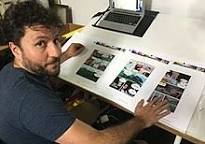
I think it’s a kind of kismet that my 100th post was a review of Dionysos: The New God. Now my 200th post was a lovely interview with The Olympians creator himself, George O’Connor!
Here he dives deep into his thoughts on mythology, and his other works including the historical Journey Into Mohawk Country, nonfiction book, Unrig, collaboraation with Adam Rapp and his upcoming series, The Asgardians.
1. Let’s start simple, when did you first get into graphic novels and comics?
I grew up in a house where both my parents read comics, but thy weren’t super religious about it. They were a lot of comics in the house and we were also very into newspaper comics. I became somone who was collecting comics on a regular basis, and followed different titles each month some time around sixth or seventh grade.
Some of the early comics were-my mom bought early Superman comics, my dad bought a lot of Marvel, I was into a lot of Conan and Indiana Jones. In sixth or seventh grade I got into superhero comics, especially The Mighty Thor. It’s a big reason why I tell mythology in comics because it struck me as a really great way to tell mythology with these visual images.
2. What drew you to this medium instead of straight fiction or other?
I was basically telling stories with my pictures before I knew how to write. The nice thing about comics as a medium to tell stories is that you have more than twice as many ways to tell a story. The standard way of telling a story is that you just write the words and that’s all you have.
But with comics or sequential art, you can tell part of the story with words, part of the story with drawings and you can combine them to tell even more of the story just by the two of them playing off each other.
It’s always been the most natural way of telling a story to me. If there’s an idea I can get across better through by writing I can do that, if I can do it by drawing it I can do that as well.
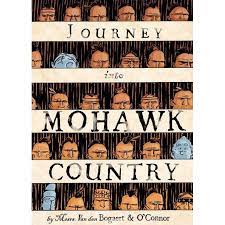
3. Journey Into Mohawk Country delves into the little known story of Harmen Meyndertsz van den Bogaert and his journey through what is today Albany to negotiate with the Oneida/Mohawks and corner the beaver market. How did you stumble upon this story, and inspire you to bring it to life?
I’m a big reader, I like to read nonfiction and I am a lifelong New Yorker resident of New York. I read a book about the history of New York when it was a Dutch colony called The Island in the Center of the World.
What a lot of people don’t realize is that the Dutch were in charge of New York for almost 200 years and left a large cultural imprint on it. That’s one of the reason, NY is so different from the rest of the United States. It wasn’t part of New England, England came later and what was really fascinating was that there was this chapter about Herman Meyndertsz can den Bogaert. It was really interesting stuff they were talking about, he was a barber/surgeon and he traveled about 100 miles into the interior of what became New York and was one of the earliest accounts of the Iroquis people.
It got me into a lot of schools. The time it came out, a couple of librarians wrote this grant where I presented in every single library in the Hudson River Valley where it takes place. So I spent a summer going up there on the weekend, travelling around. It was really cool to become a temporary expert of that period but mainly using graphic novels to learn more and teach more, which is a lot of what you see I do with The Olympians.
4. Your book is also notable for using van den Bogaert’s actual journal as its sole text. How did you come about with this choice?
I’m one of those people who like to read notes of books, that’s why I have notes in mine, and I love taking deeper dives into books. I did a deeper dive on reading this boook by Russell Shorto and there was a mention that there were copies of this guy’s diary published by Syracuse University Press. So I got a copy of it, read it and realized it was one the coolest thing I ever read and realized that no one else would ever read it unless I tricked them into reading it. So by making a graphic novel, a lot more people read it as a graphic novel than a translation of this guy’s diary.
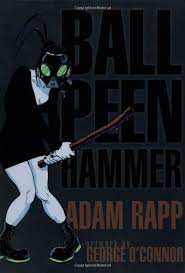
5. What was it like to collaborate with Pulitzer-nominated author and playwright, Adam Rapp to bring his dark world to life in Ball Peen Hammer?
I had done picture books for children and that’s just interesting to note because I never intended for Journey Into Mohawk Country to be a book for kids. When Journey Into Mohawk Country came out, I wasn’t in the United States. I was in Rome, Italy doing research for what would become The Olympians. So I was surprise when I came back to New York and everywhere I went I would see Journey Into Mohawk Country in kids rooms. I was like, “Aww I wanted it as something for everyone to read, not just kids.”
There’s nothing wrong with kids, that’s my preferred audience but for that book in particular I felt the audience should be more adults.
I was talking to my editor about that. I never knew this would happen because I started out with kids books and now everyone thought I only did kids. So he was like, “You want to do something for adults?”
So he, Mark Segal, reaches into his desk and pulls out a script he already had from Adam Rapp and says “This is the most adult thing you’ll ever publish. Read it and tell me what you think.”
So I took it home, I read it a bunch of times and it filled my head with imagery and I was like, “Yeah, I want to try doing this for my next book.”
Now, this script already existed before I even came on board. To be honest it was a play that Adam Rapp had written already that is essentially unperformable because of certain aspects of the play. Specifically because one of the main characters is a child and there are aspects that happen, well they could be performed but it would be a rough play.
So he had this script written about his feelings about society and where it was heading and I thought it was a really great script. We interacted a little bit during the making of it. I asked him for advice on stuff but for the most part he was very hands off. It was mainly the job of me interpretating the script. There are some things I changed to break it out of what was clearly a play, switched around the order of scenes and stuff, very small things. I hope he liked it, he always seemed he liked it.
It’s weird collaborating, I haven’t done a lot of collaboration honestly. I always joke I’m a control freak. I can write reasonably well, I can draw reasonably well so I prefer to do both myself. But it’s interesting in collaboration, there’s a lot push and pull.
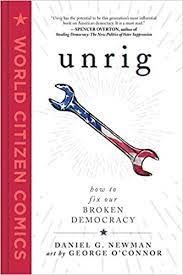
6. Most of your repotoire is for kids, with the exception of Ball Peen Hammer, but you took a departure in the past year with your new book, Unrig: How to Fix Our Broken Democracy. How did you get onto this project and your feelings on its importance?
Unrig was very similar story with that same editor, Mark Segal. I was on tour promoting either Hermes or Hephaistos in California and I was pulling up to a school for a presentation when Mark called me on the phone. He and I are very simpatico politically and we were both dismayed by certain things we saw coming on the horizon.
So he says, “Do you want to do a book on the ways people can work to protect our democracy?”
“Yeah that sounds great.”
I agreed to do Unrig because I am unhappy with the way things have gone politically in the country and a lot of people are and a lot people go on social media and scream into the void about it. I didn’t want to do that, I wanted to do something that I hoped to be constructive.
So I agreed and Mark, who’s my editor worked on it too since it meant delaying an Olympians book for bit since I had to take time off to do this 200 something novel.
I’m really glad I did it, at least for myself if no one else it was a great educational experience. I’m in a situation where I can discuss these things with a lot more understanding and sensitivity about this topic because the guy who wrote that book-Dan Newman is so ontop of it, so smart and did such a great job explaining these topics.
He also, which I think is important, didn’t make it all depressing and he didn’t make it all one side. A book like this could easily be pigeon-holed as attacking one side more than the other and honestly it does a little because one side has been acting worse than the other but both sides have done stuff that’s bad.
There’s problems baked into our democracy from the beginning that hopefully we can do things to address and change and hopefully this book would help.
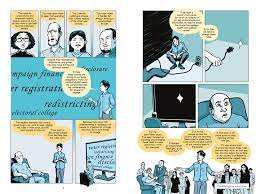
7. Was paneling and drawing for Unrig different from your comics and picture books with his limited color palatte and focus on serious topics?
It was very different. Like I said before I don’t often work with collaborators, often I’m the only writing the text. There is some text I wrote in Unrig like if there’s a character making a joke in a little speech bubble, that’s most likely me writing. But for the most part I used Dan’s text. I also drew that book entirely digitally.
For most of my comics work I don’t do that. I stilll like to draw my graphic novels for the most part. All of The Olympians is done this way, so will The Asgardians. I do pen and ink on paper scanned in, the coloring is digital.
Unrig, because there was so much and so much was technical and there was going to be editing as we went along, I did it entirely digital. I also drew it very fast. I generally draw very fast but for that I was doing four or five pages a day.
I also didn’t color it. My friend, Frank Ronosso colored that.
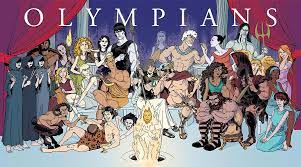
8. Now onto The Olympians. I’m sure you’ve answered this one before but what do you think about the enduring legacy of Greek myths?
There’s a lot, that’s a very big question. For me, personally, I feel like Greek mythology has grown with me. When I was a little kid I first found Greek mythology as an immersive school project in third grade. I dressed up as Hermes, did a report and everything like that. At first I loved it because of the subject matter, it was so awesome. It was all monsters and heroes and super action and it was kinda sexy, it was a very grown up scene.
But as I’ve gotten older and keep rereading it, now one of things I found so interesting about it is the human connection you can make. You read those stories and they might be fantastic stories of monsters and cyclopes and stuff. But there’s something little bit human in its drama that is captured and it’s so relatable. It’s so fascinating for me to read something like that that is thousands of years old and from a different culture. Well a different culture from the West that we strongly have taken from, but a different culture than what we are today and there’s still these little human touches that we can find.
Also as I read the myths over and over again, I find that myth, not just Greek myth, all myth, are a way of explaining big truths in the way the people understood it. Just realizing the insights to the world around them that you can glean from reading these stories is incredibly fascinating.
Like I’m not the first person who has come up with this analogy but realizing that the character of Persephone has to go underground and blossom in order to escape the shadow of her mother. Her mother is mature grain, that’s what she represents and Persephone is the seed, there’s a whole cycle. There’s so many layers and meaning in Greek myths.
9. What was your work schedule like working on this ongoing series alongside your other works?
It varies a bit from book to book. The way I write is I don’t write a story out with words first or draw it out first. I do both simultaneously. So when I’m working on this book, I’m just filling up a sketchbook with words and pictures.
There’s a lot of work that goes into it and a lot of refinement and editing on my part before I show it to anyone else.
Some of the books I had a very clear vision from the beginning. When I started this series, I wrote a plan of what an myths I’d cover, what the general themes of the story should be, and I pretty much stuck to it. I did a surprisingly good job looking back.
Some of the book I would have an easier road like Zeus, Aphrodite, Hermes was, from start to finish, writing, inking, drawing, six to eight months which was pretty quick. Then there are books like Poseidon which I had to completely rewrite twice because I wasn’t happy with it. That one was the longest. That book took me 14 months.
When I’m really working on a book I definately spend more than 48 hours a week. I try to draw on it every day. I put a solid 40 hours a week in general. I hate the term workaholic but I definately have weird guilt-related issues that if I’m relaxing too much. I feel very slothful then I feel like I should be doing something.
But know what’s awesome about my job? I’m always designing work for myself. I have bosses who are editors but the real boss is me and if I don’t come up with a new book or new projects to work on, I starve to death I guess.
10. I see in your G(r)eek Notes that you pay homage to famous works of art in your panals like Mercury and Argus, Convito delgi Dei etc. What were those research trips like and did they influence your art?
It influenced it a lot. I mentioned that in 2004-05 that I spent eight months living in Rome. I had these big plans for this Greek mythology series, very different from what The Olympians became.
Being there, travelling around the Mediterranean, spending all this time in these places where these gods used to be worshipped, doing a deeper dive I never allowed myself to do before, reading only these original sources, not reading retrellings and such; I came to understand the gods so much better. You see them in the places where these gods were worshipped or where they were created, it does change your viewpoint of them.
That was a real key thing. Sometimes I say that most people know the stereotypes of the gods. If you talk to someone who knows little about the gods, they’ll say Hermes is the messenger god, Hera is the jealous wife and these things are applicable but there’s so much more to the characters once you spend some time really immersed in their stories.
So spending that time travelling around the Mediterranean, and I’ve been back tons of times for research trips, it was very transformative. My vision of them became so much bigger, so much realer, so much more alive than before.
11. You had to do in-depth research on each of the twelve Olympians. What new insights did you get into them as you wrote/drew their stories?
I feel like in every single one of them, there’s some big insight. But here’s what’s super fascinating, I’ll use Ares for an example. The general consensus on Ares is he’s the psychopath, he’s the bad guy, if there was a straight up villain on The Olympians it would be Ares.
But there’s a remarkable consistancy that I found when I really delve deep into his stories. I like to remind readers of this, there’s no Bible for Greek mythology. It’s just a series of regional tales written over the span of 1500 years or more from different periods of time, not written all at once, and from different parts of the world, just a series of stories about these gods. But there are certain personality traits that reassert themselves with such surprising consistancy and frequency that’s its almost hard to believe they aren’t writing about real people.
Ares is a monster but I started noticing when I was doing a deep dives reading all these Ares stories by Greek writers, Roman writers, anyone else who believed in them, there came this real theme that he’s really protective of his semi-mortal children.
And I thought “That’s really interesting.”
Part of it becomes this feature called the Areopagus, the hill of Ares. It’s traditionally featured right outside of towns, it’s the the site of the first trial. And normally this trial would be out that somebody hurt or murdered a child of Ares, normally the son or daughter of another goddess or god, and Ares will seek horrendous retribution for murdering them and is placed on trial before the other gods. You can see this in multiple locations throughout Greece and even outside of Greece in ancient colonies.
Now maybe this story is the same one located in different places but you see it over and over again. That was my in-road to Ares.
He’s a brutal murderer on the battlefield but he’s actually one of the most sensitive in regards to his own family. In myths, you’ll find stories where he’s willing to risk great personal harm and even eternal damnation to himself in order to protect or avenge his kids.
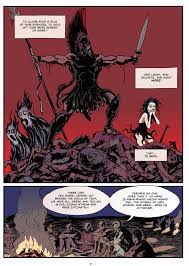
Also if you look in the placement of the series, Ares and Apollo were around the middle because I made this plan twelve years ago to do this whole series of books and I put these two in the middle because those were the ones I had zero affinity for. I wanted to place some up front that I was excited to do and a bunch in the end that I was really excited to do and the middle was the Wednesday, you got to work over it.
But researching Ares and Apollo, reading these stories and ideas over and over again, immersing myself, they both became my favorites. Apollo especially. Apollo is still a jerk but you know why he’s a jerk. He became one of my favorite characters to write. You know how writers say all the time that the characters write themselves, over time Apollo became that. If I was writing something in the crowd scene of The Olympians, he would end up saying something.
It’s things like that, if you read enough myths, these types of stories rise to the surface repeatedly. With The Olympians, there’s way too many myths for me to retell them all. I could spend the rest of my life doing it and I’ll still be doing books. But what’s super cool is that reading a bunch of this stuff, I can find the stories that were most emblematic of the god or goddess in question. The ones that let you, the reader, really understand how this god/goddess works.
12. Greek myths can get pretty crazy, did you have any censors in editing process?
I call it a true all-ages series, like the maority of my fanbase is younger people, younger children but there’s a significant adult portion reading too so I very much try to write to all ages. As such, I try not to censor the myths as much as depict them in a way where they’re not explicit.
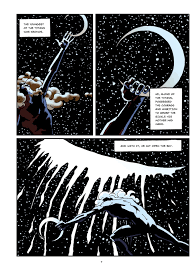
In the Theogony (Hesoid) which is the main source I use for Zeus and the Ascension in The Olympians, there is the very famous part where Kronos castrates his father Ouranos.
I chose to depict that in a way where I don’t cut away any part (Ironic) but I phrase it in a way that isn’t specifically explicit. For starters, Ouranos’ name means “sky” because he was the god of the sky and he was married to Gaea. As the two most primordial gods, I chose not to anthropomorphize them. They don’t look like people, Gaea is literally planet Earth, Ouranos is literally the sky.
So when the Titans come to being, they’re humanoid but they’re not human beings. They’re a step in between, each generation gets closer to human beings essentially.
When it comes time for Kronos to castrate his father, it looks ridiculous if you have one big guy hitting another big guy in the crotch with a sickle. It looks dumb, I didn’t want that. I wanted this big awe-inspiring moment.
So I had Ouranos as the sky and Kronos as this giant figure holding a sickle shaped like the moon, slicing the sky. There’s light pouring through and the light is the blood that gives birth to the Gigantes. You get what’s happening and the text for that part, if I’m paraphrasing myself correctly, “Kronos sliced open the sky, his father’s power bled away. He was rendered impotent.”
So it’s all there so an adult can pick up what’s happening but a six year old can’t tell what’s happening, he won’t be like, “He cut off his dad’s dick.”
That’s how I handle it, I try not to take away the edges. I just use a little bit of license in the way I depict it so if you don’t know what to look for it will go over your head till the time you’re old enough or mature enough to understand it fully.
13. Since the gods are pretty tied to other myths of Greek heroes, did you ever have trouble trying to keep one myth/hero from stealing the show?
I think I’ve read some criticism where some people feel that in Hera, I let Hercules take over and he eclipsed Hera in the story which is a bummer ’cause it is one of my favorite books, Hera is my favorite goddess. It certainly wasn’t my intention but he is a character that has a lot stories about him.
For the most part, I found a lot of times that I had to make a lot of painful cuts like Theseus. In Poseidon, there was a lot more Theseus that I had to cut because I did feel that he was stealing time away from Poseidon. Theseus is the worst, let’s not give him more time.
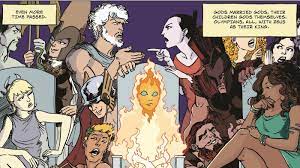
14. Now you’re working on The Asgardians. You finished The Olympians by describing them as a very human-like dsyfunctional family. Are the Asgardians similar or do they have a different dynamic?
The myths are very different. Most people are more familiar with Greek than Norse mythology since we have a lot more resources for Greek mythology and very little Norse mythology survived. We essentially have stories from the Prose Edda and the Poetica Edda and more or less that’s it. There’s a few Germanic things that have survived here and there but that’s it.
With the Norse, you don’t get a sense of the same family dynamic, you don’t get a sense of the richness of the characters. The Olympians are a great big dysnfunctional family, it’s awesome. A lot of the Norse gods we don’t know much about them beyond their name. Like two of the most famous Norse gods are Frig and Freyja and some people aren’t sure if they’re even two different people.
That being said, I”ve really been enjoying doing this dive into Norse mythology since there’s still amazing themes to pull up for every single book and every single character, everyone has a good arc I’ve been able to identify. It’s just not the same as The Olympians where there’s this big family arc. It’s more about things from individual characters that I’ve been able to spotlight.
Like I said before, I could do a book a year for every single year of my life of the Greek gods and still wouldn’t be able to finish their stories, but with the Norse gods I really feel that four books are enough. I’m going to cover virtually every single Norse myth in those four books so it will be complete in a way that The Olympians will never be.
15. If you were to do any mythologies after the Norse, what would it be?
If I were to tackle another mythology besides the big ones, Greek or Norse, I think I would be interested in doing Irish mythology. Given my last name is O’Connor and Irish mythology is very interesting. They’re weird stories but have a fun logic to them and I’ve always loved the stories of the fae people, the fairies, the leperchauns, those are really cool.
Another thing that’s interesting about mythologies is once you get beyond Greece. Obviously Greek mythology is one of the best known to such a degree that it has colored other mythologies. When you read Norse mythology, nobody wrote those stories down while people still believed in them. There are some of the poems which were written after Christianity was introduced in Scandenavia.
In the Prose Edda, which was a couple years after Christianity, the man who wrote it, Snorri Sturlson, had a chapter explaining that all these characters you’re reading, all these gods, are actually Trojan and Greek people. It’s literally explaining Norse mythology through the Greek. Which is why they’re so often linked as Norse mythology is often viewed through the prism of Greek mythology.
I think what the Norse thought of as gods are not what the Greeks thought of as gods. The Olympians can never die, can’t be killed, can’t be hurt,never age. Norse gods do all those things, they get old, they die. It’s a very different concept but because right from the beginning it’s been viewed from the prism of Greco-Roman gods, we squashed the different ideas.
15. Any other exciting news coming up?
The Asgardians, the series I’ve been working on, that’s official.
I will be cryptic and say be on the watch for another Thor related project in weeks. That’s probably all I can talk about.
Ideally the plan is after The Asgardians series is to return to Greek mythology. Tell stories about characters that aren’t Olympians. I have plans written up around minor themes like stories about demigods and minor gods/goddesses, heroes, even monsters. The stories I couldn’t fit under the umbrella of The Olympians. I would love to do a book about Helios, a story about Selene, a story about Eos, a book about the siblings and just call it The Hours of the Day or something.
I even come up with plans for maybe a thirteenth Olympian-Demeter. I originally planned for her to have a book called Demeter: Goddess of the Grain but my publisher rightfully argued that I’d sell more books if I called it Hades: Lord of the Dead which was true. Hades was the first book on the bestseller list and all the other books followed after. But still, I get mail every day of people asking when are we getting a Demeter book. I’m always like “She already had a book,” but that was really unsatisfying to people.
I recently thought of a way to do a book about her which would be a little different from The Olympians. It would be called The Mysteries of Demeter, unlike the other books which have the god’s name first, and it would be a little different.
There’s no official plans for it but I talk about it a lot and my publisher knows about it.
You can find out more about George O’Connor and his books on his website: https://www.georgeoconnorbooks.com/
 Rachel Reads & Reviews
Leave a comment