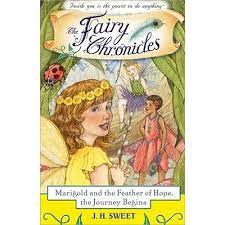
J.H. Sweet is the author of a number of Christian-inspired fantasy books for kids. In this interview she discusses her longrunning Fairy Chronicles series, Christianity, philosphy and the timelessness of stories. Please enjoy.
1. What sparked you to become a writer?
Love of reading, to start with; but also, English was my favorite subject in high school, mainly thanks to a special teacher named Ms. Patterson, whom I had for both freshman and senior English. So she was like a set of living and learning bookends for me, and this formed the foundation that led me to study English in college.
2. You’ve mainly written series in the fantasy genre, what drew you to it?
I had a great love of fairy tales and other fantastical stories from my youngest years of both being read aloud to and reading on my own. I think what drew me to these stories the most was the hope in them, and the fact that good almost always prevailed over evil. Secondly, I loved the imagination of the writers, which I could relate to, as a shy child whose mind was often lost in a world of my own imagination.
3. The one series of yours I read growing up was The Fairy Chronicles series. One thing I found amazing was how detailed and expansive the world was. You even wrote in your Author’s Note that you created it to be a house of cards, that each story built upon the other. Was it fully formed from the beginning or did it just happen?
The series built itself as it went along, as I just continued to wonder what my fairies might be up to each day—what new friends they might meet and challenges they might face. Then as I wrote, the ideas just seemed to form themselves.
I originally started writing the series using outlines, but those became unnecessary as I went along, and I rather relied on just a few notes as reminders. However, because it was like both a jigsaw puzzle and a house of cards, I did have to frequently refer to the Fairy Handbook (which was written throughout the series as it progressed from beginning to end) in order to remember exactly which gifts and what wand each fairy had, what adventures each had been a part of, what foods they liked, etc.
4. You imbue religious themes into the series such as when you incorporate significant numbers and allegories (like the reoccurrence of #3 for the Holy Trinity, the ending battle paralleling Jesus’ death and rebirth etc.), but you also balance Christianity with other philosophies like feng shui, karma and others. I found this to make the world, as fantastical as it is, to be more real. Was that your intention or it happened organically as a result of your extensive reading and curiosity?
It was intentional, more than organic. I think Philosophy was probably my second favorite subject in school, and it helped me to understand belief systems in various cultures, though mainly how we are more alike worldwide as a Human Family, rather than how our different ideas and customs might separate us.
Philosophies to me are very different from religions; and thus, most philosophical concepts don’t contradict my biblical beliefs. However, to clarify, I actually don’t feel I am a part of a “religion” as a true follower of Christ, because religious practices to me are simply ritual, which Christ never commanded us to participate in, like He never told us to celebrate His birthday, and especially not in the way that some people do, involving a lot of glitz, greed, and gluttony, with get-togethers that don’t in any way celebrate His First Coming.
I also find it disturbing for decorations to be going up as early as October these days, plus “Christmas in July” activities, like movie marathons and various sales. Though as Christians, we are expected to do certain things—like fellowship and spread the Good News—I believe most of the rituals performed inside of church buildings, in accordance with how they are organized and governed, are not based on Christ’s teachings.
Regarding modern churches, including large ministries: To me, many of their practices are not true Christianity, which in my view (after acceptance of Christ as Savior) is simply based on personal reading/studying the bible, prayer, giving praise and thanks to God, heeding the leading of the Holy Spirit, and doing our best to follow the Two Great Commandments—to love God and to love our neighbor. I actually believe we are in the dispensation in which the biblical command of “Come out of her my people” definitely applies, referring to the modern churches, which are in heresy for the most part, though I recognize that there are still some good and devout people inside of these organizations.
On the subject of real vs. fantasy, I always wanted the stories to have a real component (so we wouldn’t just be lost in a dream world), and almost as though all of the activities could be happening just down the street (or in the next town); though we might not personally witness these things, unless we are out actively looking for toadstool rings, or gnome footprints.
Plus, I had hoped readers would be able to connect with the characters more, in perhaps thinking these could be real people somewhere.
5. You also wrote that you believe scientific events have a magical component that influenced your writing of the series, can you expand on that idea of balance?
The magic basically being in God’s awesome creativity, thoughtful design (including balance), and the incredible wonder of it all (referring mainly to the natural world and all it has to offer).
I believe science grounds the wonder and majesty, making certain amazing things that we might not understand more real, and giving folks with scientific brains the desire to investigate to figure things out. I’ve never been all that scientific (though I think science is an interesting subject) but have been content to leave complexities in the background, in order to focus on magical components. Like I’d rather just marvel at (and admire) a bird building its nest, rather than try to figure out exactly how it’s scientifically done to withstand wind and rain and cold. And I’d rather gaze at the beauty of clouds and be thankful for the rain they produce, rather than study the science behind it (like Solomon did, as described in the bible).
Back of it all, I simply know that God created everything to work together as it should, which is why I am often very sad that human beings have messed things up so badly. To be clear, I am not talking about individuals for the most part, but rather our governments, which I believe have lied to us for many decades, possibly centuries, while abusively using their powers in many arenas, particularly in lording over various areas of science.
In discovering that the whole of science is basically a collection theories, many of which have changed over the years, we can wonder at how much still needs to be revised, particularly since scientists are basically human beings, some of which have been misled, or might have even been the misleaders, for various human reasons such as pride, greed, and stubbornness.
My wish and hope for the ongoing human race is that we above all desire to learn real truths, even if those truths contradict long-held beliefs. Eventually, all Truth will be revealed, in my view sooner rather than later because I believe we are at the End of the Age. And at that time of the end (which is really a beginning), it will be better for most humans—physically, psychologically, emotionally, and spiritually—to be prepared for various shocking, soul-shaking, and even earth-shattering revelations, related to both the science and the magic of this world.
6. Another thing I admire about the series is that, as you wrote, the girls are timeless and can resonate with anyone since you have hundreds of characters. How did you get that timeless effect?
By just focusing on simple things that I believe have brought humans enjoyment (and sometimes fulfillment) throughout the generations, including some small things like puppies, jumpropes, crafts, candy, etc.; but also, larger aspects of life, like the human need to help and share and create and learn and grow. I tried to write from the heart, soul, and spirit.
Since I was at least a part of each character I was writing about (with some of my essence ending up in each of them), I came to realize how incredibly complex human beings are, particularly in the areas of thinking and emotions. But even though we are all very complex, and uniquely individual, I believe we are all still more alike than different. So I think this is why people can relate to the things that I relate to, and why, in essence, we don’t really change much, even though things all around us change, sometimes rapidly and very drastically.
7. The series explores several important topics like smoking addiction, friendship problems, community service, commercialism vs simplicity, knowledge vs wisdom, sacrifice, death, extinction, environmentalism and more that cover grey areas in the fight for good and evil. In this 60+ book series, you tackled a lot, how did you balance the personal with the magic adventure?
I think by realizing that both are important, since the magical aspects give us hope, stir creativity, make us wonder and investigate, and entertain us; while all the real things ground us by practicality and often necessity, such as having to earn a living, or needing to keep the house clean. Also, I think there can be enjoyment (at least a sense of fulfillment) even in certain mundane real and personal things; for instance, I enjoyed learning how to fix a broken toilet, and even felt empowered when getting it done.
Plus, I recognized early on (thanks to my parents’ teachings) that little things are often as important as big things. Like it can be as important (to our own soul and possibly to the lives of others) to fill a bird bath, write a short poem, or bake a cake, as it is to solve some gigantic problem, or give a speech to ten thousand people. With regard to personal issues, such as my parents’ smoking, I felt it was important to draw attention to the widespread damage and pain that something like that causes.
When writing the series, I enjoyed adding magical elements to things that were real, such as when the fairies’ visited certain national parks that I had also visited. Their park adventures contained a different kind of magic (more outlandish) than I experienced, though they still needed to cook dinner and clean up after themselves, which were important activities, possibly as important as climbing the Tree of Joy. They would have needed energy to climb the tree, so the food was important. And if they had left a mess in the park, they wouldn’t have stayed true to the Fairy Code of Conduct, and wouldn’t have been real fairies in my opinion.
8. Nature in general is very important to the series as many of the fairy and brownie spirits come with flowers/trees/animal significance, how did you do all this research?
When I was growing up, we had a large garden, so I didn’t need to do a lot of research on that subject, especially since my mom and dad loved to tell me things like how marigolds repel bugs (hence, Marigold’s gift) and how asparagus spreads by its crowns.
For information on things like butterflies and birds, I have a few books on these subjects, though some information came from simple observation, such as how wrens are loud birds for their size, and how sparrows are so numerous that many people don’t seem to notice them.
Regarding trees having meaning, I think I found a short list of trees and their meanings on a website; then I just added my own views for other trees, such as making a tall and strong sycamore tree related to courage.
9. The books are also autobiographically as you incorporated quirks and hobbies and experiences of yours into the books, what are some of them?
Basket making, knitting, and quilling were some of my favorite crafts over the years that I incorporated into the series. Plus, I love pickled eggs and cherry chip loaf. Some of the deeper subjects definitely connected to my own personal experiences, like getting bullied on the school bus. My mom was very frugal, and did unwrap bars of soap to harden them and make them last longer. I kept the old canister vacuum cleaner I inherited from my parents until I finally couldn’t figure out where to take it for repairs; it was about forty-five years old when it was formally retired. It seems like there are too many things to mention here, so let’s just say I had at least some connection to most of the experiences I wrote about.
10. This may be hard since it’s like asking to pick your children, but do you have a favorite fairy or book? Or even favorite jelly-bean flavor?
As far as fairies, I favor the ones that mess up (or have unappealing personality traits like being a little too childish or selfish, E.g. Dewberry and Cherry); but then they grow up and do better, which is what I always hoped for myself, to become a better version of me as I went along, since I could definitely relate to making mistakes, as well as sometimes being selfish, stubborn, lacking patience, etc.
Favorite books would include the stories of Marigold (since she started it all), Heather (because I love the hope in concepts like matchbox genies), Eglantine (for the idea of a place where we can get back everything we’ve ever lost), Dandelion (due to the magic vs. illusion theme, and the concept of inner beauty), and Aurora (in which we learn where fairy and brownie spirits are born, and why this has to be kept secret, even from trustworthy fairies).
For jellybean flavors, I like the fruity ones best, like lemon, cherry, orange, and coconut.
11. What is one of the main messages you want readers to get out of the series?
That which is found in the very first book, Marigold and the Feather of Hope, as to what’s really important in this world: How we treat other people and what we teach to children. Other than that message, I would want folks to recognize that The Fairy Chronicles is Christian based (though it’s not overtly Christian as most of my other work is). And then I would hope it might encourage people who are not Believers, and not yet part of the Body of Christ, to look into Christianity, even if it’s just picking up the bible to read a couple of proverbs, or a psalm or two. And from there, hopefully going on to read maybe the Gospel of John, or Paul’s letter to the Hebrews.
If not inclined to pick up a bible, maybe explore Christianity another way, such as reading C.S. Lewis’ Mere Christianity, which is basically a logic argument proving Christianity to be true, and relating Lewis’ own journey from atheism into the Faith. Plus, of course, it gives the basics, as the title implies.
12. I fully believe the series can still resonate today and should have a resurgence. Though the characters’ stories are finished for now, if you hypothetically made a sequel series, are there are new topics/themes you would want to tackle or any characters you’d want to return to?
A reader suggested that I write a Next Generation Fairy Chronicles series, focusing on the children of the original characters. I would like to do this someday. I would probably add topics/themes such as dealing with anger, having patience, and how to forgive those who abuse and offend us. I would also warn about cults, including political cults, which I think are very damaging; and related to the issue of cults, rampant propaganda and lack of free speech, avoiding being deceived/misled, thinking for self, not letting others think for us, and having good overall discernment. I would also stress that history has a way of repeating itself, even horrid history such as Nazism.
Concerning fairy tales, I might address how classic stories have been changed over the years, even badly distorted. A good example is The Little Mermaid, who, in her original story, did not want the love of a man. She wanted Eternal Life, since mermaids (though long lived) could not inherit Eternal Life, as human beings could through Christ. However, sylphs in the tale could inherit Eternal Life. She was turned into a sylph at the end of the book because she had so much love for a human man and his wife that she gave her life for them. However, the story is somewhat open ended, in that the Little Mermaid, as a sylph, still had a task to perform on earth. She would pass through houses unseen as an air spirit, and if the children of the house were behaving, she would get her remaining years on earth shortened. But if the children of the house were misbehaving, years would be added to her earthly life. This, of course, was meant to encourage children to behave, so the Little Mermaid could get to heaven more quickly.
So I’m sad that people have shallowed many stories like this, mainly I believe to remove the Christian element, but also to dumb them down in general, and make people place importance on all the wrong things. I did address the issue of the re-writing of fairy tales in my Clock Winders Series, in which many older books had been banned, and burned. But I think it would be a very appropriate subject for a fairy-tale series.
It is kind of you to suggest resurgence, but I don’t think it’s possible for anything like The Fairy Chronicles to be popular in the world of today. However, I believe God has a way of getting books/messages into just the right hands in less popular ways. So to me, just a small amount of young people taking an interest in the books would be wonderful. The Fairy Chronicles flowed into my Clock Winders Series with some of the same themes, and many similar characters like unicorns, dragons, bigfoots, etc., though for a slightly older audience.
So I hope to add to that series in the future as well, in order to expand on topics like the Fifteen Dimensions, Fifteen Realms, various philosophies, and mysteries involving time, music, colors, mirrors, and such. I am currently working on poetry and essays (relating largely to the Endtimes) to add to my website as a sort of blog.
13. Finally, what are you up to today when you’re not writing?
I spend a good amount of time cooking, and taking care of a home on two acres; so lots of little house projects like painting and faucet repair, plus pruning and weeding and such outside. I am also still knitting. Most importantly, I read the bible; and my husband and I listen to an assortment of radio bible broadcasts, as well as watching some like programming on YouTube.
 Rachel Reads & Reviews
Leave a comment