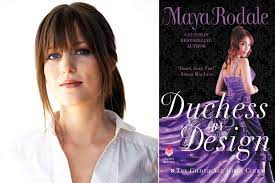
Maya Rodale is a bestseller author of historical romance, nonfiction and young adult as well as a lecturer and advocate for the romance genre which you can find in many respected mediums like NPR, The Huffington Post, PBS and more. Please enjoy this interview where she discusses the bad reputation of romance as well as her historicals, plus what’s coming next from her pen.
1. You were originally uninterested in the romance genre until your mother told you to read one, how did that one book change your views?
The book was Shauna by Kathleen Woodiwiss, and I didn’t like it but then she gave me a list of other books after that. So the next one I read was The Flame and the Flower by Kathleen Woodiwiss which started horribly with a rape scene because it was 1970 romance. I was like “What the hell, how is this going to end happily?” so I got hooked and read more.
I mainly got into early 2000s romances like Julia Quinn, Stephanie Laurens, etc.
2. This inspired your master thesis, Dangerous Books for Girls: The Bad Reputation of Romance Novels Explained. Obviously one should read it for themselves, but what is the main argument/conclusion you found in your research?
I studied the history of romance as a grenre of prose and looked at the history of novel publishing, the history of the novel etc. and my conclusion is the bad reputation of romance is that it isn’t valued. It isn’t valued because as a culture/ society we don’t value things that are considered feminine interests. I think now it’s still true but now it’s not just women anymore. It can be any sort of marginalized community or group where romance can serve as a place of joy, hope and empowerment. It’s how we value popular/feminine things that lead to the bad reputation.
3. You even spoke in lectures about the empowerment of romance novels in such venues as Duke University, Romance Writers of America, etc. There was even one talk with Gloria Steinheim in the audience, is there a particular lecture that stands out in your mind? Or a thought-provoking question?
I gave a talk to New Jersey’s Romance Writer’s Conference called Why Romance Matters. Why I liked this talk is because I want romance readers/writers should feel good about what they do and reading this genre/story type. Which you can find in my website or listen to audio here- https://mayarodale.medium.com/why-romance-matters-3f9cdcc370e3.
Why I think it matters is we portray an alternate version of the world where love wins, hope wins, peace wins, we show these stereotypes of arrogrant patriarachal figures find a new way to be happy. There’s still a lot to unpack here, but it’s a way to see an happier alternate world
4. Your first series, The Writing Girls, seem like a typical regency romance but have a more contemporary twist featuring young ladies independently (and anonymously) writing for their own income. What was the experience like to write your first regency romance?
I think it wasn’t unusual for regency women to work for money because in history women have always worked for money. So it’s not historically inaccurate as it seems. It’s not wrong or bad history, I’ve based it on research. It’s a bit of an artistic liberty that aristocratic lady would, but many others did.
But I loved writing it, researching newspapers, exploring London, went to Fleet Street, saw a lot of buildings there. I spent a lot of time in the British Library reading old newspapers from the time period. It was just so fun.
5. Your romance series, Bad Boys and Wallflowers, and YA, Alice & Gabby’s Excellent Adventure combine regency and contemporary. How did you achieve this blend?
I didn’t realize this was a theme I keep coming back to. I just love the idea of how history isn’t so far away from today and I love using history to think about the world we live in now. So when I write a contemporary overlapping a historical it is a direct way to think about what’s the same, what’s different, how do we look at today’s world through historical eyes and vice versa.
With Alice and Gabby I got the idea when I was brainstorming some novella ideas for an anthology. It didn’t fit the anthology but I just loved the idea. It stuck in my head so I went ahead with writing it.
Now with the Bad Boys and Wallflowers series, I loved the idea of looking at the ways real life inspires fiction and the links between contemporary life and regency life.
6. Keeping up with the Cavendishes and The Gilded Age Girls Club, you step away from complete regency by introducing the culture shock of American ideals to the british romance world. I found this fascinating and creates some sizzling tensions. So what draws you to it?
One of my cousins is admittedly not much of a reader, but she reads my books and she said I should do a glossary to help readers understand this regency world. I’ve also been at book signings where readers come through who say “This looks fun but I only read contemporary.” “I don’t know enough history.”
I can understand this so I thought by putting American characters, someone new, into this regency world, it’s a way to bring those novice readers in kind of a safer way. When someone says, “You can’t do that. That’s the rules,” they’re (the Americans) can say things like “What? Why?”
It seemed like a fun way to bring people into the regency world and then for longtime regency readers it is fun to see people poking fun at the rules and seeing this clash of cultural values.
7. You also begin to include more historical domain characters or based on historical domain characters; why is it so important to highlight these lesser known trailblazers?
You know, we have this idea of women’s history or women in history as women at home being wives or mothers until one day we weren’t. But actually there’s hundred and hundred of years of radical women breaking rules, speaking out, pushing the boundaries further and further.
And I love reading about women’s history. It’s what I read for fun and so I discover these women leading these really fascinating lives that changes how we thought about women’s lives in the past. A lot of it, it’s just you can’t make this stuff up so I really wanted to incorporate that into my romance.
In The Gilded Age Girls Club, lots of them were based on real women, real clubs, real everything. I thought it was fascinating when I read it so I thought the readers might find it interesting too.
8. The Gilded Age Girls Club has an running theme of reclaiming women’s vainities, do talk more about that?
I knew I wanted to write business women in this series, that was just the mood I was in, and I started looking around at what it could be. Duchess by Design I knew she would be a seamstess, I’ve always been interested in fashion. I love the history of fashion and things like that. The idea of the pockets came out as I was writing.
It was the first draft of the book, like “Nice dress” and I was in a mood and added, “Thanks it has pockets” because you know, that’s something you and I would say now. So I thought that’s funny, what’s the history of pockets in dresses?
I took a few liberties with that. The idea of women’s clothing was representative of her freedom and a battleground of women’s freedom, it has long history. So I was like okay, “women’s history, radicalism, fashion, I could do something with this.”
So while I was looking at these stereotypical female areas like fashion, I thought “I have to look into makeup” I didn’t know if I wanted to write a feminist justification for makeup, I have very conflicting feelings about it but during research for that I found it was really interesting. I don’t have to pick a side or say everyone has to wear lipstick. It’s a choice.
With the department stores, I love shopping, I love the idea of the women’s mile, they were such magnificent places. It’s an interesting dynamic where it relied on seamstress labor and cheap shopgirl labor but that also gave them a pathway out of just marriage, a way to support themselves and also gave women a third space to go to that wasn’t the home or church, somewhere else they could be meeting.
There was a sense of wanting to reclaim stereotypical feminine things and wanting to dig into the history, it’s just fascinating.
9. This leads me to The Mad Girls of New York is a bit of departure from your romances as it focuses on the very real Nellie Bly and her time at Blackwell’s Insane Asylum. What was the process like for this novel in keeping it true to Nellie’s character and creating your own spin?
I used Nellie’s original writing, Ten Days at a Madhouse as my framework. She details every step of the way in the story, how she got the assignment, how she got committed, what she found when she got in and I bolstered it with other information about her time in New York. But I knew I wanted to give more to the book then just what Nellie wrote about, I wanted the personal stuff and more about the women she met in the asylum so I took some liberties there. A lot of it is based on other research, I love taking these pieces and putting them together and adding a little bit of romance to it.
10. Were there an interesting bits of Nellie Bly knowledge that you found in your research that you weren’t able to fit into the final draft?
Nellie is so famous for the Mad House story but what I really wanted to write about the whole time were these years when she was 25 and single in New York City, and the most famous reporter in America. That just seemed so fun to me and that’s what I’m working on next; a serialized fiction that takes Nellie’s true reporting but really fleshes out more of her single and the city life behind it which is going to be super fictionalized since she didn’t leave any diaries or personal letters.
That you can sign up for that on my website, it will be ready in the fall.
11. Favorite romances?
There are so many, I’ll do novelists Some of my favorite ones are Tessa Dare, Loretta Chase. Brenda Joy’s Deadly series really inspired Nellie. Caroline Linden novels are my favorites. And whatever else is on my website for favorites.
12. What are you writing next?
I’m all in on more novels of historical women we should know about. I’m writing one now set in the history of the American Women’s Rights Movement from 1848-1920 so it will be expansive. I’ve been working on it, on and off for a few years but I’m going all in on it now.
You can find out more about Maya’s books, see her conferences and sign up for her newsletter on https://www.mayarodale.com/
 Rachel Reads & Reviews
Leave a comment