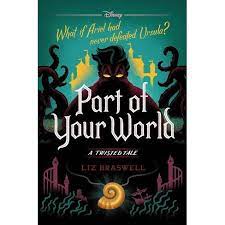
Liz Braswell’s take on the Little Mermaid asks “What if Ariel had never defeated Ursula?” And that is a dark future indeed.
Ariel is the mute ruler of Atlantica with her father’s demise, Eric is in a permanent hypnotic daze content in his role as the Mad Prince making operettas as his wife, Princess Vanessa rules the kingdom in his stead, waging war on neighboring kingdoms and villages for no reason other than boredom and power.
However, six years later, lovable Scuttle gives everyone hope when he spots Vanessa talking to a disheartened polyp. It’s King Triton! King Triton is alive and once Ariel hears this news, she knows she must return to the world she had so loved to rescue him.
Sounds like a simple plot, but that it’s not so. It’s one thing to have a goal, but when Ariel surfaces to accomplish it, things are much more complicated than she thought. Since becoming queen, Ariel understands some of her father’s grumpy, stoic demeanor and has become much more calm, more decisive, queenly because of it. She worked twice as hard to be heard and respected as an authority, made doubly hard that she had to have Sebastian and Flounder as her translators. But returning to the surface and the potential of returning things to normal, some of her natural impulsivity and recklessness pops up again. What’s more, she realizes her actions have not only ruined her life but that she inadvertently brought Eric’s kingdom, Tirulia to ruin.
If she hadn’t made the deal with Ursula to go on land to see Eric, Ursula wouldn’t have gone to her tricks to foil Ariel, and so on. Now Tirulia has a mad princess plunging the people to war, poverty and more. Now, Ariel is determined not only to rescue her father but that she must fix things on the Dry World too. She must get Vanessa off the throne.
Again, it is not as easy as just sneaking into the palace and finding her father in Vanessa’s room, especially as the seagulls weren’t able to tell her which bottle the King Triton polyp was in. However, she is able to grab the magical nautilus that Ursula stole her voice. This is where the story picks up, not only in the joyful reclamation of her voice, but it breaks the memory haze that Ursula had cast upon everyone else. Eric is free from the spell, confused but free and when Ariel appears seeking his help, he is more than willing to take his kingdom back. But that rash act to take back her voice ruins Ariel’s opportunity for surprise. Ursula knows she’s back and thus a grand game of sea chess begins.
As I have written in my other reviews, Braswell does an excellent job in building this world. The Dry Land kingdom of Tirulia seems to be inspired by Italy with its closeness to the coast, Roman architecture, vineyards and seafood cuisine. Though I suppose it could be Denmark as that would make more sense as a nod to the origins of The Little Mermaid as a Danish fairytale. But with how it was described in the story, I immediately thought Italy.
Point is, it felt like a very real breathing kingdom with allies, enemies, a specific culture etc. This was a fascinating point to Ariel as she returns to land and is able to more fully explore it without the three day time limit. She muses on how the humans have so much diversity in culture and their urge to explore whether in diplomacy or war. This is especially intriguing compared to Atlantica where it has been left in complacency. The merfolk are peaceful, content with festivals and concerts, and not so much exploring other oceans like Ariel wishes to do.
And that world building continues to Atlantica. Not only describing the state of complacency but their origins are heavily tied to Greek mythology as Triton (and all merfolk) are descendants of Neserus, the sea Titan. Ariel corrects Eric that they are not part human, part fish but part god, part fish as they are immortals. At least until they turn into foam, but they are far more immortal than humans. She also uses the ancient names of Prosperine, Cedes and others as major figures in their mermaid festivals. Braswell also describes the ancient evil powers of Elder Gods that Ursula tries to summon, describing them and their powers as almost eldritch abominations of the deep. So very vast world-building here creating landmarks, runes and a set of rules for how her trident’s powers operate.
As for the characters, I admire how Braswell manages to retain the Wonder Ariel has for the human worlds, her flaws of thoughtlessness and impulsivity and the effect of age and experience all at once in Ariel. She is a changed woman from her forced turn on the throne. She is more aware of her actions and consequences making her seem more adult, but still has the energetic heart and courage of her youth. I’m probably not giving her the depth she deserves here, but honestly you have to read for yourself the layers that Braswell created in this new Ariel, there’s a lot to analyze and unpack with it especially in one memorable scene of unpardonable poaching/fishing of sea life where she unleashes her fury much like the old gods of the sea.
Eric was a fun character and well-done love interest and ally. He is often described with a boyishness and sweet youthful personality that absolutely shines her, he perfectly fits what we see in the movie as a guy playing a flute on the ship, he just loves adventure on the sea just as Ariel loves exploring shipwrecks and the Dry World. But he too has grown up. Not quite the same reserve as Ariel but a more haunting one after he realizes he spent six years under Ursula’s spell. It speaks a lot to his character that he was most upset of how he had been complacent, writing music and operas while letting Vanessa control all other kingdom matter. Again, it is a youthful urge to do what is right and protect everyone, acting on emotion though he doesn’t quite have the knowledge and/or experience to back it up.
But he is not dumb as Ursula thinks he is either. He is actually quite adept at playing the role of a complacent, Mad Prince when it is needed and so it is all the more shocking when he turns the tables on Ursula in a stunning one on one battle of wits. Seriously I cheered at the scene, he was like a chess master.
Additionally the choice to have him be a composer, one given to dramatics and epics like Sebastian adds another part to him. It shows his creative side and gives him another relation to Ariel as a singer. She sings not for the sake of performance but that she feels so much, she has to get it out in song. He does the same, writing down the notes that express things he can’t put into words. Truly, Braswell did a great job connecting them together and why they would have such a deep connection. Plus I love the choice that his popular operetta Le Sirenetta was a reflection of his forgotten memories, retelling The Little Mermaid, it really showed how love is stronger than spells. Also I thought it was like a cool allusion to the Broadway play with singers, stage effects etc. Only they didn’t have Broadway back then obviously, so operetta was more historical accurate.
The supporting characters of Carlotta the no nonsense maid, Grimsby the stalwart fatherly butler (he was my favorite), scatterbrained Scuttle, his great grandgull Jona, Flounder and Sebastian were fine additions and did well in providing support and help in moving the plot and helping the heroes. They were all very sweet in their own right.
As for Ursula, she had her own twists too. At first, she seems to be her same grand self given to boasts and grandstanding of her own superiority especially over humans. But it is soon clear that she is as manipulative as ever. She manages to keep one step ahead of everyone almost the whole book but even so, her anger at Ariel’s reappearance brings some snarls to her grand plan. The problem Ursula has is that she wants power and revenge but her need to make it big and make everyone know it is her, proves to be one of her downfalls. That and how her pride deludes her into thinking that all she should bow to her without question, and that she can handle human politics with the same methods as from under the sea. Her power-hungry descent to madness creates a unique sort of terrifying villain that readers will shiver from.
I have a few nitpicks here that kept this from being a solid 5 like the repeated phrase Queen of the Sea. I get it, Ariel’s the queen of the sea but Braswell used it so much in the place of Ariel or She, it became annoying.
I also understand that Braswell wanted to create an immersive world but she had one-two page chapters from the point of view of random villagers, from Flotsam and Jetsam, Grimsby and Carlotta that really didn’t provide anything. They were one time chapters and were unnecessary as they didn’t really foreshadow anything that was revealed or talked in Ariel/Eric/Ursula’s chapters.
There was also one chapter where Ursula attempted trick another human for her voice to disguise her true one now that Ariel had hers back. It failed but it felt like it was a cut off thread leading to something bigger. But the whole act was never mentioned again like it hadn’t happened so what was the point?
Furthermore, it took 30 pages before Ariel was introduced. I suppose Braswell wanted to illustrate the dire state of Tirulia first, but since this is Ariel’s story I felt like she should be have given the Prologue at least so it would set who this story was about.
Finally, there was an interesting thread of Ariel’s interactions with her sisters. They are mostly flighty and concerned only with having fun. They place Ariel as queen as a punishment for her role in Triton’s death but Ariel soon sees they it was less punishing her but more avoiding royal duties themselves. She also sees it as an attempt to distract themselves from their grief by focusing on silly things that provide little thought. Attina, the eldest is the only one who gets a little more depth which I loved as she was always my favorite.
But it felt a bit half done. There was one line that stood out to me, “The oldest sister who had tried to take over as mother when their real mother died, and never succeeded in the role,” (Braswell 64). Like there’s so much in that line! But Attina spent most of her time insulting Ariel’s choices and fascination with the Dry World. Which I did sense there might be some jealousy from Attina’s part, that Ariel who was the prettiest, most talented favorite daughter wanted to throw everything for the Dry World as if mers meant nothing. But ultimately, there were only hints and not much else. She only gave rude comments, and didn’t help with saving Triton, even though as later said, as eldest she had more training royal matters. It just felt off.
Overall, this was a solid Twisted Tale albeit with a few cut off threads. I give it 4 nautiluses.
 Rachel Reads & Reviews
Leave a comment