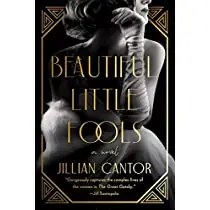
With The Great Gatsby now in public domain, Jillain Cantor duly stepped in to provide the ladies of Gatsby their own story. Set in the years leading up to, during and after Gatsby’s death, the novel follows Daisy, Jordan and Catherine and shows the pasts they hide, the secrets they keep and the disillusioned view they hold of a world that sees them as beautiful little fools.
Some spoilers under the cut.
The title is taken from one of Daisy’s most important lines. Dozens of essays have been written about what it says of her character and her position as a rich woman in the 1920s, Cantor gets deep into her past with her carefree childhood as one of the Kentucky elite, young and forever wild when she meets Gatsby at the social dance all until tragedy strikes. Her younger sister and her father are killed in a train crash, leaving her mother and her in debt. Then comes Tom Buchanan. Strong, forceful, he makes her feel safe and a chance for a stable life, he loves her and as she writes,
“He loved me; he needed me. And that made me more than a fool didn’t it? That, in itself, gave me all the power.” (Cantor 134)
But we all know the state of their marriage by the time The Great Gatsby comes along. She has grown cold and disillusioned and she can’t recreate the former love she has for Gatsby, even though she wants it, because she’s no longer that person. She feels nothing. Nothing but love for her little daughter, Pammy whom she hopes to provide a home if only Tom’s humiliating philandering didn’t keep ruining it.
Cantor does an amazing job exploring the feelings of love and hopelessness Daisy must feel. The longing for stability but feeling trapped. Wanting power, but having none unless you play the fool. It’s tragic yet you can’t help but feel for her as Daisy doesn’t know what she wants. Well, she does, she wants to be happy like her childhood again, but she can’t. There’s no options.
Jordan Baker is in a similar boat, trying to make it as a pro golfer which was somewhat considered a worthy and acceptable pasttime, but not so much that would overshadow any man’s sport. But what’s more, she’s a lesbian in a loving relationship till they get caught. They’re not outed but the chaperones are deeply suspicious and so they ruin Jordan’s career but putting out a cheating scandel and her lover goes home to get married. Like Daisy, Jordan is a adrift in a world that offers no alternatives for her. And her secret and scandel provides Gatsby ammunition to get her to help him win Daisy even though she is troubled by his overbearing nature. So Jordan buries herself in golf and a need to protect her dear friend stuck in a tulmutuous love triangle with two overbearing men. Her friendship with Daisy also gives me some of the idolization-love vibes as Nick does to Gatsby in the novel which I admire as a parallel.
Finally, there is Catherine, Myrtle’s sister and a budding suffregist. I thought this was a made up original character, but it wasn’t until midway through the book I remembered her as the one who hooked up with Nick in Tom/Myrtle’s secret apartment. Anyway, she’s the most “modern” of the three as a middle-class girl she has more freedom to pursue her wants even though she’s still expected to marry. Not that she has plans to do so, like I said she’s a suffragist so she wants to go her own way, have independence and not be tied down like all the other women she sees. Especially her sister, Myrtle for whom she wishes to save from her abusive marriage.
But she can’t as Myrtle’s in denial. This gets worse after Catherine meets Gatsby and he offers to help her save Myrtle. He just needs Myrtle to meet Tom. From there, it helps his grand vision of having Tom cheat on Daisy with Myrtle and save Daisy for himself but Catherine is horrified. Now Myrtle is certain that Tom will rescue her and marry her even though he is just an abusive scumbag as her husband.
Cantor has a deep love for The Great Gatsby, you can tell by the prose that almost perfect mimics Fitzgerald’s dazzling descriptions and she says in an interview how she highlighted every mention of the women in The Great Gatsby so she can have a thorough, tight timeline of them so she can expertly weave their pespectives as in line with the original novel. Therefore, some of the scenes like the Plaza scene, and the party etc. are familiar yet the switched perspective makes it all new. Gatsby and Daisy seems like a true love story when they first, but Jordan’s POV shows how possessive and stalker-like Gatsby was from the beginning. Similarly Daisy’s palpable sadness in the Plaza scene when Tom and Gatsby fight shows her thoughts as she realizes that she can never escape this world of men and be happy instead of one who is too scared to leave her rich lifestyle.
There were a few things that fell flat for me. Catherine’s POV, while offering a more “modern” perspective to the 1920s did not feel like it fit in with the others. She’s not a beautiful fool like the others, she’s sharp and self-aware and doesn’t feel the need to pretend otherwise. Myrtle was more of one even if she was middle class because she believed if she played the part for Tom, her life would be better. Alas, Myrtle only gets two chapters for herself and they are both tragic as she innocently yet endearingly believes in Tom’s love.
Additionally, Catherine’s relation with Gatsby includes a physical one that I felt did not fit Gatsby. He was so solidly in love with Daisy, I find it hard to believe he would even sleep with another women. Even though it means nothing to him, I still believe he would have been steadfast to sleep alone until he had Daisy again because he’s just that obsessed. That is part of the reason why I had thought Catherine was an original character because if you had one, why wouldn’t you have her sleep with Gatsby? He may be devious, but he’s still Gatsby.
Additionally, the car scene implies Gatsby was the one to have pulled the wheel that killed Myrtle, and then subsquently gaslight Daisy that it was her fault, painting it as another secret they share together and she should run away with him or else. While it highlights how devious Gatsby could be, I feel like it erases Daisy’s flaw as a selfish, rich person in the original. The novel does such a good job in humanizing her, I still think it’d be okay if she was the one to hit Myrtle, to show how preoccupied she is with her own problems, she still doesn’t care that she killed a person because that person was poor. But that might just be me.
Also, the post-Gatsby death thread is taken up by an original character, Detecive Frank Charles as he questions each of them. They all have motives and they all lie about their relations to Gatsby but I just found that thread to be uninteresting. The After Reading Questions imply that Cantor was trying to show a contrast with Charles’ healthy marriage with his wife compared to the other main couples, but there was so little of it, I didn’t care. I didn’t care about Frank’s personal life, if it had just stuck to interrogation transcripts, it would have been fine.
If you’re into a new look into the glamourous world of Gatsby, this book is it as it has the luxery and the hollowness of the New York elite who are caught in Gatsby’s manipulative web. It’s three-way tying it all together of the Gatsby whodunnit is a slippery one whose reveal will make you gasp.
3 stars.
 Rachel Reads & Reviews
Leave a comment