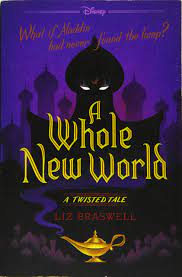
This book was an excellent and dark take on the scenario of “What if Aladdin never found the lamp?”
That turns out to be a bit of misnomer because Aladdin does find the lamp. Jafar just happens to snatch it out of Aladdin’s hands and leaves him to be buried under mounds of sands. In fact Aladdin is buried under the sand for at least a week so when he gets out and survives his sunstroke, he finds out that Jafar threw the sultan over the balcony, claimed the throne and makes it rain bread and gold coins. So technically it’s “What if Jafar made his wishes first?”
But back to the plot, it starts off slow as the first hundred pages goes over the beginning of the movie up to the Cave of Wonders. This dragged a bit as I knew what would happen. Although she did add a few more sweet conversations between Aladdin and Jasmine besides exploring what ran through their heads at first meeting. Plus the prologue features several of Aladdin’s street rat friends (that’s important later) and his mom who left an undeniable imprint on his life telling him that he can be better. That’s why he follows his own code of only stealing to eat and nothing more and breaks off from the more organized network of thieves his friends made.
Plus his dad’s name is Cassim! Clearly Braswell did her homework utilizing the King of Thieves movie. She also names his mom, Hatefeh. So there you go.
As I said the first hundred pages recap the movie but when it veers off from it, it goes dark. I did mention that the sultan was killed by being pushed over the balcony. What I didn’t mention is that he did this in front of an entire crowd watching below and Jasmine.
Oh yes, Braswell really leans into the homocidal and vainglorious tendencies of the former Grand Vizier from his erratic decrees, ambitions to rule the dead and desire for everyone to love them even if he has to brainwash them all to do so. Plus he killed his beloved parrot in his first appearance so he could get blood magic and briefly see the future. This man has no limits to what he’ll do.
So one can easily imagine that Jasmine had wanted to escape before, she does so immediately as Jafar solidifies his plans to marry Jasmine to cement his claim on the throne.
Jasmine really comes into her own here combining the fiery independence, and longing for freedom from the original movie with the insight and spark of leadership that we see in the 2019 adaptation (though I must remind people this one came out first and I believe it does a better job of combining the two traits to make her fully dimensional).
Jasmine has a sweet talk with Genie whom they commiserate over being trapped, and delves a bit into the state of genies in this world as well as his backstory. For even though Braswell’s genie is just as goofy as the original, this one belies a bitter past and hidden sadness. After their talk she decides she’s done with feeling trapped, she’s not like the genie who’s bound to his lamp, she can take action. Luckily, Aladdin had the same idea as he heads to the palace to rescue her from her impending wedding. They literally almost bump into each other, which I found adorable as it adds to how alike they are in.
After they escape the palace, and forced to leave the magic carpet behind and accidentally killing a familiar character, they head to the Street Rat hideout where they figure out their best bet to stop Jafar’s madness is to revolt against him and gather the people of Agrabah to store Jasmine on her rightful throne. As for the rest, you’ll have to read about their rebellion/revolution yourself.
Braswell always does an excellent job of creating each world to be distinct and magical in itself and Agrabah is no exception as she describes the metropolitan marketplace with diverse wares and peoples trading, the luxe glamor of the white washed palace and the decrepit surroundings of the Street Rat Quarter. They’re all so vividly described as they all create one grand kingdom.
As for Aladdin’s Street Rat friends, Morgiana the Shadow and Duban, she makes very likable distinct allies with a sharp edge thanks to their upbringing scheming others and living in the shadows with no chance of improving their standards. They provide some nuance to not only the dire poverty gap in Agrabah that Jasmine was not privy to before, but also asks the ethical question of stealing. Aladdin only takes what he needs to live but looks down on his former friends for recruiting street kids to a larger network of pickpockets and thieves.
Duban and Morgiana point out that those kids would starve otherwise as the rich aren’t going to look out for them, and their parents are dead/ equally poor/abusive/ selling them to marriage. What else can you do if you have no other opportunities to rise up? They offer a more grounded perspective from the optimism of Aladdin and Jasmine.
Though I must admit, Morgiana and Duban did remind me a lot of Aladdin’s thief friends from the animated series, Minos and Fatima right down to the reasoning for the split in their friendship and the implied romance between the two. So much so, that I almost wished Braswell had just changed their names to that instead. But I understand the animated series is an even lesser known property than the movies, and Braswell should feel free to make her own original characters for the story.
Other nuances that Braswell explores is Jasmine seeing what it takes to be a real leader noting how her father was kind but neglectful, childish really playing with his toys in the palace while a vast swathes of his people lived in poverty. This is what makes them so open to Jafar when he first takes over giving gold and bread until he begins to tighten his control, branding people, setting up aggressive patrols and only giving bread to those who swear absolute loyalty. As Morgiana and Aladdin point out none of the citizens really care whose in charge as long as their basic needs are met which is why they have to work to mobilize people against Jafar. To quote, “Having the freedom to choose is better than having everything you want.”
“You’d better convince the people of Agrabah that. Otherwise they’ll never back you. So far they seem to prefer full bullies and no choice.”
“When I am sultana, they shall have both.” (Braswell 214).
It also offers a darker side to Jasmine as she grows not only a backbone, but a cynicism from her father’s death that she’ll do anything to stop Jafar. Get revenge on Jafar, really which leads to some disputes with Aladdin about the choice of keeping dark magic in their hands to use against Jafar rather than burning it.
Which brings me to how much I enjoy that Braswell shows these fights between the two. Despite their similarities, they still have their spats. One of the reasons Aladdin and Jasmine stood out to me as one of the better Disney couples is because they communicate and talk more, they fight and they have adventures, and I appreciate that Braswell depicted that here. She does a great job in expanding the characters while keeping them true to the original essence. Yes, even the “Do you trust me” line is there. How could she not put that in?
She even keeps that sweet essence with non romantic relationships, showing how much Aladdin and Abu mean to each other with individual passages that highlight how much Aladdin cares for his monkey.
The only relationship I wished she had added was the Genie and Aladdin’s friendship but with how the book goes, it makes no sense for their interaction and the few moments Jasmine shares with Genie almost makes up for it.
So while it drags a bit in the beginning, this is a thoroughly engaging read with an even bigger twist at the end that any reader who enjoys the desert magic of Agrabah and the companionship of Al and Jas will enjoy.
4 brass lamps.
 Rachel Reads & Reviews
Leave a comment