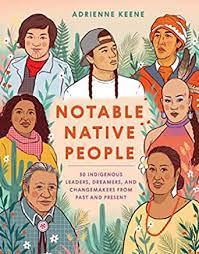
This informative nonfiction book by Cherokee writer and creator, Adrienne Keene educates readers about 50 Native people, past and present who are helping to change the future by renewing and reclaiming their heritage and traditions.
As stated in her introduction, she felt the need to write this book in order to reclaim the narrative that Native people are historic/extinct/in the past. No, that is patently false. In fact they are numerous Natives who are living and thriving today and this book shows just that. She intentionally made her spread diverse, including Black and LGTBQ Natives and honors their roots by using the tribal names that they prefer to be referenced to rather than the tribal names hoisted on them by colonists (ie. Diné instead of Navajo, Yupik instead of Eskimo etc.).
Keene also states that she included indigenous Alaska peoples and indigenous Hawaiian/Kānaka Maoli besides the continental tribes in the US, emphasizing that their experiences do not have the same timeline, colonization process, nor federal relationship as the others do. Again, emphasizing the point that Native tribes are not monolithic but a diverse tapestry of stories.
Additionally she includes a few primers of important Native issues that tribes are facing today, what is colonization and the decolonization process, and land acknowledgements.
I heartily enjoyed this book for its meticulous research and deep connection that Keene clearly shares with others in the Native sphere. While all of them are notable as the title implies here are a few Natives that I was particularly impressed to learn about.
Rowen White (Akwesasne Mohawk): An activist for seed soverignity and seed keeping, the ancient practice of saving seeds for future use especially those of indigenous crops that were nearly extinct duringg colonist contact.
Geo Soctomah Neptune (Passamaquoddy): A drag artist and basket keeper, Geo is working to renew traditional tattooing. the youngest Master Basketmaker in Maine and first openly Two Spirit to be elected into office when he ran for school board.
Sergie Sovoroff (Aleut): Helped to retain knowledge of iqyax and uluxtax (traditional Aluet boats for hunting) by creating models that are shown in museums all over the word He also survived the little known Aleut incarceration during WWII where Native villages were moved and incarcerated, much like the Japanese, because of fears of Japanese invasion. Their villages weren’t restablished after the war.
Elizabeth Peratrovich (Tlingit): Activist that fought for citizenship for Native people and successfully campaigned for Alaska’s Anti-Discrimination Bill of 1945 making it illegal to discriminate based on race, and desegregated schools/ hospitals/etc. that treated Natives as inferior. 14 years before Alaska was even a state and 20 years before the federal Civil Rights Act.
Chris Newman (Choptico Band Piscataway): Working for Land Reclamation, Food Soverignity and reform the farming system to retur to sustainable indigenous traditions so to restore ecosystems and provide stable jobs.
James Keauliuna Kaulia (Kanaka Maoli): A Hawaiian loyalist and patriot who was part of the Hawaiian Commission that successfully convinced the U.S. Senate not to annex Hawaii. Unfortunately President McKinley annexed Hawaiian anyway, but in a process that makes the annexation technically illegal today. He is an inspiration for many Native Hawaiians who seeks to restore the Kingdom of Hawaii.
Billy Frank Jr. (Nisqually): Billy was part of the Fish wars in the 60s-70s where Natives staged “fish ins” and other forms of civil disobedience to protest discrimination by the state government that tried to curtail Native fishing/ hunting and gathering rights. This led to the US v. Washington decision that affirmed tribal treatues supersede laws.
Earl Kawa’a (Kanaka Maoli): Earl’s mission is to teach poi pounding (a traditional Hawaiian food using traditional tools like stone pounders and wooden boards) and bring “a board and stone in every home”. He uses his classes to connect his students to their heritage, ancestral stories and uses their Olelo Hawai’i language for instruction.
Nainoa Thompson (Kanaka Maoli): Revitalized traditional navigation practices, proving that their Polynesian ancestors did travel across the vast Pacific using their large doubled-hilled canoes and the stars. This was considered a myth by many Westerners who doubted that Natives could do so with such “primitive practices.” He is now presidet of the Polynesian Voyaging Society and teaches traditional navigation practices to future generations.
Now go on and read this book to learn more!
 Rachel Reads & Reviews
Leave a comment