Hey, it’s my birthday and I got the final book of George O’Connor’s The Olympians series as a gift.
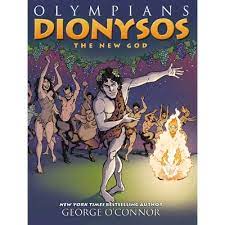
And is Dionysos a fitting conclusion to this 10+ year series? You bet it is.
For those who don’t know, The Olympians is a comic series tackling each god in the Greek pantheon, depicting their fantastical myths, greatest foes and mentors to the Greek’s most famous champions. O’Connor has a great flair for not only illustrating expressive faces, humorous asides and action packed sequences, but he really highlights the humanity of the gods, showing why they have endearing to us for ages and why they were used by the Greeks to make sense of their world.
Dionysos is narrated by Hestia, which I adore as a nice full circle of the eldest goddess looking over the new god. Since both don’t have as many stories as the main eleven, it’s a good way of presenting them both since they tend to be most forgotten and are connected by the throne myth in the finale.
Not only does it give some depth to Hestia, but it is a true showcase to Dionysos, him being the star of the title.
Dionysos is a classic coming of age story. Born of a human princess (accidentally killed thanks to Hera’e manipulations) and Zeus, he is hidden among mortals and later centaurs to be safe from Hera’s wrath. Understandably, he is confused about his destiny. He feels he is meant to be for bigger things but not sure how.
Then he invents wine for wine and revelry are the areas he excells. Hdecides that he’ll become the god of both, and become great enough, speading his invention across Greece, for the gods to notice him.
Like the other books in the series, it does a good job tracing Dionysos’ loves and his cunning with famous myths like his invasion of the Greek states to spread his creation of wine, the frenzy of his maened followers, his marriage to Ariadne, capture by pirates etc.
Dionysos is often depicted as a fun loving god which fits his talent, and the raucous party scenes serve to restate that, but O’Connor also shows the vulnerabilties of Dionysos with how so many of his loved ones end up dead to which he questions whether he is to blame.
Not that Dionysos is all fun and wine spills. He is still a god after all, and O’Connor reminds us of this when Dionysos uses his powers of insanity to make a fatal point to his enemies. Don’t mess with the fun ones.
But the ending is the best, not only to bringing Dionysos up to the Olympian pantheon where we know he belongs, but serving a reminder that the Olympians may be unpredictable, powerful, untouchable, and their petty motivations may be incomprehensible to us mortals, they also share love, joy and fun times together too. Like the ultimate dysnfunctional family, which we can all relate to.
 Rachel Reads & Reviews
Leave a comment